Difference Between Linux and Unix
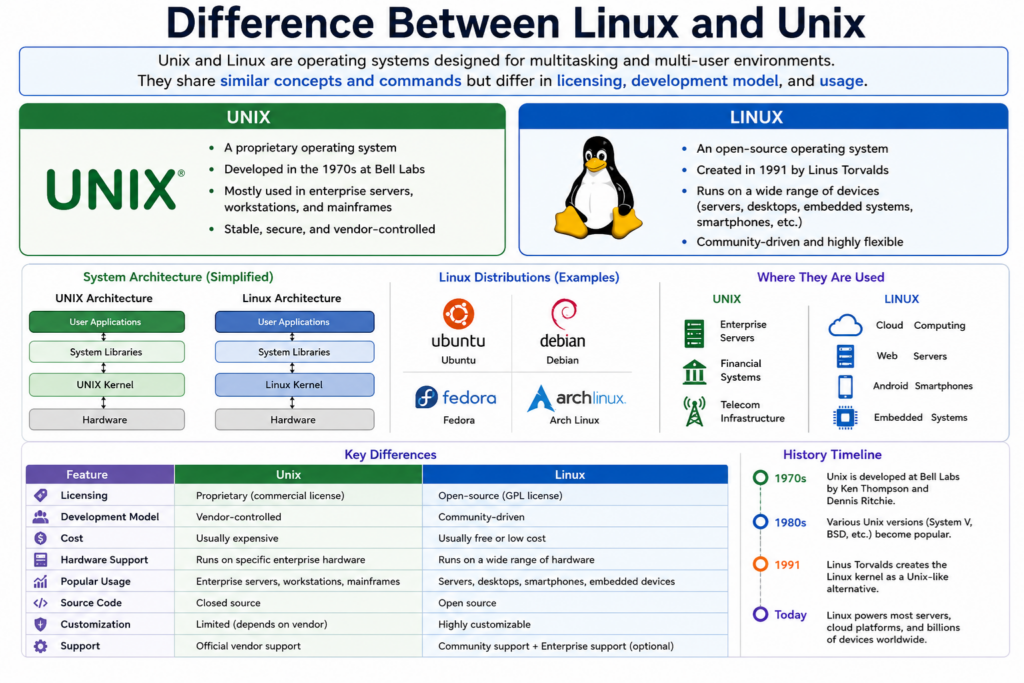
Unix and Linux are two of the most important operating systems in computer history.
They are similar in many ways, but they are not the same.
Linux was heavily inspired by Unix and follows many Unix design principles.
However, Linux is open source, while traditional Unix systems are usually proprietary.
In this tutorial, we will learn:
- What Unix is
- What Linux is
- Their history
- Their similarities
- Their differences
- Why Linux became so popular
What Is an Operating System?

An operating system (OS) is software that manages computer hardware and software resources.
It acts as a bridge between applications and hardware.
Without an operating system:
- Programs cannot access hardware safely
- Memory cannot be managed properly
- Multiple programs cannot run efficiently
Common operating systems include:
What Is Unix?
Unix is a multi-user and multitasking operating system developed in the 1970s at Bell Labs.
It was created by:
- Ken Thompson
- Dennis Ritchie
Unix became extremely popular in:
- Universities
- Research labs
- Enterprise servers
- Telecommunications systems
One major reason for its success was portability.
Unix was rewritten in the C programming language, allowing it to run on different hardware platforms.
Early Unix Design Philosophy
Unix introduced several important ideas that still influence modern systems today.
Small Programs
Each tool should do one task well.
Pipes
Programs can work together using pipes.
Example:
cat log.txt | grep error | sort
Multiuser Design
Multiple users can use the same system simultaneously.
Multitasking
Many programs can run at the same time.
Unix Architecture
A simplified Unix system looks like this:
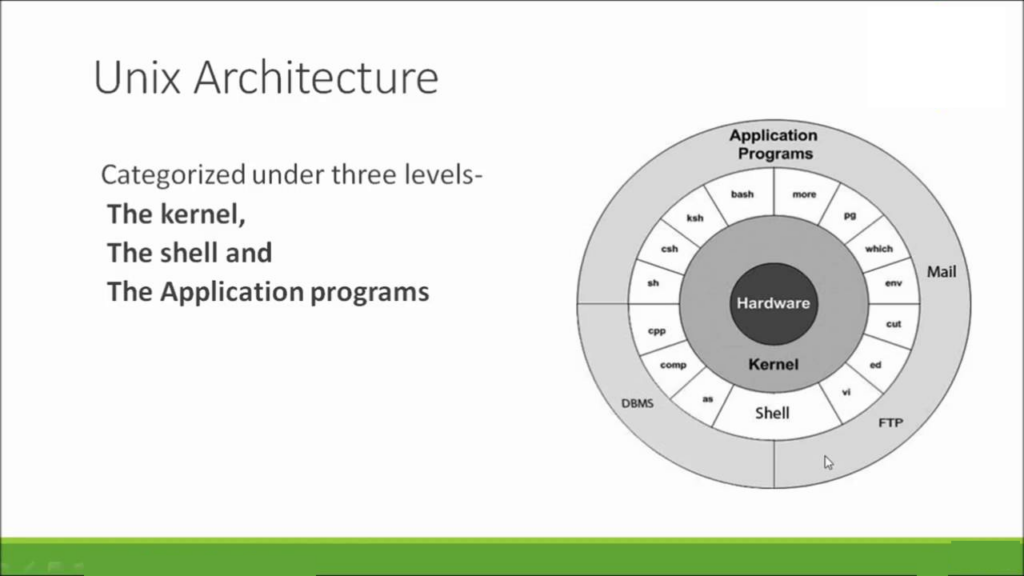
The kernel is the core of the operating system.
It manages:
- CPU scheduling
- Memory
- Devices
- File systems
- Processes
What Is Linux?
Linux is a Unix-like operating system kernel created in 1991 by:
- Linus Torvalds
Linux was designed as a free and open-source alternative inspired by Unix.
Unlike traditional Unix systems, Linux source code is publicly available.
Anyone can:
- Study it
- Modify it
- Improve it
- Distribute it
Linux Architecture
Linux follows a structure very similar to Unix.
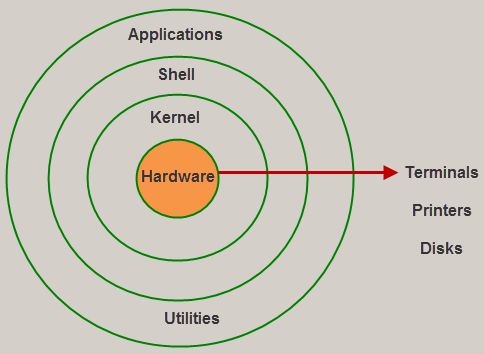
The Linux kernel controls:
- Processes
- Memory
- Networking
- File systems
- Hardware devices
Linux Is Everywhere
Today Linux powers:
- Web servers
- Cloud infrastructure
- Android smartphones
- Supercomputers
- Embedded systems
- IoT devices
- Raspberry Pi boards
Most internet servers today run Linux.
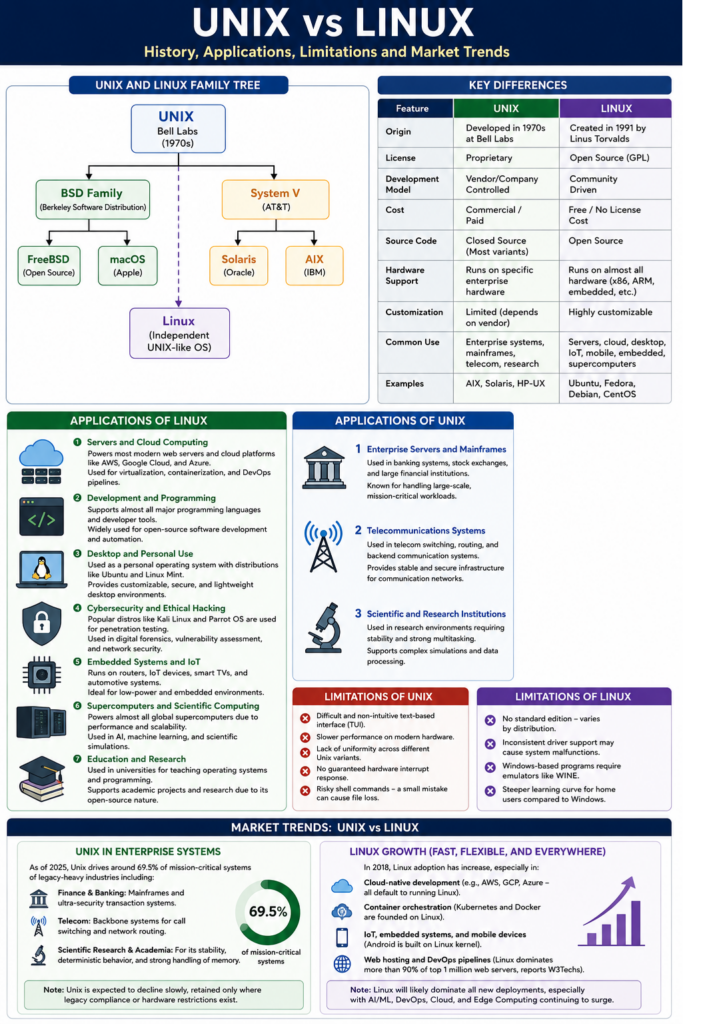
Main Differences Between Linux and Unix
1. Licensing
Unix
Traditional Unix systems are proprietary.
Examples include:
- AIX
- Solaris
- HP-UX
Users usually need commercial licenses.
Linux
Linux is open source under the GPL license.
Most Linux distributions are free.
2. Development Model
Unix
Unix systems are usually controlled by companies.
Development is centralized and vendor-managed.
Linux
Linux is developed by a global open-source community.
Thousands of developers contribute improvements.
Major contributors include:
3. Cost
Linux dramatically reduced server operating system costs.
4. Hardware Support
Unix traditionally ran on specialized enterprise hardware.
Linux runs on almost everything:
- PCs
- Servers
- ARM devices
- Smartphones
- Embedded boards
- Supercomputers
5. Popular Usage
Unix
Mostly used in:
- Enterprise servers
- Financial systems
- Telecom infrastructure
Linux
Widely used in:
- Cloud computing
- AI infrastructure
- Web hosting
- Embedded systems
- Android devices
Linux Distributions
Linux itself is only the kernel.
A complete Linux operating system includes:
- Shell
- Libraries
- Desktop environment
- Applications
- Package manager
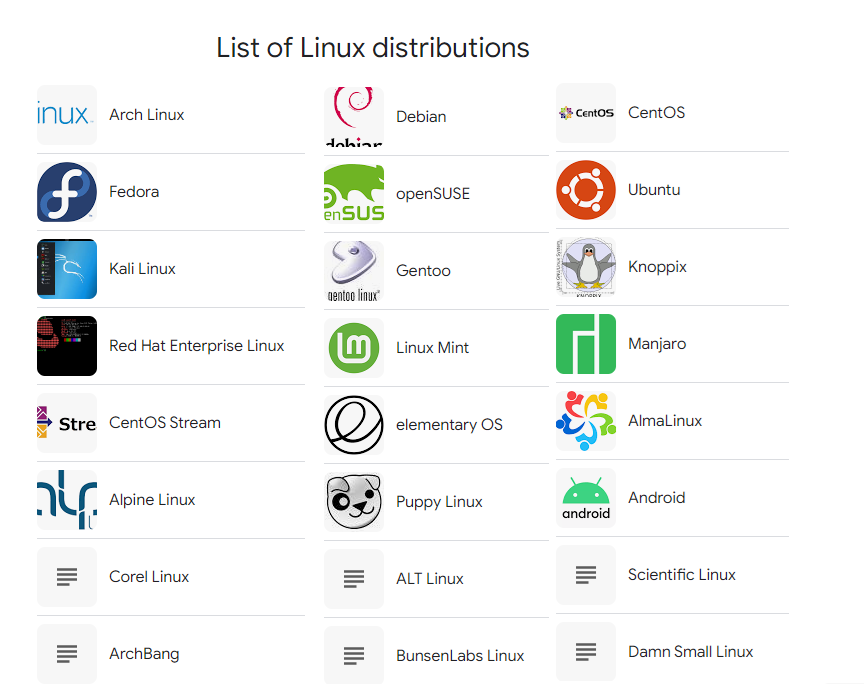
Popular Linux distributions include:
- Ubuntu
- Debian
- Fedora
- Arch Linux
Each distribution packages Linux differently.
Linux Command Example
Linux and Unix share many commands.
List Files
ls
Change Directory
cd /home/user
Copy Files
cp file1.txt backup.txt
Search Text
grep error server.log
These commands come from Unix traditions.
Linux vs Unix Kernel Philosophy
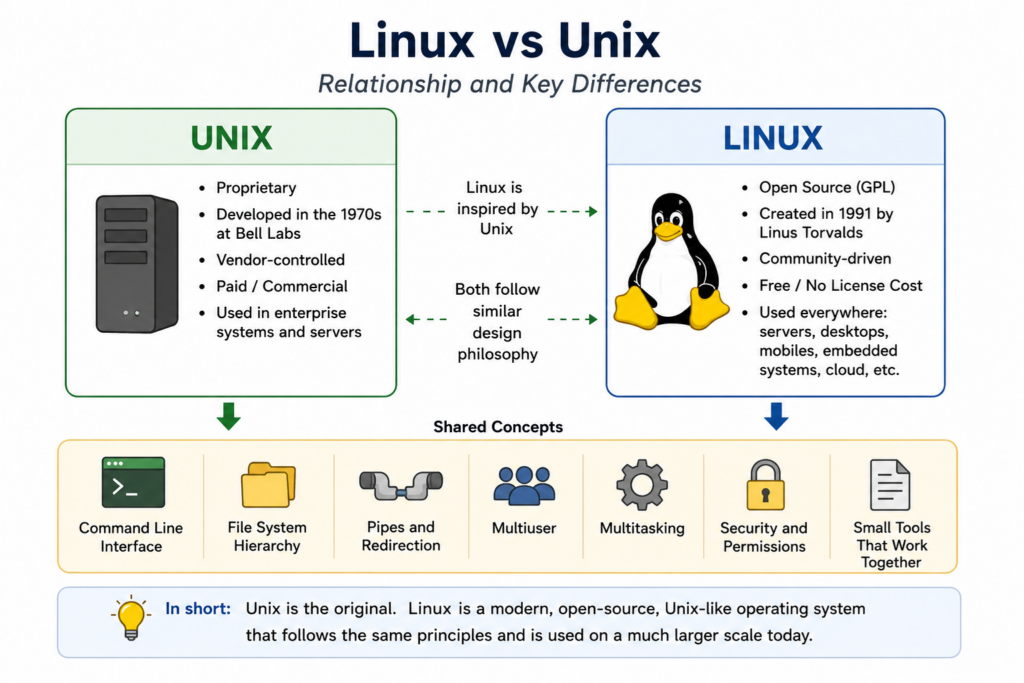
Both systems follow similar core ideas:
- Stability
- Multiuser support
- Multitasking
- Modular tools
- Command-line power
Linux inherited much of the Unix philosophy while remaining independently developed.
POSIX Compatibility
POSIX is a standard for Unix-like systems.
It defines:
- APIs
- Shell behavior
- System interfaces
Linux follows many POSIX standards.
This allows many Unix programs to run on Linux with little modification.
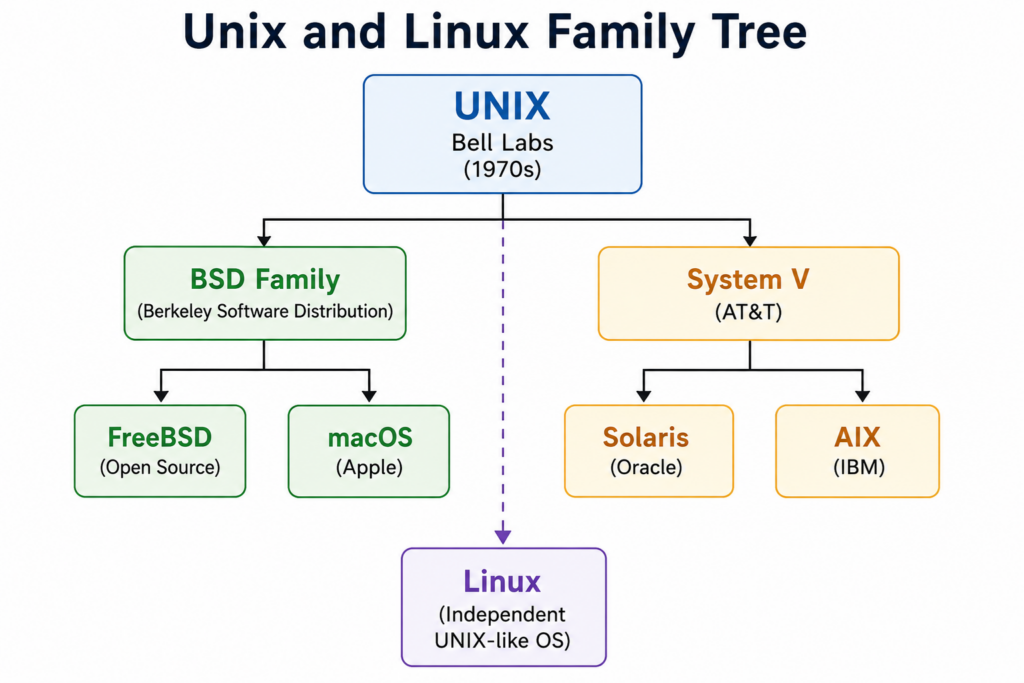
BSD and macOS
BSD (Berkeley Software Distribution) is another important Unix branch.
BSD later evolved into:
- FreeBSD
- OpenBSD
- NetBSD
Modern macOS also contains Unix/BSD foundations.
So:
Simple Linux vs Unix Diagram
Why Linux Became More Popular
Linux became dominant because it is:
Free
No expensive licensing fees.
Open Source
Anyone can contribute.
Flexible
Runs on nearly all hardware.
Internet Friendly
Perfect for servers and networking.
Community Driven
Rapid innovation and support.
Linux vs Unix Comparison Table
| Feature | Unix | Linux |
|---|---|---|
| Created | 1970s | 1991 |
| Creator | Bell Labs | Linus Torvalds |
| Source Code | Proprietary | Open Source |
| Cost | Commercial | Usually Free |
| Development | Vendor-Controlled | Community Driven |
| Hardware Support | Enterprise Hardware | Nearly All Hardware |
| Popular Usage | Enterprise Systems | Servers, Cloud, Mobile |
Conclusion
Unix changed computing forever.
It introduced many core ideas used in modern operating systems.
Linux inherited these ideas and expanded them through open-source development.
Today:
- Unix remains important in enterprise and historical systems
- Linux powers much of the modern internet and cloud infrastructure
Understanding the relationship between Linux and Unix is an important step for anyone learning:
- Linux administration
- Operating systems
- Embedded systems
- Cloud computing
- Computer engineering
Applications of Linux
Linux is used almost everywhere in modern computing.
1. Servers and Cloud Computing
Linux powers most modern web servers and cloud platforms, including:
Linux is widely used for:
- Virtualization
- Containers
- Docker
- Kubernetes
- DevOps pipelines
Most cloud-native infrastructure today runs Linux.
2. Development and Programming
Linux supports almost all major programming languages, including:
- C
- C++
- Python
- Java
- Go
- Rust
It is heavily used for:
- Open-source software development
- Automation
- Scripting
- Backend systems
Many developers prefer Linux because of its powerful command-line tools.
3. Desktop and Personal Use
Linux is also used as a desktop operating system.
Popular desktop distributions include:
- Ubuntu
- Linux Mint
- Fedora
Linux desktops provide:
- High customization
- Strong security
- Lightweight performance
- Free software ecosystems
4. Cybersecurity and Ethical Hacking
Linux is extremely popular in cybersecurity.
Specialized distributions include:
- Kali Linux
- Parrot OS
Linux is used for:
- Penetration testing
- Digital forensics
- Vulnerability assessment
- Network analysis
Many security tools were originally developed for Linux environments.
5. Embedded Systems and IoT
Linux runs on:
- Routers
- Smart TVs
- IoT devices
- Automotive systems
- Industrial controllers
Linux is ideal for embedded systems because it is:
- Lightweight
- Portable
- Highly customizable
Android itself is based on the Linux kernel.
6. Supercomputers and Scientific Computing
Linux powers nearly all modern supercomputers.
It is widely used in:
- AI
- Machine learning
- Scientific simulations
- Big data processing
Linux is preferred because of:
- Scalability
- Performance
- Flexibility
7. Education and Research
Universities widely use Linux for:
- Operating systems courses
- Programming
- Networking
- Embedded systems
- Research projects
Its open-source nature makes it ideal for academic environments.
Applications of Unix
Unix is still widely used in enterprise environments where reliability is critical.
1. Enterprise Servers and Mainframes
Unix systems are used in:
- Banking systems
- Stock exchanges
- Financial institutions
Unix is trusted for:
- Stability
- Long uptime
- Mission-critical workloads
2. Telecommunications Systems
Unix powers many telecom backend systems.
It is used for:
- Network routing
- Switching systems
- Communication infrastructure
Unix provides highly stable networking environments.
3. Scientific and Research Institutions
Unix systems are also used in research environments requiring:
- Strong multitasking
- Stability
- Reliable memory handling
Unix supports large-scale simulations and scientific workloads.
Limitations of Unix
Although Unix is powerful, it also has limitations.
Complex Text-Based Interface
Unix systems can be difficult for beginners.
Expensive Licensing
Commercial Unix systems are often costly.
Lack of Uniformity
Different Unix variants may behave differently.
Legacy Hardware Dependence
Some Unix systems rely on older enterprise hardware.
Dangerous Shell Commands
A small mistake in shell commands can accidentally delete files.
Example:
rm -rf /
This command can destroy an entire system.
Limitations of Linux
Linux also has disadvantages.
No Single Standard Distribution
Linux behavior varies across distributions.
Driver Compatibility
Some hardware may lack proper Linux drivers.
Software Compatibility
Certain Windows applications require compatibility layers like WINE.
Learning Curve
Linux can be harder for beginners compared to Windows.
Linux vs Unix Commands
Linux and Unix share many commands.
List Files
ls
Change Directory
cd /home/user
Search Text
grep error server.log
Copy Files
cp file1.txt backup.txt
This similarity exists because Linux follows Unix traditions.
POSIX Compatibility
POSIX is a standard for Unix-like systems.
It defines:
- APIs
- Shell behavior
- System interfaces
Linux follows many POSIX standards, which helps software portability between Unix and Linux systems.
Market Trends: Unix vs Linux
Unix in Enterprise Systems
As of 2025, Unix still powers many mission-critical enterprise systems in industries such as:
- Finance
- Banking
- Telecommunications
- Research institutions
Unix remains valuable where:
- Legacy systems exist
- Specialized hardware is required
- Long-term stability is critical
However, Unix usage is gradually declining.
Linux Growth
Linux continues to grow rapidly in nearly every computing field.
Linux dominates in:
- Cloud computing
- AI infrastructure
- Containers
- DevOps
- Embedded systems
- Edge computing
Linux powers more than 90% of many large-scale web hosting environments.
Technologies such as:
- Docker
- Kubernetes
- Cloud-native infrastructure
are heavily dependent on Linux.
Linux is expected to dominate future deployments involving:
- AI
- Machine learning
- Cloud infrastructure
- IoT
- Automation
BSD and macOS
BSD (Berkeley Software Distribution) is another important Unix branch.
BSD later evolved into:
- FreeBSD
- OpenBSD
- NetBSD
Modern macOS also contains Unix/BSD foundations.
So:
Linux vs Unix Comparison Table
| Feature | Unix | Linux |
|---|---|---|
| Created | 1970s | 1991 |
| Source Code | Proprietary | Open Source |
| License | Commercial | GPL |
| Development | Vendor-Controlled | Community Driven |
| Cost | Expensive | Usually Free |
| Hardware Support | Enterprise Hardware | Nearly All Hardware |
| Usage | Enterprise Systems | Servers, Cloud, Mobile, Embedded |
| Flexibility | Limited | Highly Customizable |
Conclusion
Unix introduced many of the core ideas behind modern operating systems.
Linux inherited these ideas and expanded them through open-source development.
Today:
- Unix remains important in enterprise infrastructure
- Linux powers much of the modern internet, cloud computing, AI, and embedded systems
Understanding the relationship between Linux and Unix is essential for learning:
- Linux administration
- Operating systems
- Embedded systems
- Cloud computing
- Cybersecurity
- DevOps
- Computer engineering