C and C++ look very similar.
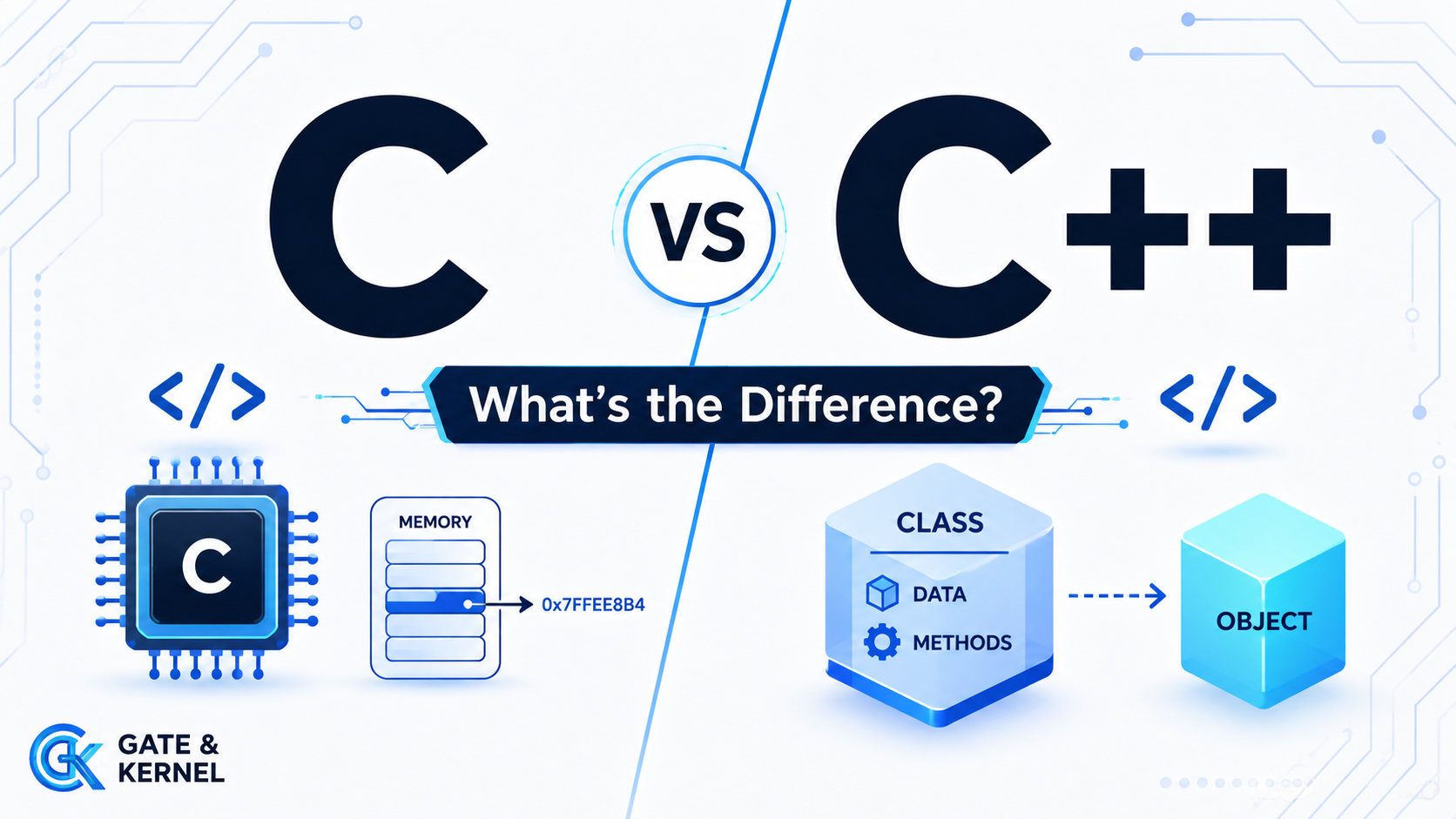
They share much of the same syntax, and C++ was originally developed from C.
But today, they are two different programming languages with different goals.
The simplest way to think about them is:
C gives you direct control over data and memory.
C++ adds more tools for organizing large and complex programs.
1. C Is Older
C was created in the 1970s and became closely associated with Unix and system programming.
Its basic model is simple:
Data
+
Functions
+
Memory
A C program is usually built from functions that operate on data.
C++ came later.
It started as an extension of C and was originally called:
C with ClassesOver time, C++ became a much larger language.
2. C Uses Functions and Data
In C, data and functions are usually separate.
For example:
struct Account {
    double balance;
};

void deposit(struct Account *account, double amount)
{
    account->balance += amount;
}
Here we have:
Account → data

deposit() → function
The function operates on the data.
This is a typical C programming style.
3. C++ Can Combine Data and Functions
C++ introduces classes.
For example:
class Account {
private:
    double balance;

public:
    void deposit(double amount)
    {
        balance += amount;
    }
};
Now the data and the function belong to the same object.
Conceptually:
Object
├── Data
└── Functions
This is one of the biggest differences between C and C++.
4. C Is Mainly Procedural
C is usually described as a:
Procedural Programming LanguageA program may look like this:
main()
   ↓
read_data()
   ↓
process_data()
   ↓
save_data()
Functions perform operations step by step.
C++ can also use procedural programming.
But it also supports:
Object-Oriented Programming
Generic Programming
So C++ gives programmers more ways to organize software.
5. C++ Has Classes and Objects
C does not have built-in classes.
C++ does.
For example:
class CPU {
public:
    void execute()
    {
    }
};
Classes allow C++ to support concepts such as:
Encapsulation
Inheritance
Polymorphism
These features are useful when building large software systems.
6. Memory Management Is Different
In C, dynamic memory is commonly managed with:
malloc()
free()
Example:
int *data = malloc(100 * sizeof(int));

free(data);
The programmer must remember to release the memory.
C++ can also manage memory manually, but modern C++ usually prefers objects that manage memory automatically.
For example:
std::vector<int> data(100);When the vector is no longer needed, its memory is automatically released.
This makes resource management easier and safer.
7. C++ Has References
C mainly uses pointers when a function needs to modify another variable.
Example:
void increment(int *x)
{
    (*x)++;
}
C++ can use pointers too, but it also has references:
void increment(int &x)
{
    x++;
}
References are widely used in C++.
8. C++ Supports Function Overloading
In C, functions usually need different names:
add_int()
add_double()
C++ can use the same function name with different parameter types:
int add(int a, int b);

double add(double a, double b);
The compiler decides which version to use.
This is called:
Function Overloading9. C++ Has Templates
Suppose we want one function that works with many data types.
C++ can use templates:
template <typename T>
T add(T a, T b)
{
    return a + b;
}
The same function can work with:
int
double
float
Templates are one of the most important features of modern C++.
C does not have an equivalent built-in template system.
10. C++ Has a Much Larger Standard Library
C has a relatively small standard library.
Common examples include:
printf
malloc
strlen
memcpy
C++ includes a much larger standard library.
For example:
std::string
std::vector
std::map
std::set
std::queue
std::sort
Consider a dynamic array.
In C, you may need to allocate and manage memory yourself.
In C++:
std::vector<int> numbers;The container handles much of the memory management automatically.
11. Strings Are Easier in C++
C strings are usually arrays of characters:
char name[] = "Gate & Kernel";String operations often use functions such as:
strlen()
strcpy()
strcmp()
C++ provides:
std::string name = "Gate & Kernel";You can easily write:
name += " Channel";This is much more convenient for many applications.
12. Error Handling Is Different
C usually handles errors using:
Return Values
Error Codes
errno
C++ also supports:
try
catch
throw
This is called exception handling.
However, some high-performance or low-level C++ projects choose not to use exceptions.
13. C Is Closer to the Machine
C exposes many low-level concepts directly:
Pointers
Addresses
Memory
Arrays
Structures
Function Calls
When learning C, you quickly start asking questions such as:
Where is this variable stored?

What does this pointer contain?

What is the stack?

What is the heap?

How is memory allocated?
These questions lead directly into:
Computer Architecture
Operating Systems
Linux
Embedded Systems
This is one reason C is so useful for understanding how computers work.
14. C++ Is Also a Low-Level Language
C++ is sometimes described as a higher-level language than C.
But C++ can still work very close to the hardware.
It supports:
Pointers
Manual Memory Access
Bit Operations
Hardware Access
Assembly Integration
The difference is that C++ also provides higher-level abstractions.
So C++ tries to offer both:
Low-Level Control
+
High-Level Abstraction
15. Is C Faster Than C++?
Not necessarily.
Both languages are normally compiled into machine code.
C
↓
Compiler
↓
Machine Code
and:
C++
↓
Compiler
↓
Machine Code
Performance depends more on:
Algorithms
Data Structures
Memory Access
Compiler Optimization
Program Design
A well-written C++ program can be just as fast as a C program.
16. Where Is C Commonly Used?
C is widely used in:
Operating Systems
Linux Kernel
Embedded Systems
Microcontrollers
Device Drivers
Firmware
Low-Level Libraries
These areas often require very direct control over memory and hardware.
17. Where Is C++ Commonly Used?
C++ is widely used in:
Game Engines
Browsers
Databases
Graphics Software
Trading Systems
Desktop Applications
High-Performance Software
These programs often need both:
High Performance
+
Large Software Architecture
C++ is especially strong in this area.
18. C++ Is Not Simply C
A common statement is:
C++ is C with classes.Historically, that was partly true.
But modern C and modern C++ are separate languages.
Some valid C code is not valid C++ code.
And modern C++ contains many features that do not exist in C.
So it is better to think of them as:
Two related languages
with different design philosophies
19. Which One Should You Learn First?
If your goal is to understand:
Memory
Pointers
CPU
Operating Systems
Linux
Embedded Systems
Computer Architecture
C is an excellent place to start.
If your goal is to build:
Large Applications
Game Engines
High-Performance Software
Complex Software Systems
C++ becomes very useful.
A natural learning path is:
Computer Architecture
        ↓
Assembly
        ↓
C
        ↓
Memory and Pointers
        ↓
Operating Systems
        ↓
C++
This path makes C++ much easier to understand.
Conclusion
C and C++ share a common history, but they are not the same language.
C focuses on:
Functions
Data
Pointers
Memory
Direct Control
C++ adds:
Classes
Objects
Templates
STL
RAII
Higher-Level Abstractions
The simplest summary is:
C helps you understand the machine.

C++ helps you build larger systems
while still staying close to the machine.
Both languages remain important.
And understanding C first can make many of the ideas in C++ much easier to understand.