When people compare operating systems, the discussion often turns into a simple question:
Is Linux better than Windows 11?
The truth is more nuanced. Windows dominates the desktop market, while Linux quietly powers servers, cloud infrastructure, embedded systems, and even supercomputers.
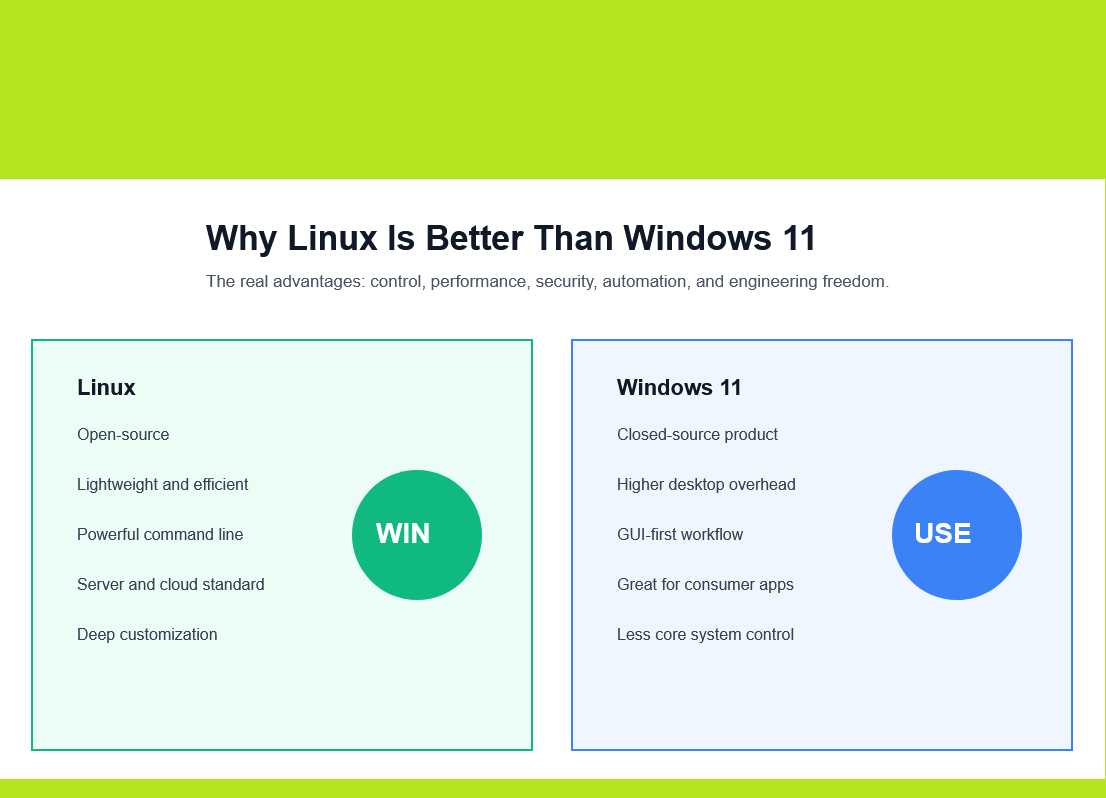
This is not an accident. It is the result of fundamental design choices that give Linux distinct advantages in performance, control, and engineering flexibility.

This article focuses specifically on why Linux is considered superior in many technical and practical scenarios, especially from a systems and engineering perspective.
1. Complete Control Over Your System
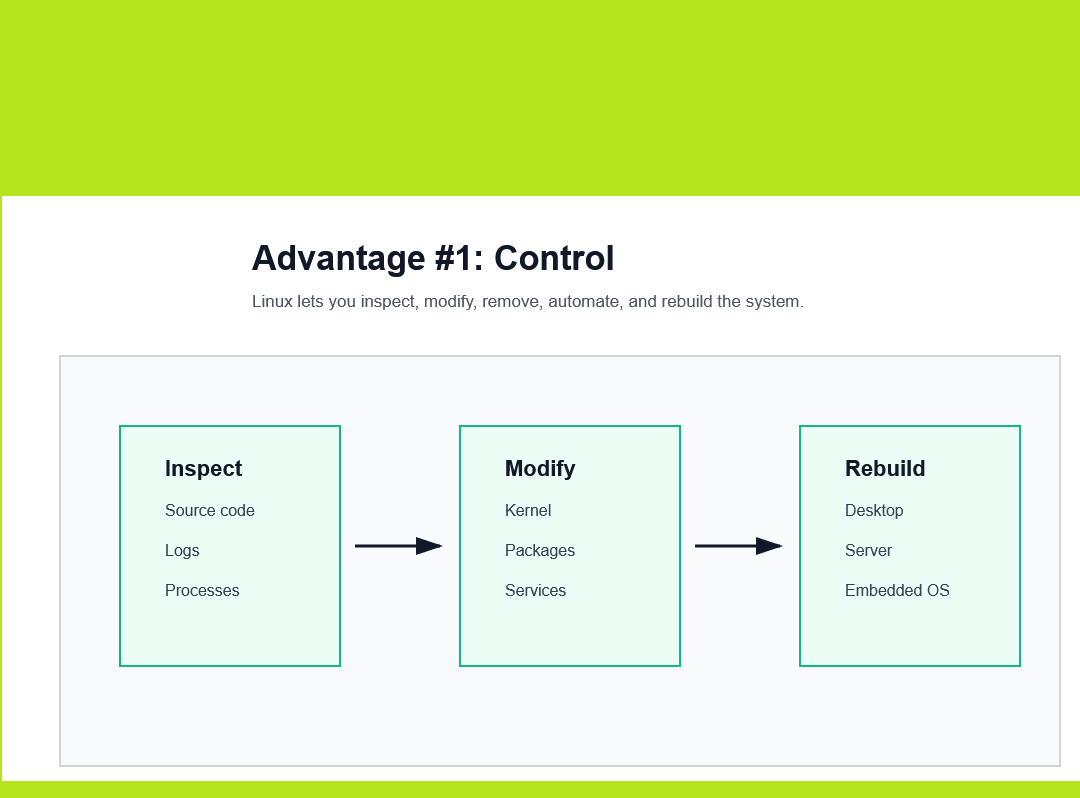
One of the most powerful advantages of Linux is that it gives users full control over the operating system. Because Linux is open-source, anyone can inspect the source code, modify it, and even build a completely customized version of the system. This is fundamentally different from Windows, which is controlled by Microsoft and does not allow users to change its core behavior.
In practical terms, this means that Linux is not just an operating system—it is a platform for building your own system. Developers can remove unnecessary components, optimize performance, or tailor the OS for specific hardware such as embedded devices or FPGA-based systems. This level of control is impossible in a closed system.
From a teaching perspective, this is one of the most important concepts to understand:
Linux is something you can shape.
Windows is something you use.
2. Superior Performance and Efficiency
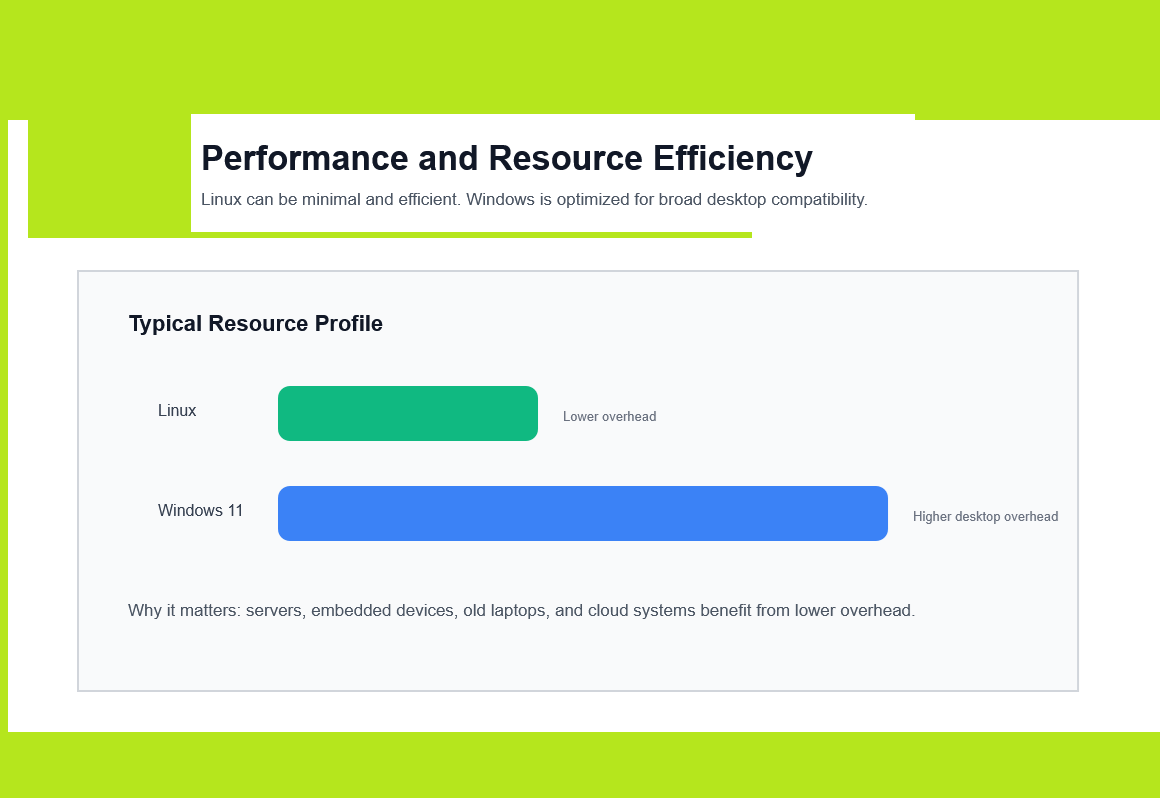
Linux is widely known for its ability to run efficiently even on limited hardware. Unlike Windows 11, which requires significant system resources to maintain its graphical interface and background services, Linux can be configured to run with minimal overhead.
This efficiency comes from several factors:
- lightweight distributions (such as minimal Debian or Arch setups)
- fewer background processes
- more direct interaction between software and hardware
- highly optimized kernel design
As noted in your material, Linux typically uses fewer resources and delivers faster performance, especially on older machines.
This is why Linux dominates environments where performance matters most:
- cloud servers
- high-performance computing clusters
- networking equipment
- embedded systems
In many cases, Linux does not just perform better—it makes systems possible that would otherwise be too resource-constrained.
3. Strong Security by Design
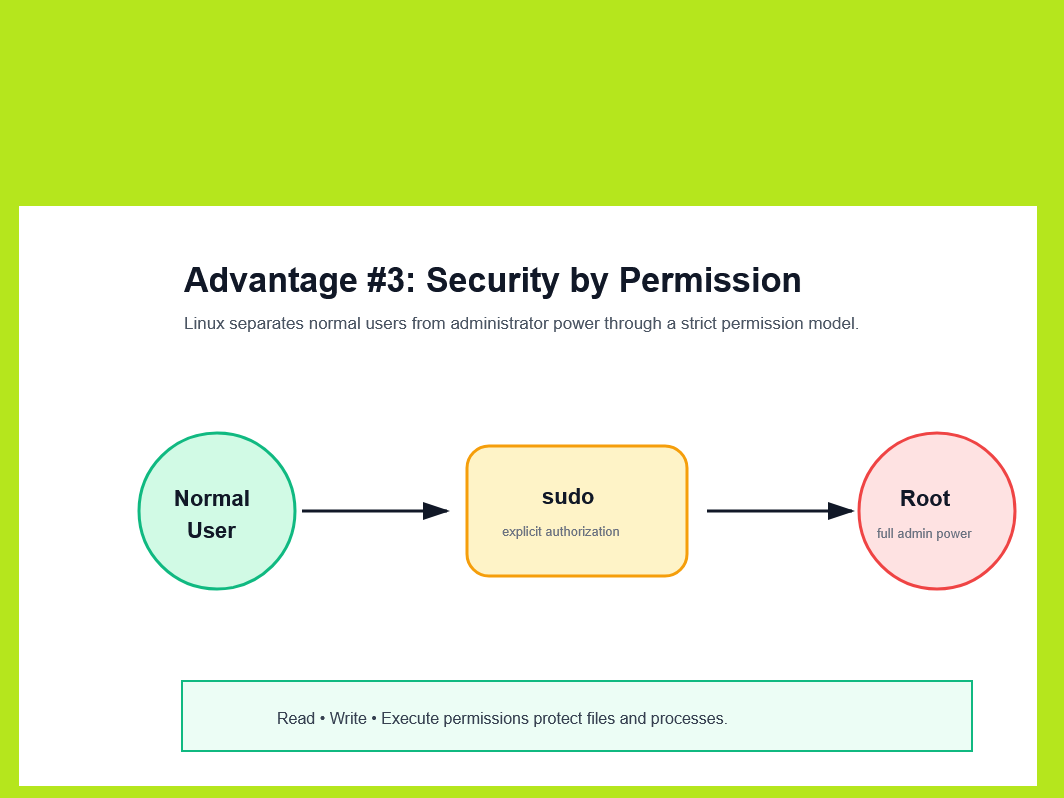
Security in Linux is not an afterthought; it is built into the system from the ground up. Linux uses a strict permission model that separates normal users from administrative control, ensuring that critical operations require explicit authorization.
Key security features include:
- user privilege separation (root vs regular users)
- fine-grained file permissions
- open-source transparency for rapid vulnerability detection
- lower exposure to malware compared to mainstream desktop systems
While Windows has improved significantly in recent years, its widespread usage makes it a more attractive target for attackers. Linux, by contrast, benefits from both its architecture and its ecosystem.
Your material highlights this clearly: Linux is generally considered more secure, while Windows has historically been more vulnerable.
For engineers and system administrators, this translates into a simple reality:
Linux gives you control over security, not just protection from threats.
4. A Powerful Command-Line Ecosystem

One of the defining strengths of Linux is its command-line interface (CLI), which is deeply integrated into the system. Unlike Windows, where graphical tools are dominant, Linux encourages users to interact with the system through commands and scripts.
This approach unlocks a level of productivity and automation that is difficult to achieve with graphical interfaces alone. With tools like Bash, users can:
- automate repetitive tasks
- manage large-scale systems
- process data efficiently
- build complex workflows with simple commands
As your material explains, the Linux command line is central to system operation, whereas Windows relies more on graphical tools.
For students and engineers, mastering the Linux CLI is a major step forward:
It transforms you from a user into a system operator.
5. Stability and Reliability
Linux systems are known for their long uptime and reliability. It is common for Linux servers to run continuously for months or even years without needing a reboot.
This stability is a direct result of:
- simpler system design
- fewer forced updates
- strong process isolation
- mature kernel development
In contrast, Windows systems often require restarts due to updates or system changes. While this is acceptable for desktop users, it is a limitation in production environments.
For this reason, Linux has become the standard in:
- data centers
- financial systems
- telecommunications infrastructure
In these environments, stability is not optional—it is critical.
6. Flexible Software Installation and Management
Linux offers a fundamentally different approach to software management through package managers such as APT, YUM, or Pacman. Instead of downloading software from various websites, users install applications directly from trusted repositories using simple commands.
This provides several advantages:
- faster installation
- improved security
- easier updates
- consistent system management
Your material also points out that Linux enables efficient operations such as installing software or managing files directly from the terminal.
From an engineering standpoint, this is essential:
Package managers make Linux scalable and maintainable.
7. Freedom from Vendor Lock-In
One often overlooked advantage of Linux is the absence of vendor lock-in. Because Linux is open and community-driven, users are not tied to a single company or ecosystem.
In contrast, Windows users depend on Microsoft for:
- updates
- licensing
- system policies
- feature availability
With Linux, users and organizations can:
- choose their distribution
- migrate systems freely
- avoid licensing costs
- maintain long-term independence
This is particularly important for enterprises and governments, where control over infrastructure is a strategic concern.
8. Ideal for Developers, Engineers, and System Builders

Linux is the preferred operating system for developers and engineers because it aligns closely with how systems actually work. It provides direct access to:
- system internals
- networking stacks
- development tools (GCC, Make, etc.)
- containerization technologies (Docker, Kubernetes)
For fields such as FPGA development, embedded systems, and RISC-V architecture, Linux is not just an option—it is often the default environment.
This makes Linux not only a tool, but also a learning platform for understanding computing at a deeper level.
Conclusion: Why Linux Wins in the Long Run
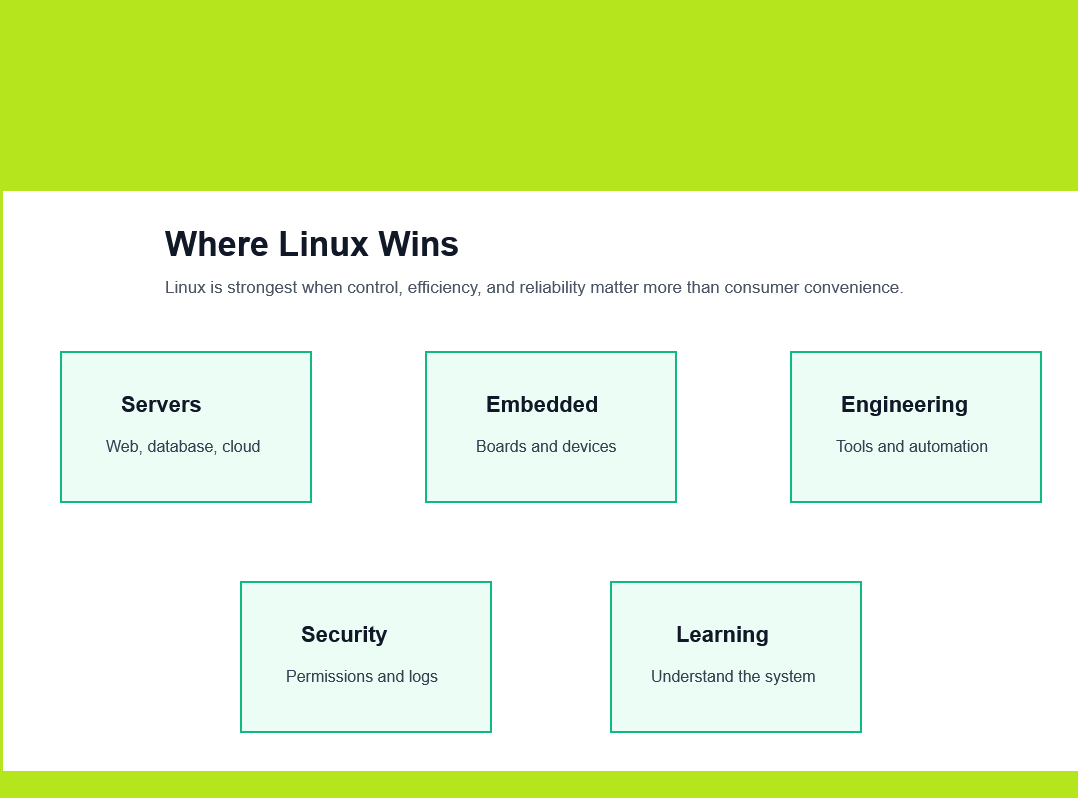
Linux is not necessarily better for every user, but its advantages become increasingly clear as you move closer to the core of computing systems.
- It gives you control instead of limitations
- It prioritizes performance over convenience
- It offers transparency instead of abstraction
- It enables learning instead of hiding complexity
Windows remains dominant in desktop usage because it is designed for accessibility and compatibility. However, Linux dominates the infrastructure of the modern digital world because it is designed for power, flexibility, and efficiency.
In the end, the question is not simply “Which is better?” but rather:
Do you want to use a system, or understand and control it?