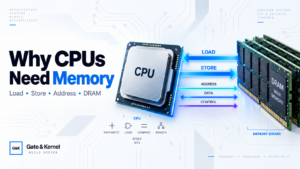
A CPU can perform arithmetic, compare values, execute branches, and manipulate bits. But most useful programs need much more than registers and an ALU. They…
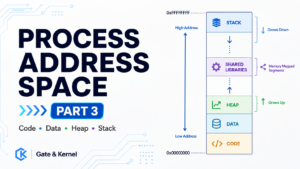
In Part 1, we learned how virtual addresses are translated into physical addresses. In Part 2, we looked at page faults, demand paging, memory protection,…
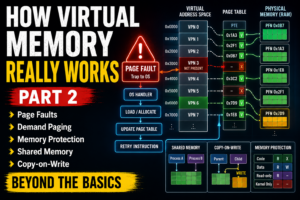
How Virtual Memory Really Works, Part 2: Page Faults, Demand Paging, Memory Protection, Shared Memory, and Copy-on-Write In Part 1, we followed the path from…
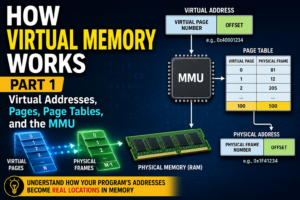
How Virtual Memory Works(1): Virtual Addresses, Pages, Page Tables, and the MMU Virtual memory is one of the most important ideas in modern computer systems.…
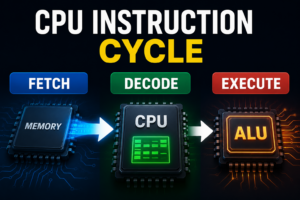
Every program eventually becomes a sequence of instructions that the CPU must execute. A line of C such as: c = a + b; looks…

A CPU contains many important components: registers, an ALU, control logic, memory interfaces, and other supporting circuits. But these components are useful only when they…
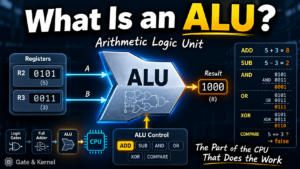
In the previous lessons, we learned how logic gates can perform simple operations. We then built a half adder, which can add two binary bits.…
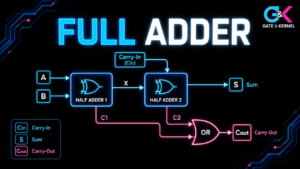
In the previous lesson, we learned how a half adder can add two binary bits. A half adder takes two inputs: A B and…
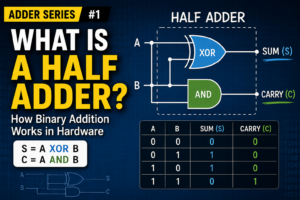
Computers perform billions of arithmetic operations every second. But underneath CPUs, ALUs, registers, and complex instruction sets, arithmetic begins with a surprisingly simple question: How…
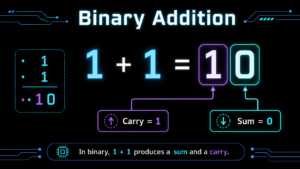
Computers perform billions of calculations every second. They add numbers, calculate memory addresses, update counters, compare values, and execute instructions. But deep inside the processor,…
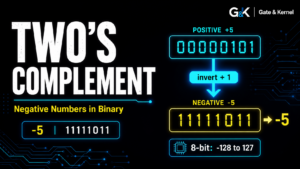
Computers naturally store patterns of bits. For unsigned integers, this is straightforward. With 8 bits, for example: 00000000 = 0 00000001 = 1 00000010 =…
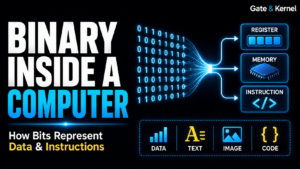
In Part 1, we learned how binary numbers work. We saw that binary uses only two digits: 0 and 1 We also learned about bits,…
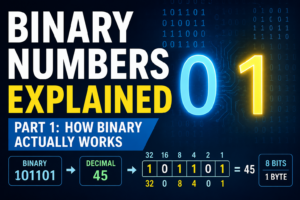
Computers can process text, images, video, programs, websites, games, and artificial intelligence. But underneath all of this complexity is a surprisingly simple idea: binary. Binary…
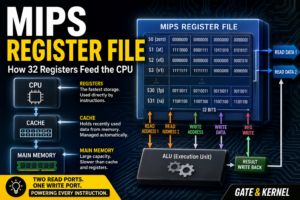
A processor can perform millions or billions of operations every second. It can add numbers, compare values, calculate addresses, control loops, call functions, and move…

A modern GPU is far more than a chip with thousands of cores. Follow one frame from CPU commands through vertices, triangles, rasterization, shaders, VRAM,…
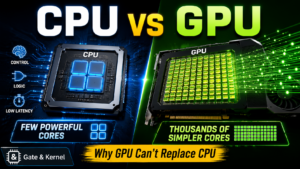
GPUs may contain thousands of cores, but those cores are not equivalent to CPU cores. This article explains latency, throughput, parallel computing, memory architecture, and…
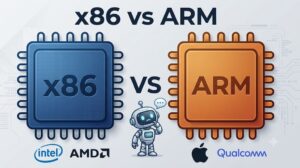
Modern computing is largely built around two major processor architecture families. Traditional desktop computers, gaming PCs, workstations, and many servers primarily use x86 processors. Smartphones,…