1. What Is a Computer Chip?
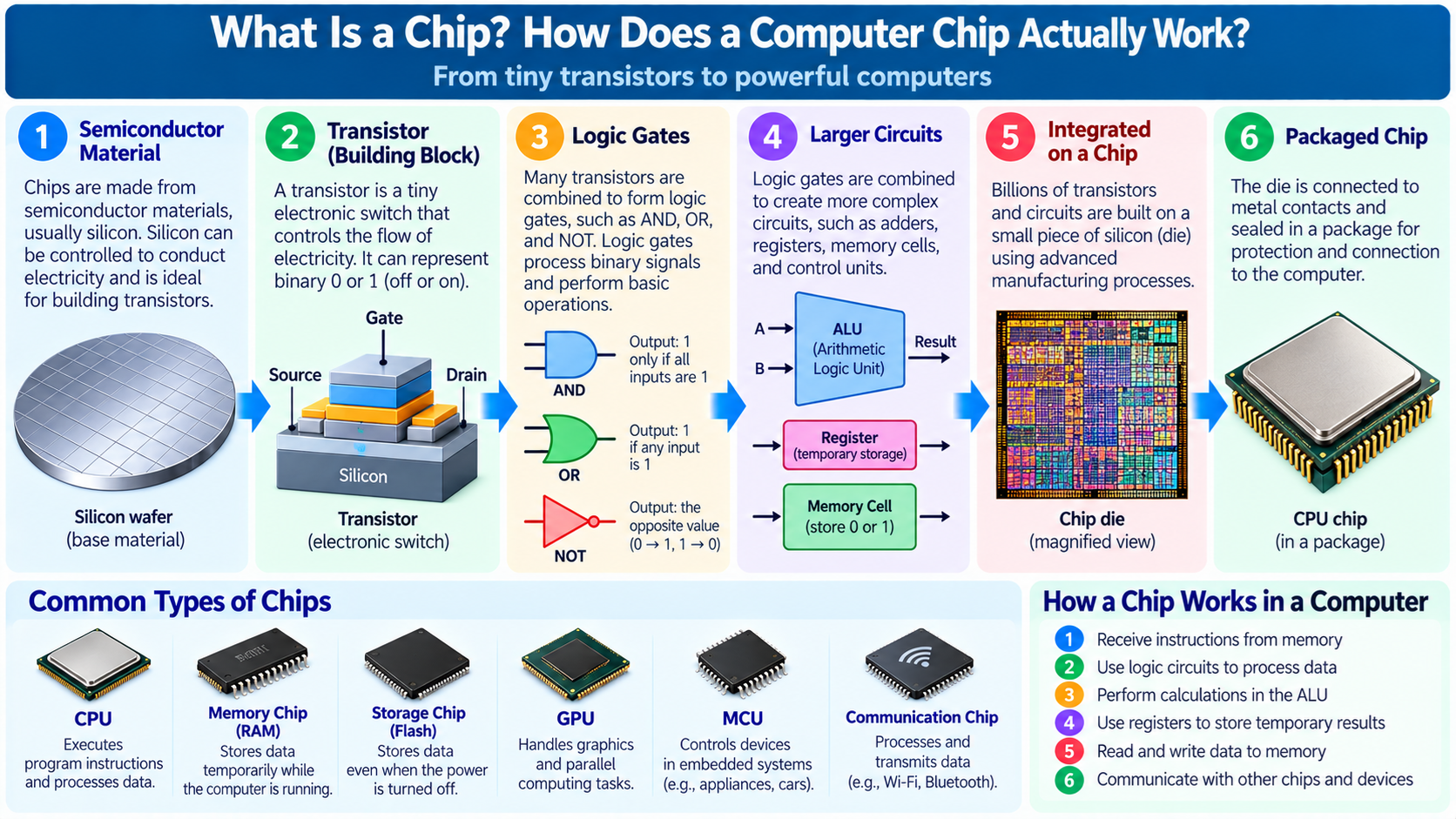
A computer chip is a small electronic device made from semiconductor materials that contains circuits designed to process, store, control, or transmit information.
Chips are among the most important components of modern electronic systems, including computers, smartphones, automobiles, industrial machines, communication equipment, and household appliances.
A chip is also commonly called an integrated circuit, or IC.
The term integrated circuit describes an electronic circuit in which many components, such as transistors, resistors, and capacitors, are manufactured together on a small piece of semiconductor material.
In modern digital chips, transistors are the most important building blocks.
They act as electrically controlled switches that can represent and manipulate binary information.
For example, a processor chip may contain billions of transistors working together to execute instructions, perform calculations, access memory, and communicate with other components.
A memory chip uses transistor-based circuits to store digital information, while a communication chip may process radio signals or transmit data through high-speed interfaces.
Although these chips serve different purposes, they share an important principle: electronic circuits are constructed from semiconductor devices and interconnected to perform useful functions.
The remarkable feature of modern chips is their integration.
Instead of connecting thousands or millions of separate electronic components using wires and circuit boards, engineers manufacture enormous numbers of tiny components on a single semiconductor die.
Understanding how a chip works begins with three basic concepts: semiconductor materials, transistors, and digital logic.
2. What Is the Difference Between a Chip and an Integrated Circuit?
The words chip and integrated circuit are often used interchangeably, but they are not always exactly the same.
An integrated circuit refers to the electronic circuit formed by components and interconnections fabricated within or on a semiconductor substrate.
A chip commonly refers to the physical semiconductor die containing that circuit, although people also use the word to describe the complete packaged device.
For example, when someone refers to a CPU chip, they may mean the processor package installed on a computer motherboard.
Inside that package is one or more semiconductor dies containing the actual circuitry.
A die is a small piece of semiconductor material cut from a larger processed wafer.
Modern packages can contain multiple dies, including processor dies, memory dies, or specialized interface dies.
Therefore, one packaged chip does not necessarily contain only one semiconductor die.
The important distinction is that the integrated circuit performs the electronic functions, the die physically contains the fabricated circuitry, and the package provides mechanical protection and electrical connections to the outside system.
3. Why Are Computer Chips Made from Silicon?
Silicon is the most widely used semiconductor material in modern digital integrated circuits.
A semiconductor is a material whose electrical behavior can be controlled under suitable conditions.
Its conductivity lies between that of a good conductor and an insulator, but this simple description does not fully explain its usefulness.
The most important feature of a semiconductor is that engineers can control the movement of electrical charge through the material.
Pure silicon has a crystalline atomic structure. By introducing carefully selected impurity atoms, engineers can modify the concentration of charge carriers.
This process is called doping.
For example, adding suitable donor impurities creates n-type semiconductor regions, where electrons are the majority charge carriers.
Adding suitable acceptor impurities creates p-type regions, where holes are the majority charge carriers.
A hole represents the absence of an electron in an otherwise occupied electronic state and behaves like a positive charge carrier in semiconductor analysis.
By combining differently doped regions with insulating layers and conductive structures, engineers can manufacture transistors, diodes, and other electronic devices.
Silicon is widely used because it offers a practical combination of material availability, manufacturing experience, electrical characteristics, and compatibility with advanced fabrication techniques.
Another important advantage is that silicon can form a high-quality insulating oxide, silicon dioxide, which has played a central role in semiconductor manufacturing.
However, not every chip uses silicon exclusively. Materials such as silicon carbide, gallium nitride, and gallium arsenide are used in applications where their particular electrical or physical characteristics provide advantages.
4. What Is a Transistor?
A transistor is a semiconductor device that can control electrical current or voltage.
Transistors can be used as electronic switches, amplifiers, and other circuit elements.
In digital computer chips, switching is one of their most important functions.
A transistor can help control whether a particular circuit path conducts current, allowing electronic circuits to represent and process binary information.
Modern digital integrated circuits mainly use metal-oxide-semiconductor field-effect transistors, commonly called MOSFETs, along with related advanced transistor structures.
A MOSFET contains several important terminals, including the gate, source, and drain.
The gate controls the electrical behavior of the region between the source and drain.
In a simplified n-channel MOSFET, applying a suitable gate-to-source voltage creates a conductive channel that allows current to flow between the source and drain.
When the gate voltage is below the relevant threshold, the channel becomes much less conductive.
Real transistors do not behave as perfect switches. They have leakage current, switching delays, capacitance, and other electrical characteristics.
Nevertheless, the switching model is useful for understanding digital logic.
A modern processor may contain billions of these devices arranged into complex circuits.
A single transistor does not understand instructions, perform arithmetic, or store an entire program.
Those functions emerge when many transistors are interconnected into larger electronic structures.
5. How Does a Transistor Represent Binary 0 and 1?
Digital computers use binary information, which consists of two logical states commonly represented as 0 and 1.
These values are logical abstractions. Inside a chip, they are normally represented by electrical voltage ranges.
For example, in a simplified digital circuit, a voltage near the lower supply rail may represent logic 0, while a voltage near the upper supply rail may represent logic 1.
The exact voltage thresholds depend on the semiconductor technology, circuit design, and supply voltage.
A transistor can participate in circuits that produce, preserve, or change these logical values.
For example, consider a CMOS inverter, also called a NOT gate.
A typical CMOS inverter uses two complementary transistors: a p-channel MOSFET and an n-channel MOSFET.
When the input is at a low logical voltage, the p-channel transistor conducts and the n-channel transistor is off, causing the output to move toward the positive supply voltage.
When the input is at a high logical voltage, the n-channel transistor conducts and the p-channel transistor is off, pulling the output toward the lower supply rail.
The circuit therefore produces the opposite logical value from its input.
If the input is 0, the output is 1. If the input is 1, the output is 0.
This simple operation is one of the foundations of digital computing.
It is important to understand that a single transistor is not necessarily equivalent to one bit.
Transistors are combined into circuits that implement logic functions, memory cells, and other operations.
6. How Do Transistors Become Logic Gates?
A logic gate is an electronic circuit that performs a logical operation on one or more binary inputs.
Common logic gates include AND, OR, NOT, NAND, NOR, and XOR.
Each gate follows a defined relationship between its inputs and output.
For example, an AND gate produces logic 1 only when all its inputs are 1.
An OR gate produces logic 1 when at least one input is 1.
An XOR gate produces logic 1 when its two inputs are different.
These operations can be implemented using combinations of transistors.
In conventional CMOS logic, NAND and NOR gates are particularly important because they can be implemented efficiently with complementary transistor networks.
Logic gates can also be combined to create other gates and more complex functions.
For example, several gates can form a circuit that compares two binary numbers.
Other combinations can add binary values or select one input from several alternatives.
The key idea is that complex digital computation can be constructed from relatively simple logical operations.
A computer processor does not require a separate physical circuit for every possible software program.
Instead, it contains reusable logic and state elements that perform operations selected by instructions and control signals.
7. How Does a Chip Perform Addition?
Arithmetic is one of the fundamental tasks performed by processors.
To understand chip arithmetic, consider binary addition.
Binary numbers use the digits 0 and 1 rather than the decimal digits 0 through 9.
For example, the binary addition of 1 and 1 produces a result of binary 10, which represents decimal 2.
An electronic circuit called a half adder can add two one-bit values.
It produces two outputs: a sum and a carry.
The sum is calculated using an XOR function, while the carry is calculated using an AND function.
A full adder extends this design by accepting three inputs: two data bits and an incoming carry bit.
It produces a sum bit and an outgoing carry bit.
By combining multiple full adders, engineers can create circuits that add larger binary numbers.
For example, a 32-bit adder can process two 32-bit values, using a circuit structure that handles carry propagation between bit positions.
Modern processors often use more advanced adder architectures to improve speed, area efficiency, or power consumption.
Examples include carry-lookahead and parallel-prefix adders.
This demonstrates an important principle: a mathematical operation such as addition becomes a physical arrangement of transistors and wires.
The silicon does not understand the meaning of a number. It follows electrical behavior, while the circuit structure implements the rules of binary arithmetic.
8. How Does a Chip Store Information?
Computer chips do more than perform calculations. Many also store information.
Digital storage circuits preserve binary states so that information remains available for later operations.
One important storage element is the flip-flop.
A flip-flop is a sequential logic circuit that can retain a logical state.
In synchronous digital systems, flip-flops commonly update their stored values in response to a designated clock edge.
For example, a group of 32 flip-flops can store a 32-bit value.
Such groups can form registers used inside a processor.
Registers are extremely important because they hold operands, addresses, intermediate calculation results, and processor state.
Chips also use larger memory structures.
SRAM, or Static Random Access Memory, uses circuits capable of maintaining stored bits while power is supplied.
A common six-transistor SRAM cell uses a pair of cross-coupled inverters and access transistors.
SRAM is widely used for processor caches and other on-chip memory structures.
DRAM, or Dynamic Random Access Memory, generally uses a storage capacitor and an access transistor per conventional memory cell.
Because the stored electrical charge gradually leaks away, DRAM requires periodic refresh operations.
Flash memory stores information using devices that retain programmed states without continuous external power.
These different memory technologies involve trade-offs among speed, density, cost, power consumption, and data retention.
9. What Is a Clock Signal Inside a Chip?
Many digital chips use a clock signal to coordinate operations.
A clock is a periodic electrical signal that alternates between logical states.
For example, a clock operating at 1 GHz completes one billion cycles per second.
In a synchronous circuit, registers and other state elements can use clock edges to determine when stored values should change.
Consider a simple processor operation.
During one part of the computation, combinational logic calculates a result from current input values.
At an appropriate clock edge, a register captures the result.
The new register value can then be used by the next stage of computation.
This approach helps organize complex circuits into predictable stages.
However, a 1 GHz clock does not mean that a processor necessarily completes one instruction every nanosecond.
An instruction may require multiple cycles, and modern processors may execute or complete multiple instructions during a single cycle under suitable conditions.
Performance depends on microarchitecture, instruction dependencies, memory behavior, and many other factors.
Also, not every chip is entirely synchronous. Some circuits use asynchronous logic, multiple clock domains, or other timing mechanisms.
10. How Does a CPU Chip Execute a Program?
A CPU, or Central Processing Unit, is a processor designed to execute instructions defined by an instruction set architecture.
Examples of instruction set architectures include x86, Arm, and RISC-V.
A software program is translated into machine instructions that the CPU can execute.
Each instruction represents an operation, such as adding numbers, loading data from memory, storing results, or changing the program’s execution flow.
At a simplified level, CPU operation can be described using three stages: fetch, decode, and execute.
During instruction fetch, the CPU obtains the instruction from an appropriate memory hierarchy.
During decode, the processor determines what operation the instruction represents and which resources are required.
During execution, the relevant hardware performs the operation.
For example, an ADD instruction may cause the CPU to read two register values, send them to an arithmetic unit, and write the result into a destination register.
A load instruction may request data from memory and place it into a register.
A branch instruction may change which instruction is executed next.
Modern CPUs use additional mechanisms such as pipelining, caching, branch prediction, and, in many designs, out-of-order execution.
These techniques allow processors to use hardware resources more efficiently.
Despite their complexity, CPU instructions ultimately control electronic circuits built from transistors, memory cells, and interconnections.
11. What Is an ALU?
ALU stands for Arithmetic Logic Unit.
It is a processor component responsible for performing arithmetic and logical operations.
An ALU may support operations such as addition, subtraction, AND, OR, XOR, shifts, and comparisons.
For example, when the CPU executes an addition instruction, the relevant operands may be directed to an ALU.
Control signals select the required operation.
The ALU processes the input values through its internal logic circuits and generates the result.
The result can then be stored in a register or forwarded to another execution stage.
A modern processor may contain multiple integer execution units rather than a single ALU.
It may also include floating-point units, vector execution units, and specialized mathematical hardware.
These additional units implement operations that are more complex than simple one-bit logic.
For example, floating-point arithmetic follows numerical representations and rules such as those defined by IEEE 754.
The underlying hardware still consists of electronic circuits, but the organization is far more sophisticated than a basic logic gate.
12. What Is Inside a Modern Processor Chip?
Modern processor chips contain much more than a collection of arithmetic circuits.
A CPU core typically includes instruction processing logic, registers, arithmetic units, control circuitry, and other execution structures.
Caches store frequently needed instructions and data close to the processing units.
Memory management hardware supports virtual address translation and memory protection.
Branch prediction circuitry helps the processor anticipate possible instruction paths.
Clock distribution networks provide timing signals to appropriate circuit regions.
Power management circuitry helps regulate energy use across the chip.
Many processors also integrate memory controllers, communication interfaces, and other system functions.
A modern chip may include several CPU cores sharing parts of the memory hierarchy and system infrastructure.
Some processor packages contain multiple dies or chiplets connected through advanced packaging technology.
Other integrated circuits combine CPU cores with GPU units, neural processing accelerators, display engines, video processing circuits, and peripheral interfaces.
When many of these functions are integrated into a single system-oriented chip, the device is commonly called a System on Chip, or SoC.
Therefore, the internal organization of a modern processor is much more complex than the basic fetch-decode-execute model, even though that model remains useful for learning.
13. What Is the Difference Between a CPU, GPU, MCU, FPGA, and ASIC?
Not all chips are designed to perform the same tasks.
A CPU is a general-purpose processor designed to execute a wide variety of programs. It is commonly used for operating systems, applications, control logic, and tasks requiring flexible instruction execution.
A GPU, or Graphics Processing Unit, is designed around high-throughput parallel processing. Modern GPUs are widely used for graphics rendering, artificial intelligence, and scientific computing.
An MCU, or Microcontroller Unit, typically combines a processor core, memory, and peripheral functions in a device intended for embedded control.
For example, an MCU may control a household appliance, read sensor values, or manage a motor.
An FPGA, or Field-Programmable Gate Array, contains configurable logic and interconnect resources that allow engineers to implement different digital hardware circuits after manufacturing.
An ASIC, or Application-Specific Integrated Circuit, is designed for a particular application or class of functions.
For example, an ASIC may accelerate network packet processing, video encoding, or a specific cryptographic workload.
These categories are not completely exclusive. An SoC may include CPU and GPU cores, an ASIC may contain embedded processors, and an FPGA can implement a soft-core CPU.
The difference lies primarily in the architecture, flexibility, and design objectives rather than in whether a device is physically a chip.
14. How Are Billions of Transistors Connected?
A modern digital chip contains many layers of electrically conductive interconnections.
These interconnections allow signals and power to move between different circuit components.
Transistors are fabricated in or near the semiconductor substrate, and additional processing steps create contacts, insulating layers, and metal wiring.
The wiring system is often called the interconnect network.
Smaller local connections link nearby transistors into logic gates and other circuits.
Larger interconnections connect functional blocks, memory structures, clock networks, and power distribution systems.
Modern integrated circuits contain multiple metal routing layers, separated by insulating materials.
Vertical connections called vias connect conductors between layers.
This creates a complex three-dimensional wiring structure above the semiconductor devices.
The interconnect system is critically important because electrical signals do not propagate instantaneously.
Long wires introduce resistance and capacitance, which can increase delay and power consumption.
As chips become more complex, interconnect design can be as important as transistor performance.
Engineers use specialized electronic design automation tools to place circuit elements and route the connections between them.
15. How Is a Computer Chip Manufactured?
Computer chip manufacturing begins with semiconductor wafers, usually made from highly purified single-crystal silicon.
A wafer is a thin circular slice of semiconductor material.
Many copies of an integrated circuit can be fabricated on the same wafer.
The manufacturing process uses numerous steps to create transistors, insulating layers, electrical contacts, and metal interconnections.
One important technique is photolithography.
During lithography, a light-sensitive material called photoresist is applied to the wafer.
An optical patterning system exposes selected regions according to a circuit pattern.
The resulting pattern is used in subsequent manufacturing steps to define areas for processing.
Other important operations include deposition, etching, ion implantation, oxidation, and chemical mechanical polishing.
Deposition adds thin material layers.
Etching removes selected material.
Ion implantation introduces dopants into semiconductor regions.
Chemical mechanical polishing helps produce sufficiently flat surfaces for later processing.
These processes are repeated many times to construct the required semiconductor devices and interconnect structures.
Modern chip fabrication is extremely complex and requires precise control over materials, dimensions, and contamination.
After fabrication, the wafer is tested, and individual dies are separated for packaging.
16. What Do 3 nm, 5 nm, and 7 nm Mean?
Semiconductor manufacturing technologies are often described using process node labels such as 3 nm, 5 nm, or 7 nm.
Historically, process labels were more closely related to particular transistor dimensions.
In modern semiconductor manufacturing, however, these names function primarily as technology generation labels.
They do not necessarily describe a single physical feature measuring exactly the stated number of nanometers.
Different semiconductor manufacturers may also use different naming conventions.
A process node typically represents a combination of transistor design, manufacturing techniques, density improvements, and electrical characteristics.
Smaller or newer process generations may provide opportunities for improved transistor density, performance, or power efficiency.
However, the actual improvements depend on the particular design, operating conditions, and manufacturing technology.
A processor manufactured using a newer process is not automatically faster than every processor manufactured using an older process.
Chip architecture, clock frequency, cache organization, memory bandwidth, power limits, and software behavior remain important.
The process node is one aspect of chip technology, not a complete measure of performance.
17. What Are FinFET and GAAFET Transistors?
As semiconductor technology advanced, manufacturers developed new transistor structures to improve electrostatic control and reduce unwanted leakage.
Traditional planar MOSFETs use a relatively flat channel structure.
FinFET technology uses a raised, fin-shaped channel, allowing the gate to control the channel from multiple sides.
This improves gate control compared with a comparable traditional planar structure and has been widely used in advanced digital semiconductor manufacturing.
GAAFET stands for Gate-All-Around Field-Effect Transistor.
In this structure, the gate surrounds the channel more completely.
Implementations may use nanosheets or nanowires as the channel structures.
The goal is to improve electrostatic control, supporting further transistor scaling and optimization.
However, implementing new transistor structures requires complex manufacturing processes.
Different chip manufacturers and process generations may use different transistor architectures.
These developments illustrate that modern chip improvement involves not only making components smaller but also changing their physical structures.
18. Why Do Computer Chips Generate Heat?
Computer chips consume electrical energy while operating.
Some of this energy is converted into heat because of transistor switching, leakage currents, resistive losses, and other physical effects.
In CMOS digital circuits, dynamic power consumption is often approximated using the relationship:
P ≈ αCV²f
Here, P represents dynamic power, α is the switching activity factor, C is the effective switched capacitance, V is the supply voltage, and f is the switching frequency.
This equation shows why voltage, frequency, circuit activity, and capacitance influence dynamic power consumption.
Because supply voltage is squared, voltage changes can have a strong effect on dynamic power.
However, total chip power also includes leakage and other forms of consumption.
When a processor performs intensive work, more circuit resources may become active, increasing power consumption and heat generation.
Excessive temperature can reduce reliability and limit performance.
Therefore, computer systems use heat spreaders, heatsinks, fans, liquid cooling, or other thermal management techniques.
Processors also commonly include temperature monitoring and power management mechanisms.
If temperature or power limits are reached, a processor may reduce its operating frequency or other activity to remain within safe operating conditions.
This behavior is often called thermal throttling when temperature is the limiting factor.
19. Why Can’t We Simply Make Every Chip Faster?
Increasing chip performance is more complicated than raising the clock frequency.
Higher operating frequencies generally make timing requirements more demanding and may increase power consumption.
Electronic signals require time to propagate through transistors and interconnections.
Each register-to-register path has timing constraints that must be satisfied for reliable synchronous operation.
If the clock period becomes too short, some paths may not settle before the next required sampling event.
Increasing voltage may improve certain switching characteristics but can also raise power consumption and create reliability concerns.
Adding more transistors does not automatically improve performance either.
The application must be able to use the additional computing resources.
For example, a program dominated by serial dependencies may gain little benefit from additional processor cores.
Memory performance can also become a bottleneck.
A fast processor may spend time waiting for data from caches or external memory.
Modern chip design therefore involves balancing computation, memory, interconnect, power, temperature, and software requirements.
This is why improving computer performance requires more than increasing transistor counts.
20. What Is the Difference Between a Chip and a Circuit Board?
A chip and a circuit board serve different functions.
A chip contains integrated electronic circuits fabricated using semiconductor manufacturing processes.
A printed circuit board, or PCB, provides mechanical support and electrical connections between components.
For example, a computer motherboard contains a processor package, memory modules, power regulation circuits, connectors, and many other components.
Copper traces inside the PCB connect these components.
The processor itself contains a much denser network of microscopic transistors and internal wiring.
PCB features are generally far larger than the smallest structures used within advanced semiconductor dies.
The circuit board also provides power distribution and connections to external devices.
Therefore, a modern electronic system typically uses both semiconductor chips and printed circuit boards.
The chip performs specialized electronic functions, while the PCB helps connect multiple devices into a complete working system.
21. What Is Chip Packaging?
After a semiconductor die is manufactured and tested, it generally needs to be connected to the outside world.
Packaging provides mechanical protection, electrical connections, and a path for heat transfer.
The die may be attached to a package substrate and connected through techniques such as wire bonding or flip-chip bonding.
The completed package can then be mounted onto a printed circuit board or connected through a socket.
Different packaging technologies support different electrical, thermal, and mechanical requirements.
For example, many processors use packages designed to accommodate large numbers of electrical connections and significant power delivery.
Advanced packaging can also connect multiple semiconductor dies within a single package.
This approach is increasingly important for some high-performance processors and AI accelerators.
Multiple dies may contain CPU cores, I/O circuits, cache memory, or other components.
The dies communicate through high-density package interconnections.
Packaging is therefore not merely a protective covering. It is an important part of modern semiconductor system design.
22. What Is a Chiplet?
A chiplet is a semiconductor die designed to function as part of a larger multi-die system.
Instead of manufacturing every function on one large monolithic die, engineers can divide selected functions among multiple smaller dies.
These dies are then connected using suitable advanced packaging and interconnect technology.
For example, a processor package may contain several compute chiplets and a separate I/O die.
This approach can offer manufacturing and design advantages under suitable conditions.
Smaller dies may improve manufacturing yield, and different chiplets may use different semiconductor process technologies.
For example, high-performance computing logic may benefit from a newer process, while certain analog or I/O functions may be more economical on another process.
However, chiplet systems also introduce challenges involving communication bandwidth, latency, power delivery, packaging complexity, and thermal design.
A chiplet-based processor is not automatically superior to a monolithic design.
The architecture must be evaluated as a complete system.
23. How Does a Chip Communicate with Other Chips?
Computer systems usually contain multiple chips that must exchange information.
A CPU may communicate with memory, storage controllers, network interfaces, and other devices.
These connections use electrical interfaces and communication protocols.
For example, DDR memory interfaces transfer data between processors or memory controllers and DRAM devices.
PCI Express, commonly called PCIe, provides high-speed communication between compatible system components.
SPI, I2C, and UART are widely used in embedded systems for communication between microcontrollers, sensors, and peripheral devices.
The communication process depends on agreed rules for electrical signaling, timing, data framing, and other protocol behavior.
A chip may contain dedicated hardware blocks to manage these interfaces.
For example, a memory controller coordinates commands and data transfers with DRAM.
A PCIe controller manages communication according to the relevant PCIe protocol.
These interfaces allow individual chips to operate as parts of a larger computer or electronic system.
24. How Does a Chip Know What to Do?
A chip does not understand instructions or electrical signals in the human sense.
Its behavior is determined by the electronic circuits and configuration designed into it.
For a CPU, the instruction set defines the operations that software can request.
The processor’s internal control logic interprets those instructions and directs the appropriate hardware resources.
For a microcontroller, firmware stored in memory can control peripherals, process sensor inputs, and execute embedded software.
For an FPGA, configuration data determines how programmable logic resources and interconnections are arranged.
For a fixed-function ASIC, much of the operational behavior is implemented directly in dedicated hardware.
These devices therefore differ in how much of their behavior can be changed after manufacturing.
A CPU can execute many different programs without changing its physical circuitry.
An FPGA can reconfigure its digital logic within the available hardware resources.
An ASIC may perform highly optimized functions while offering more limited flexibility, although many ASICs also include programmable control features.
In every case, the physical chip responds to electrical inputs according to the circuits and stored states that define its operation.
25. How Do Engineers Design a Computer Chip?
Modern chip design begins with defining the intended functions and engineering requirements.
For example, a processor design project may specify an instruction set, target performance, power budget, memory interfaces, and manufacturing constraints.
Engineers then develop an architecture describing how the main functional blocks work together.
For a digital chip, the hardware may be described using languages such as Verilog, SystemVerilog, or VHDL.
These languages are commonly used to describe registers, combinational logic, control systems, and other digital structures.
A design representation called RTL, or Register Transfer Level, describes the behavior of a digital circuit in terms of registers and the logic operating between them.
Engineers verify the design using simulation, formal methods, and other techniques.
Logic synthesis converts the RTL into a gate-level representation using cells from an appropriate technology library.
Physical design tools then arrange the cells and create the required interconnections.
The design must satisfy timing, power, area, and manufacturing requirements.
Additional verification checks help confirm that the layout is suitable for fabrication.
Once the design is finalized, manufacturing data is delivered to a semiconductor foundry.
After fabrication, the chips are tested, packaged, and validated.
This process can involve large engineering teams and sophisticated electronic design automation tools.
26. Why Are Modern Computer Chips So Complex?
The complexity of modern chips comes from the enormous number of electronic components and the need to coordinate their behavior reliably.
A simple logic gate may contain only a few transistors.
A basic counter may require registers and supporting logic.
A CPU core contains far more complex structures for instruction processing, arithmetic, data movement, and control.
Modern processors also include caches, memory management circuits, branch prediction, clock distribution, and many other functions.
Adding multiple cores increases the need for communication and coordination between processing units.
Memory hierarchies must provide data efficiently.
Power delivery networks must support rapidly changing electrical loads.
Clock networks must distribute timing signals while controlling skew and other timing effects.
Thermal management must prevent excessive temperatures.
Manufacturing variations must also be considered.
Despite these challenges, designers can build complex chips by dividing them into manageable modules and using structured verification and design methods.
This hierarchical approach allows engineers to create systems containing billions of transistors without designing every transistor individually.
27. Does a Smaller Chip Always Use Less Power?
A physically smaller chip does not necessarily consume less power.
Power consumption depends on transistor technology, circuit activity, operating voltage, frequency, leakage, and architectural design.
A compact high-performance processor running at high utilization may consume more power than a larger chip designed for low-frequency control tasks.
Similarly, moving a design to a newer semiconductor process may improve certain electrical characteristics, but actual power savings depend on the implementation.
A manufacturer may use a newer process to increase performance rather than minimize total energy use.
Another important factor is data movement.
Moving data between memory and compute units can consume substantial energy.
A chip that performs arithmetic efficiently but repeatedly transfers large amounts of data may have poor overall energy efficiency.
This is why specialized AI accelerators often emphasize on-chip memory and data reuse.
Effective chip design must consider the entire computation, including storage, communication, and control overhead.
28. Are All Computer Chips Digital?
Not all integrated circuits are digital.
Digital chips process information represented using discrete logical states.
Examples include CPUs, memory devices, microcontrollers, and many digital accelerators.
Analog integrated circuits process continuously varying electrical signals.
Examples include operational amplifiers, voltage regulators, analog filters, and certain sensor interfaces.
Mixed-signal chips combine analog and digital circuitry.
For example, an analog-to-digital converter, or ADC, converts an analog input signal into a digital representation.
A digital-to-analog converter, or DAC, performs the reverse operation.
Communication chips often contain both analog radio-frequency circuitry and digital processing logic.
Power management integrated circuits also use analog and digital control techniques.
Therefore, semiconductor technology extends far beyond the binary logic used by conventional computer processors.
The common element is the integration of electronic functions into semiconductor devices.
29. Where Are Computer Chips Used?
Computer chips are present in nearly every category of modern electronic equipment.
Desktop computers and laptops use processors, memory chips, storage controllers, network interfaces, and power management circuits.
Smartphones combine application processors, communication hardware, memory, sensors, and specialized accelerators.
Automobiles use microcontrollers and specialized chips for engine control, vehicle safety, displays, communication, and other functions.
Industrial equipment uses chips to monitor sensors, control motors, and manage automation systems.
Network switches and routers use processors, memory, interface circuits, and specialized packet-processing hardware.
Medical devices may use chips for measurement, imaging, signal processing, and control.
Artificial intelligence systems use CPUs, GPUs, memory devices, and specialized accelerators to perform large-scale computation.
Even relatively simple household devices may contain a microcontroller that executes a small embedded program.
The range of applications demonstrates why semiconductor chips have become essential to modern technology.
30. Why Are Chips So Important to Artificial Intelligence?
Modern artificial intelligence relies on large quantities of computation and data movement.
Neural networks frequently perform matrix multiplication, vector operations, and other mathematical calculations.
These workloads can involve billions of numerical operations.
CPUs can perform these tasks, but many AI workloads benefit from hardware designed for high-throughput parallel computation.
GPUs contain many processing resources and specialized arithmetic units that accelerate suitable AI operations.
Dedicated AI ASICs can further optimize selected computation patterns, data formats, and memory movement.
However, computational throughput is only one part of AI performance.
Memory capacity and bandwidth are also essential.
For example, a large model may require substantial memory just to store its parameters and intermediate data.
Moving data between external memory and processing units can limit overall speed.
Modern AI chip design therefore combines arithmetic performance, memory architecture, interconnection bandwidth, and power efficiency.
This demonstrates the same principle seen throughout computing: effective performance depends on matching hardware architecture to the workload.
31. Can a Computer Work Without Chips?
Most modern computers depend fundamentally on semiconductor integrated circuits.
A conventional computer requires processing, memory, control, and communication functions, which are normally implemented using chips.
Historically, electronic computers were constructed using vacuum tubes and later discrete transistors before large-scale integrated circuits became practical.
It is therefore possible to build computing machinery without modern semiconductor chips.
Mechanical computers and other specialized computing systems also demonstrate that computation is not limited to silicon devices.
However, such approaches generally cannot match the compact size, energy efficiency, reliability, and production economics of modern integrated circuits for mainstream electronic computing.
The development of semiconductor chips allowed computers to become dramatically smaller, faster, more affordable, and more widely available.
This transformation made personal computers, smartphones, embedded systems, and modern data centers possible.
32. The Complete Journey from Electricity to Software
The operation of a computer chip can be understood as a hierarchy of increasingly complex systems.
At the physical level, semiconductor materials allow electrical charge to be controlled.
Transistors use this behavior to implement switching and other electronic functions.
Groups of transistors form logic gates and storage circuits.
Logic gates and registers form adders, counters, multiplexers, and state machines.
These circuits combine into larger components such as arithmetic units, register files, caches, and control systems.
The larger components form processors, memory controllers, communication interfaces, and other chip-level subsystems.
A processor executes machine instructions defined by its instruction set architecture.
Compilers and other software tools translate programs into instructions supported by the processor.
Operating systems manage resources and provide services that applications use.
Finally, applications perform tasks that users recognize, such as browsing websites, editing documents, watching videos, and running artificial intelligence models.
Each layer depends on the mechanisms provided by the layers below it.
A software program may appear completely abstract, but its execution ultimately depends on physical electrical activity within electronic circuits.
33. Common Misunderstandings About Computer Chips
One common misunderstanding is that a chip is simply a tiny piece of metal.
In reality, an integrated circuit contains carefully engineered semiconductor devices, insulating layers, conductive connections, and other structures.
Another misunderstanding is that a transistor directly represents one stored bit.
A transistor can contribute to switching or storage circuits, but digital functions often require multiple transistors.
A third misunderstanding is that every chip contains a CPU.
Many chips are memory devices, analog circuits, interface controllers, sensors, or specialized accelerators.
Another misconception is that a higher transistor count automatically guarantees better performance.
Performance depends on architecture, clock frequency, memory behavior, software, thermal limits, and other factors.
People also sometimes assume that all chips use the same manufacturing technology.
In reality, semiconductor devices may use very different process nodes, materials, transistor structures, and packaging methods.
Finally, chips do not execute software merely because electricity flows through them.
Their circuits must be designed to perform specific operations, and programmable processors require suitable instructions and control mechanisms.
Understanding these distinctions makes it easier to study computer architecture and semiconductor technology accurately.
34. How to Begin Learning Computer Chip Technology
For beginners, the best way to understand chips is to study the relationship between digital logic and computer architecture.
Start with binary numbers and Boolean logic.
Learn how AND, OR, NOT, XOR, NAND, and NOR gates operate.
Next, study combinational circuits such as adders, multiplexers, decoders, and comparators.
Then learn sequential circuits, including flip-flops, registers, counters, and finite state machines.
These topics explain how digital circuits store state and perform operations over time.
After understanding basic digital logic, study CPU architecture.
Important subjects include registers, the arithmetic logic unit, instruction decoding, memory access, and the fetch-decode-execute process.
RISC-V is a useful instruction set architecture for learning because its documentation and open ecosystem make it possible to study processor behavior and hardware implementations.
For practical hardware experience, FPGA development provides a way to implement digital circuits using Verilog or SystemVerilog.
You can begin with simple designs such as an LED controller, counter, UART transmitter, or arithmetic unit.
These projects connect the theoretical behavior of logic circuits with real digital hardware.
Once the fundamentals are clear, more advanced subjects such as CMOS transistor design, semiconductor manufacturing, timing analysis, ASIC implementation, and chip packaging become easier to understand.
35. Conclusion: How Does a Computer Chip Actually Work?
A computer chip is an integrated electronic circuit manufactured using semiconductor technology.
Its fundamental building blocks include transistors, which control electrical behavior and enable switching, amplification, and other functions.
In digital chips, combinations of transistors implement logic gates and storage elements.
Logic gates perform operations on binary information, while registers and memory structures preserve data and state.
Larger groups of circuits form arithmetic units, processors, memory systems, controllers, and communication interfaces.
A CPU executes software instructions by coordinating these hardware resources according to its architecture.
Other chips, such as GPUs, MCUs, FPGAs, and ASICs, organize electronic circuits differently to meet particular computing requirements.
Modern semiconductor manufacturing allows billions of transistors and complex interconnections to be fabricated on extremely small areas.
Advanced packaging can connect multiple dies to create even larger systems.
Despite this enormous complexity, the underlying principle remains straightforward: carefully designed electronic circuits manipulate electrical signals to represent, store, process, and communicate information.
A computer chip does not understand numbers, programs, or commands. It consists of physical electronic circuits whose behavior implements the rules of digital logic. By combining billions of simple devices into an organized architecture, engineers create processors capable of executing complex software.
Understanding the progression from semiconductor materials to transistors, logic gates, registers, processors, and software provides the foundation for studying computer architecture, embedded systems, FPGA development, ASIC design, and modern semiconductor technology.