1. What Is an SoC?
An SoC, or System on a Chip, is an integrated circuit that combines several major functions of a computer or electronic system into a single chip.
Instead of using separate chips for processing, graphics, memory control, communication, and other functions, an SoC integrates many of these components into one semiconductor device.
Modern SoCs are widely used in smartphones, tablets, laptops, smart televisions, automobiles, industrial equipment, and embedded systems.
For example, a smartphone SoC may contain CPU cores, a GPU, a neural processing unit, memory controllers, image processing hardware, and communication interfaces.
These components work together to execute applications, process images, manage data, and communicate with external devices.
The main advantage of an SoC is integration. Combining multiple functions can reduce circuit board space, shorten communication paths, lower certain power requirements, and simplify system design.
However, an SoC does not necessarily contain every component required by a complete computer.
External RAM, storage, power management circuits, and other devices may still be necessary.
2. What Does System on a Chip Mean?
The term System on a Chip describes the integration of multiple system-level functions into one semiconductor chip.
A traditional computer may use several separate integrated circuits for processing, graphics, memory control, and peripheral communication.
An SoC combines many of these functions into one integrated design.
For example, a simple SoC might contain a CPU, SRAM, timers, GPIO, and communication interfaces.
A more advanced SoC may contain multiple CPU cores, a GPU, an NPU, display controllers, video engines, security hardware, and high-speed interfaces.
The exact components depend on the application.
The word system does not mean that every external device is physically integrated. Instead, it refers to bringing together several major functions normally required by an electronic system.
3. What Is Inside an SoC?
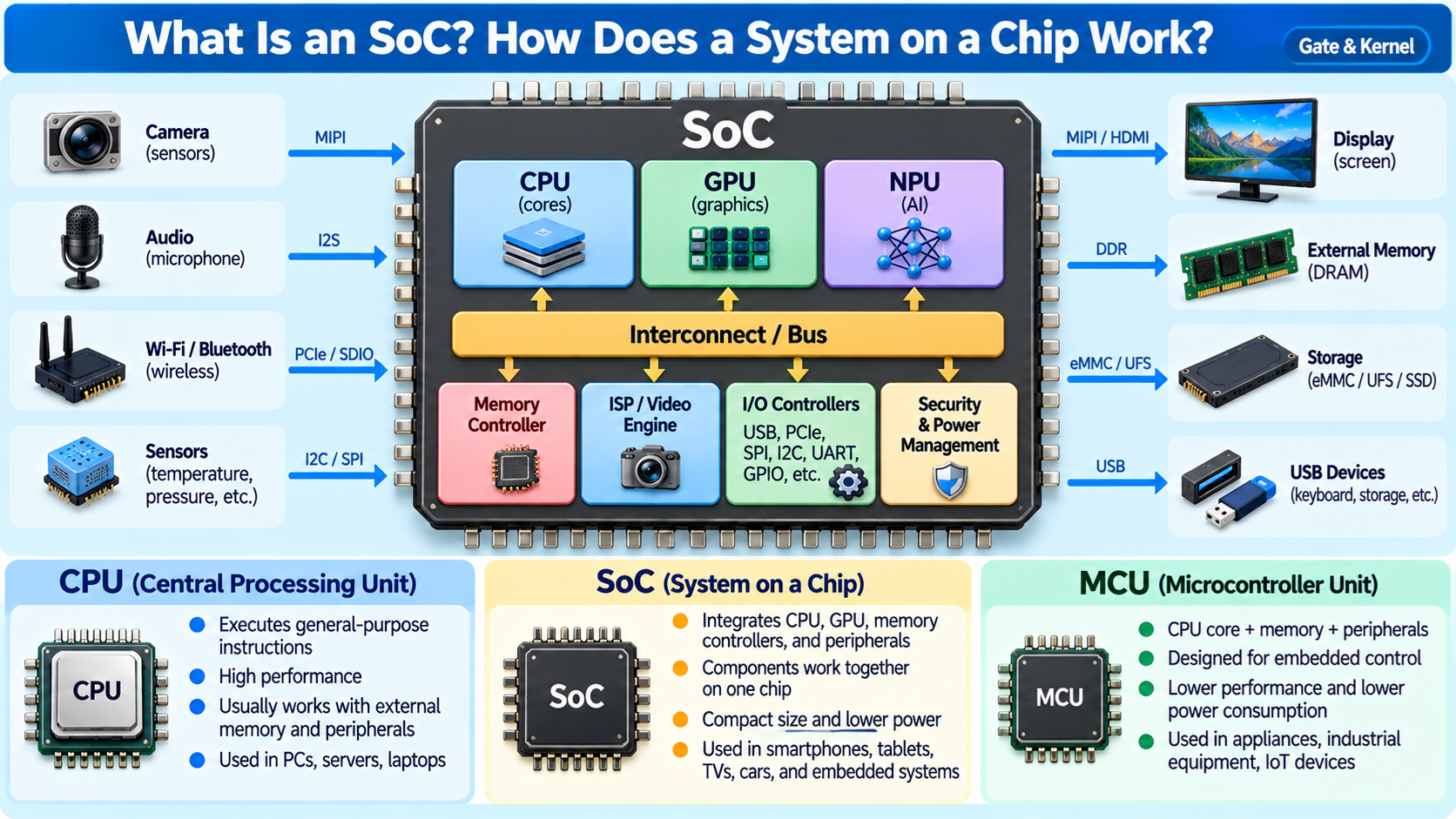
A typical SoC contains several functional blocks connected through an internal communication system.
The CPU executes general-purpose software instructions.
The GPU accelerates graphics rendering and suitable parallel computations.
An NPU, or Neural Processing Unit, may accelerate artificial intelligence operations.
Memory controllers manage communication with external or integrated memory.
Peripheral controllers provide interfaces such as USB, SPI, I2C, UART, and GPIO.
Some SoCs contain image signal processors, video encoders, video decoders, display controllers, and audio processing hardware.
Security components may provide cryptographic acceleration, secure boot support, and protected execution functions.
The SoC also contains clock distribution, reset control, interrupt handling, and power management logic.
Not every SoC includes all these components. A small embedded SoC may contain only a processor, memory, and a limited set of peripherals.
4. How Does an SoC Work?
An SoC works by allowing its integrated components to communicate and cooperate through internal interconnections.
For example, when a smartphone takes a photograph, the camera sensor captures light and converts it into electrical signals.
The image data is transferred to the SoC through an appropriate camera interface.
An image signal processor may perform operations such as demosaicing, noise reduction, and color processing.
The CPU controls the application and coordinates the process.
The GPU or NPU may perform additional image enhancement or computational photography operations.
The processed image can then be displayed or stored.
These operations involve several specialized hardware blocks working together.
The advantage of an SoC is that many of these components are integrated into a compact system with carefully designed communication and power management.
5. What Is an SoC Interconnect?
An SoC interconnect connects the functional blocks inside the chip.
For example, CPU cores, GPU units, memory controllers, and peripheral interfaces need to exchange information.
An internal interconnect provides the communication pathways required for these transfers.
Some SoCs use bus-based architectures.
Others use crossbars, hierarchical interconnects, or Networks on Chip, commonly called NoCs.
A Network on Chip uses a structured communication network to transfer information between internal components.
Modern Arm-based systems commonly use protocols from the AMBA family, including AXI, for communication between compatible hardware blocks.
The interconnect architecture affects latency, bandwidth, power consumption, and overall system performance.
A powerful processor can still be limited if it cannot access memory or communicate with other components efficiently.
6. What Is the Difference Between an SoC and a CPU?
A CPU is a processing unit designed to execute machine instructions.
An SoC is a larger integrated system that may contain one or more CPU cores along with other hardware functions.
For example, a conventional desktop processor may work with separate memory modules, storage devices, and peripheral controllers.
A smartphone SoC may integrate CPU cores, graphics processing, memory controllers, video processing, and other hardware into one chip.
However, modern desktop and server processors also integrate many functions.
Therefore, the distinction is not always based on a strict physical boundary.
The CPU describes a processing function, while the SoC describes the integration of multiple functions into one semiconductor system.
An SoC usually contains a CPU, but a CPU alone is not necessarily a complete SoC.
7. What Is the Difference Between an SoC and an MCU?
An MCU, or Microcontroller Unit, typically combines a CPU core, memory, and peripherals for embedded control.
An SoC is a broader category of integrated electronic systems.
Many MCUs can be considered simple forms of SoC because they integrate processing, memory, and hardware interfaces.
However, the term SoC is often used for more complex devices containing multiple processing engines and system-level functions.
For example, an MCU controlling a washing machine may contain a small CPU, flash memory, SRAM, timers, and GPIO.
A smartphone SoC may contain multiple CPU cores, GPU resources, AI accelerators, multimedia engines, and high-speed memory interfaces.
The two categories overlap, but their typical applications and levels of complexity often differ.
8. What Is the Difference Between an SoC and an ASIC?
ASIC stands for Application-Specific Integrated Circuit.
An ASIC is designed for a particular application or class of functions.
An SoC is an integrated circuit that combines several major system components.
These terms describe different aspects of chip design.
An SoC may be implemented as a custom ASIC.
For example, a smartphone manufacturer may develop an application-specific SoC containing CPU cores, graphics hardware, and specialized accelerators.
However, not every ASIC is an SoC.
A simple ASIC may implement only a specific communication or signal-processing function.
Likewise, some SoCs use programmable or configurable hardware resources.
Therefore, ASIC describes the design purpose, while SoC describes the level of system integration.
9. What Is the Difference Between an SoC and an FPGA?
An FPGA, or Field-Programmable Gate Array, contains configurable digital logic and interconnection resources.
Engineers can configure these resources to implement different hardware functions.
An SoC integrates multiple system components into one chip.
These concepts are not mutually exclusive.
For example, some FPGA devices contain hard CPU cores, memory controllers, and peripheral interfaces alongside programmable logic.
Such devices are often called SoC FPGAs.
A conventional SoC usually contains fixed hardware blocks designed for particular functions, although many blocks remain software-programmable.
An SoC FPGA combines integrated processing hardware with programmable digital logic.
This is useful in industrial control, communication equipment, robotics, and hardware acceleration.
10. What Is an Application Processor SoC?
An application processor SoC is designed to run complex software applications and operating systems.
These devices are commonly found in smartphones, tablets, and certain computers.
A typical application processor may contain several CPU cores, a GPU, memory controllers, and multimedia processing hardware.
Some also include AI accelerators and advanced security functions.
For example, a smartphone application processor executes the operating system and applications while coordinating graphics, image processing, and other tasks.
Application processor SoCs commonly use external DRAM and nonvolatile storage.
The SoC therefore forms the main computing platform but does not necessarily contain all the hardware required by the device.
11. Why Are SoCs Common in Smartphones?
Smartphones require substantial computing performance within strict size, battery, and thermal limitations.
Using separate chips for every major function would consume additional board area and introduce more external connections.
An SoC integrates many functions into a compact semiconductor device.
For example, CPU cores execute applications, the GPU handles graphics, and an image signal processor supports camera processing.
An NPU may accelerate supported AI operations.
Integrated memory controllers and internal interconnections help coordinate data movement.
Power management mechanisms can also reduce energy consumption by adjusting the operating conditions of individual blocks.
However, smartphone systems still contain external components, including memory, storage, wireless front-end devices, sensors, and power management circuitry.
The SoC is the main processing system, not the entire smartphone on one die.
12. What Are Some Examples of SoCs?
Many modern computing products use System-on-Chip architectures.
Apple’s A-series processors are examples of application SoCs used in iPhones.
Apple’s M-series processors are SoCs used in Mac computers and other Apple products.
Qualcomm Snapdragon platforms include SoCs for smartphones and other computing devices.
MediaTek produces SoCs for mobile, multimedia, and embedded applications.
Samsung Exynos is another family of mobile processors using SoC architectures.
Embedded platforms from manufacturers such as NXP, Texas Instruments, and STMicroelectronics also integrate multiple processing and peripheral functions.
Different SoCs serve different markets.
A smartphone SoC may emphasize mobile graphics, AI, and multimedia.
An industrial SoC may emphasize deterministic control, communication interfaces, reliability, and long-term product availability.
The architecture depends on the intended application.
13. What Is a Heterogeneous SoC?
A heterogeneous SoC contains different types of processing units optimized for different tasks.
For example, one chip may contain CPU cores, a GPU, an NPU, and specialized multimedia engines.
The CPU handles general-purpose instruction execution.
The GPU processes graphics and suitable parallel workloads.
The NPU accelerates supported neural network operations.
Dedicated video hardware performs selected encoding and decoding functions.
This approach can improve energy efficiency because each task can use hardware designed for its requirements.
For example, decoding video using a dedicated media engine may consume less energy than performing the same operation entirely on general-purpose CPU cores.
However, performance also depends on software support and data movement between the processing blocks.
Heterogeneous computing is an important principle in modern SoC design.
14. How Does an SoC Use Memory?
An SoC may contain several types of memory.
Small internal SRAM blocks are often used for caches, buffers, and other high-speed storage.
Some embedded SoCs and microcontrollers contain integrated flash memory.
Advanced application SoCs commonly use external DRAM for larger program and data storage requirements.
A memory controller manages communication with the DRAM.
Different processing units may share portions of the memory system.
For example, CPU and GPU components may access a common physical memory pool in certain architectures.
However, sharing physical memory does not guarantee identical latency or bandwidth for every processing unit.
Caches, interconnects, memory controllers, and access policies all influence performance.
An SoC’s memory architecture is therefore essential to its overall computing capability.
15. How Does an SoC Manage Power?
Power management is one of the most important aspects of SoC design.
An SoC may contain several processing units with different power requirements.
For example, the CPU may be active while the GPU is idle.
A video engine may be operating while other components remain in low-power states.
Modern SoCs often use clock gating, power gating, and dynamic voltage and frequency scaling.
Clock gating reduces unnecessary switching activity.
Power gating can disconnect selected circuitry from power when appropriate.
Dynamic voltage and frequency scaling adjusts operating conditions according to workload requirements.
These techniques can improve energy efficiency.
However, power management also depends on external regulators, thermal conditions, firmware, and operating system support.
Effective power management is particularly important in battery-powered devices.
16. What Are the Advantages of an SoC?
One major advantage of an SoC is reduced system size.
Integrating multiple functions can reduce the number of separate chips required on a circuit board.
Another advantage is the potential for lower power consumption.
Internal communication paths can be shorter than equivalent connections between separate packaged chips.
An SoC can also provide optimized communication between CPU cores, accelerators, and memory-related hardware.
Integration may reduce certain manufacturing and assembly costs at high production volumes.
Reliability can also benefit from reducing external connections.
However, these advantages depend on the design.
A complex SoC requires substantial development investment and verification.
Integrating several functions onto one die can also create thermal, yield, and design challenges.
Therefore, SoC integration involves trade-offs rather than guaranteed improvements in every situation.
17. What Are the Disadvantages of an SoC?
SoCs can be difficult and expensive to design.
Integrating multiple complex hardware blocks requires extensive verification, physical design, timing analysis, and power management.
A problem in one subsystem can affect the entire chip.
Highly integrated devices may also provide less flexibility for replacing individual hardware functions.
For example, a system using a separate graphics card can often upgrade that card independently.
A device with integrated graphics inside its SoC generally cannot replace only the GPU portion.
Thermal management can also become challenging because several processing engines share a limited physical area and power budget.
Manufacturing yield and development costs may increase with large monolithic dies.
Advanced multi-die packaging can address selected integration challenges, but it introduces other costs and complexities.
The best architecture depends on product requirements and manufacturing economics.
18. Can an SoC Run Linux?
Yes. Many SoCs are designed to run Linux or other complex operating systems.
For example, embedded Linux systems often use Arm-based or RISC-V-based SoCs with suitable memory management hardware and external DRAM.
The processor must provide the architectural features required by the intended operating system configuration.
The hardware platform also needs appropriate firmware, device drivers, and system initialization support.
Linux uses device descriptions, such as Device Tree on many embedded platforms, to identify and configure hardware resources.
However, not every SoC can run a conventional Linux system.
Small embedded devices with limited RAM or without suitable memory management hardware may use bare-metal firmware or an RTOS instead.
Therefore, Linux support depends on the SoC’s hardware capabilities and software ecosystem.
19. How Are SoCs Designed?
SoC design begins with defining system requirements.
Engineers identify the required CPU performance, memory capacity, communication interfaces, accelerators, power budget, and other functions.
The architecture is divided into functional blocks.
These blocks may be developed internally or licensed as semiconductor intellectual property, commonly called IP.
For example, an SoC designer may integrate a licensed CPU core with custom hardware accelerators and peripheral controllers.
Digital hardware is commonly described using Verilog or SystemVerilog.
The design must be verified to ensure that the components communicate correctly.
Logic synthesis converts suitable RTL into gate-level circuits.
Physical design tools place the required cells and larger hardware blocks, route electrical connections, and analyze timing and power.
After verification, manufacturing data is prepared for semiconductor fabrication.
The completed chip is then tested and packaged.
SoC development requires coordination among hardware architecture, digital design, verification, physical design, firmware, and software engineering.
20. What Is IP in SoC Design?
IP stands for Intellectual Property.
In semiconductor design, an IP core is a reusable hardware design or functional block.
For example, an SoC may contain a licensed CPU core, USB controller, memory controller, or communication interface.
Using existing IP can reduce development time compared with designing every subsystem from the beginning.
Some IP is delivered as synthesizable RTL.
Other IP is delivered as a predesigned physical implementation or another representation.
IP blocks must still be integrated and verified within the complete SoC.
For example, a CPU core must communicate correctly with memory and peripheral controllers.
The SoC designer must also satisfy timing, power, security, and manufacturing requirements.
Reusable IP is one of the reasons highly complex SoCs can be developed by engineering teams without independently reinventing every hardware component.
21. What Is the Difference Between an SoC and a Chiplet-Based Processor?
A conventional monolithic SoC integrates its major functions on one semiconductor die.
A chiplet-based processor divides selected functions across multiple semiconductor dies within a package.
For example, a processor package may contain separate compute dies and an I/O die.
These dies communicate through advanced packaging interconnections.
The chiplet approach can provide manufacturing flexibility and allow different functions to use different semiconductor process technologies.
However, communication between dies introduces additional latency, power, and packaging considerations.
The distinction is mainly physical.
A monolithic SoC places its integrated functions on one die, while a multi-die system combines functions across several dies.
Modern packaging technologies are making this boundary increasingly important in computer architecture.
22. Where Are SoCs Used?
SoCs appear in many categories of electronic equipment.
Smartphones and tablets use SoCs to combine processing, graphics, multimedia, and other functions.
Laptops and compact computers use highly integrated processors to improve system efficiency.
Smart televisions and streaming devices use SoCs for media decoding, graphics, and application execution.
Automotive systems use SoCs for infotainment, advanced driver assistance, and other functions.
Industrial equipment uses embedded SoCs for control, communication, and data processing.
Robotics systems may combine CPU cores with hardware accelerators and specialized interfaces.
Network equipment uses SoCs that integrate processors, communication controllers, and packet-processing functions.
IoT devices may use smaller SoCs with wireless communication and embedded control capabilities.
The widespread use of SoCs reflects the value of integrating several electronic functions into compact semiconductor systems.
23. How Can Beginners Understand an SoC?
A useful way to understand an SoC is to imagine several separate electronic chips connected on a circuit board.
One chip contains the CPU.
Another provides graphics processing.
Another controls memory.
Additional chips provide communication and peripheral interfaces.
An SoC integrates many of these functions into one semiconductor device.
Internally, the components still exist as separate functional blocks.
They communicate through on-chip buses, interconnects, or network structures.
For example, a CPU can send work to a GPU or access external memory through an integrated controller.
The difference is that these components are designed together as one system-level semiconductor product.
Studying simple block diagrams of CPU cores, memory controllers, buses, and peripherals is an effective introduction to SoC architecture.
24. Common Misunderstandings About SoCs
One common misunderstanding is that an SoC is simply another name for a CPU.
In reality, a CPU is a processing unit, while an SoC combines multiple system functions.
Another misconception is that an SoC contains every component of a complete computer.
Many SoCs still require external RAM, storage, power management circuitry, and other devices.
Some people assume that every SoC contains a GPU or NPU.
However, these components are application-dependent.
Another misunderstanding is that SoCs are used only in smartphones.
SoCs are also widely used in industrial equipment, networking, automobiles, embedded systems, and personal computers.
It is also incorrect to assume that every SoC is manufactured as a single monolithic die in all industry usage.
Modern package-level integration increasingly combines multiple dies, although the strict term System on a Chip traditionally refers to integration on one die.
Finally, a highly integrated SoC is not automatically faster or more energy-efficient than a system using separate chips.
Performance depends on architecture, memory design, power management, and workload.
25. Conclusion: How Does a System on a Chip Work?
An SoC, or System on a Chip, integrates several major computing and electronic functions into one semiconductor device.
A typical SoC may contain CPU cores, GPU resources, memory controllers, communication interfaces, and specialized processing hardware.
These components communicate through internal interconnections and cooperate to perform system-level tasks.
For example, a smartphone SoC can coordinate application execution, graphics rendering, camera processing, video decoding, and artificial intelligence operations.
The main advantages of SoC integration include compact size, reduced external connections, and opportunities for improved power efficiency and communication performance.
However, SoCs also introduce challenges involving design complexity, thermal management, verification, and manufacturing cost.
The most important principle is simple: a CPU executes program instructions, while an SoC integrates a CPU and other hardware functions into one coordinated electronic system.
Understanding SoCs provides a foundation for studying smartphone processors, embedded Linux, computer architecture, microcontrollers, heterogeneous computing, chiplets, and modern integrated circuit design.