1. What Is an MCU?
An MCU, or Microcontroller Unit, is a small integrated circuit designed to control electronic devices and embedded systems.
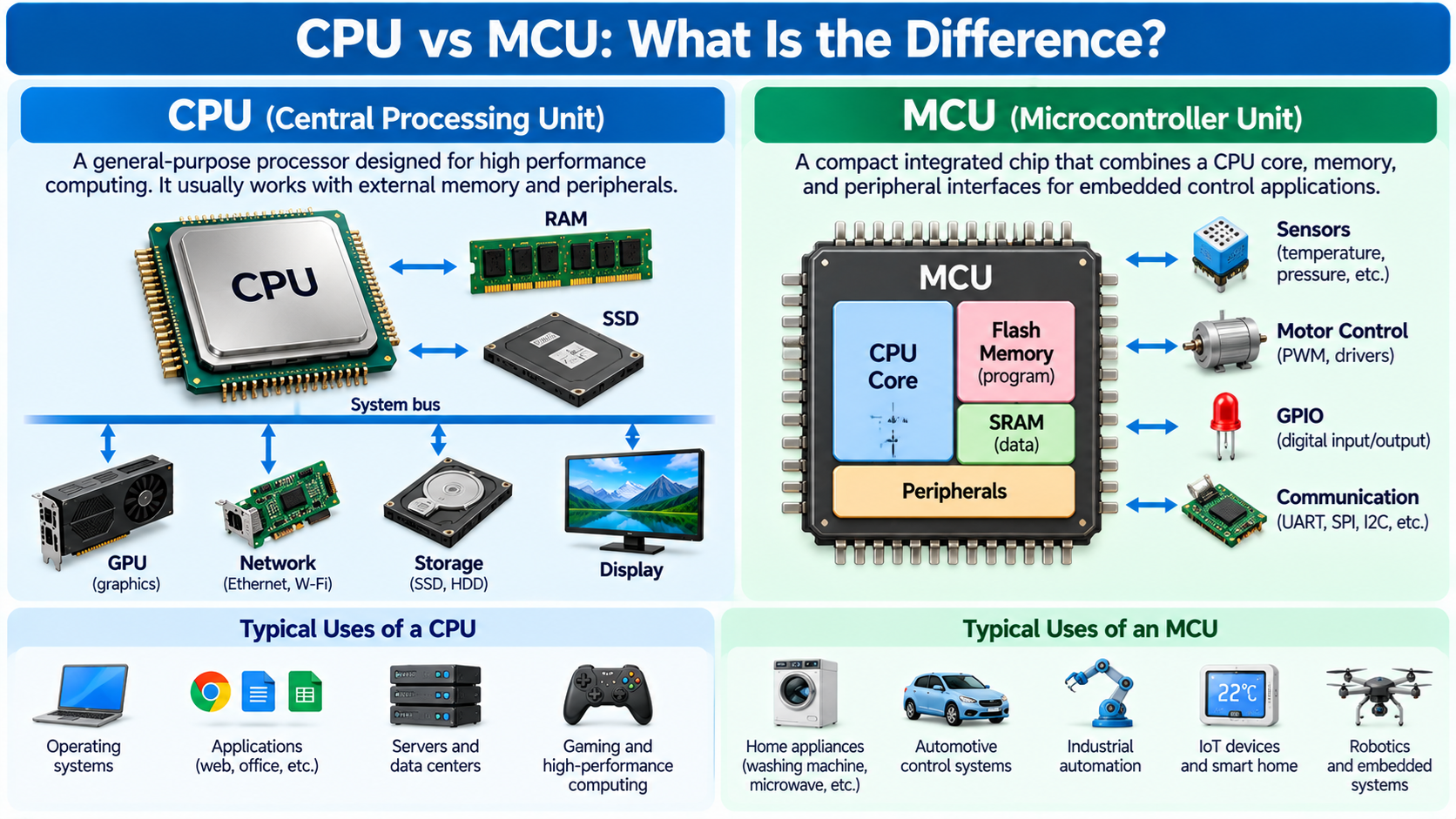
It typically combines a CPU core, memory, and peripheral interfaces into a single chip.
Microcontrollers are widely used in household appliances, automobiles, industrial equipment, medical devices, sensors, and Internet of Things (IoT) products.
For example, a washing machine may contain an MCU that reads water-level sensors, controls a motor, monitors temperature, and manages washing cycles.
A thermostat may use an MCU to measure temperature and control heating or cooling equipment.
Unlike a desktop computer processor, an MCU is generally designed to perform specific control tasks with relatively low cost, low power consumption, and minimal external hardware.
Many microcontrollers can operate without an external RAM chip or a separate storage device because they include memory directly on the chip.
The most important feature of an MCU is integration. It combines processing, memory, and hardware control functions into one compact device.
2. What Is Inside a Microcontroller?
A typical microcontroller contains several important components.
The CPU core executes machine instructions and performs arithmetic and logical operations.
Flash memory commonly stores the firmware, which is the software program controlling the device.
SRAM stores temporary data, variables, and runtime information.
GPIO, or General-Purpose Input/Output, allows the MCU to read digital signals and control external devices.
Timers and counters support timing operations, event measurement, and pulse generation.
Communication interfaces such as UART, SPI, and I2C allow the MCU to exchange information with sensors and other electronic components.
Many MCUs also contain analog-to-digital converters, or ADCs, which convert analog voltages into digital values.
Some include PWM controllers, digital-to-analog converters, watchdog timers, and other specialized peripherals.
Not every microcontroller includes all these features. The exact combination depends on the manufacturer and application.
3. How Does a Microcontroller Work?
A microcontroller operates by executing firmware stored in its memory.
When power is applied, the MCU begins executing instructions from an architecture-defined startup location or boot mechanism.
The firmware initializes the hardware and configures the peripherals required by the application.
For example, consider a temperature-control system.
A sensor measures the temperature and provides an electrical signal.
The MCU reads the sensor using an appropriate digital interface or ADC.
Its CPU core processes the measurement and compares it with a desired temperature.
If the temperature is too high, the firmware may activate a fan through a suitable driver circuit.
When the temperature falls, the MCU may reduce the fan speed or turn it off.
This process can repeat continuously.
The MCU therefore combines computation with direct control of external hardware.
4. What Is the Difference Between an MCU and a CPU?
The CPU and MCU are closely related, but they describe different concepts.
A CPU is a processing unit that executes machine instructions.
An MCU is an integrated circuit containing a CPU core along with memory and peripheral hardware.
For example, a desktop CPU is designed for general-purpose computing. It commonly works with external DRAM, storage devices, and other system components.
A microcontroller is usually designed for embedded applications that require relatively simple and predictable control operations.
It may contain everything needed to execute its firmware, including program memory, SRAM, timers, and communication interfaces.
Desktop and server CPUs often provide high computational performance, advanced caching, virtual memory, and sophisticated execution architectures.
MCUs typically emphasize low power consumption, low cost, direct hardware control, and compact system design.
However, these are common design patterns rather than absolute rules. Some modern MCUs are powerful, and many modern application processors integrate numerous peripherals.
The key distinction is that a CPU is a processing unit, while an MCU is a complete embedded-control device built around a CPU core.
5. What Is the Difference Between an MCU and an MPU?
MPU commonly stands for Microprocessor Unit.
In embedded system discussions, an MPU generally refers to a processor intended to operate with a more extensive external memory and system environment.
For example, an application processor running Linux may use external DRAM and support virtual memory, complex operating systems, and multiple applications.
An MCU commonly includes on-chip program memory, SRAM, and control peripherals.
Many MCUs execute firmware directly without requiring a full desktop-style operating system.
However, the distinction is not always strict.
Some microcontrollers support memory protection, external memory, and real-time operating systems.
Some microprocessors also integrate substantial memory and peripheral functions.
The appropriate classification depends on the product architecture and intended application.
6. What Is Firmware?
Firmware is software designed to control hardware devices.
In many microcontrollers, firmware is stored in nonvolatile flash memory.
Unlike an ordinary desktop application, MCU firmware often interacts directly with hardware registers and peripherals.
For example, firmware may configure GPIO pins, read sensor values, control timers, or communicate with external chips.
Firmware is commonly written in C or C++, although Rust, assembly language, and other languages can also be used.
A microcontroller program may run continuously while power is available.
Some MCUs execute a simple main loop.
Others use interrupts, scheduled tasks, or a real-time operating system to coordinate different activities.
The firmware determines the behavior of the device, while the MCU provides the electronic hardware needed to execute it.
7. What Are GPIO Pins?
GPIO stands for General-Purpose Input/Output.
GPIO pins allow a microcontroller to exchange digital signals with external circuits.
A GPIO pin configured as an input can read a suitable electrical logic level.
For example, it may detect whether a button is pressed.
A GPIO pin configured as an output can drive a digital signal.
For example, it may turn an LED on or off through an appropriate circuit.
Some GPIO pins support additional functions such as UART, SPI, I2C, or PWM.
However, microcontroller pins have electrical limitations.
They cannot necessarily drive motors, relays, or high-power devices directly.
Such loads often require external transistors, driver ICs, and protective components.
Understanding GPIO is one of the easiest ways to begin learning embedded programming.
8. What Are Timers, PWM, and Interrupts?
Microcontrollers often include dedicated hardware timers.
A timer can count clock cycles, measure time intervals, or generate periodic events.
For example, a timer may trigger an operation every millisecond.
PWM stands for Pulse Width Modulation.
PWM generates a periodic signal whose duty cycle can be controlled.
It is commonly used for LED brightness control, motor control, and other applications.
An interrupt allows certain events to request processor attention.
For example, a timer expiration or incoming communication event may trigger an interrupt.
The MCU then executes an appropriate interrupt handler according to its architecture and firmware configuration.
Timers, PWM, and interrupts allow microcontrollers to respond to external events and perform timing-related tasks without relying entirely on continuously checking every device in software.
9. What Are UART, SPI, and I2C?
Microcontrollers commonly communicate with other electronic devices using standard serial interfaces.
UART stands for Universal Asynchronous Receiver/Transmitter.
It provides asynchronous serial communication and is widely used for debugging, terminal connections, and communication with other devices.
SPI stands for Serial Peripheral Interface. It commonly uses synchronous clocked communication between a controller and peripheral devices.
SPI is frequently used with sensors, displays, and external memory devices.
I2C stands for Inter-Integrated Circuit. It uses two principal signal lines, commonly called SDA and SCL, to communicate with compatible devices.
I2C is useful for connecting sensors, configuration devices, and other relatively low-bandwidth peripherals.
The appropriate interface depends on required bandwidth, wiring, device compatibility, and other system requirements.
These interfaces are important because an MCU rarely works completely alone. It usually communicates with sensors, drivers, displays, or other integrated circuits.
10. What Is an ADC in a Microcontroller?
ADC stands for Analog-to-Digital Converter.
An ADC converts an analog electrical signal into a digital numerical representation.
Many sensors produce continuously varying voltages.
For example, a temperature sensor may output a voltage related to the measured temperature.
A CPU executes digital instructions and generally needs the analog signal to be converted into a numerical value before processing it.
An MCU with an integrated ADC can perform this conversion internally.
For example, a 12-bit ADC provides 4,096 possible digital output codes.
The actual voltage represented by a particular code depends on the ADC reference voltage and configuration.
ADC accuracy also depends on factors such as noise, reference stability, sampling behavior, and converter characteristics.
Integrated ADCs make microcontrollers especially useful for measurement and control applications.
11. What Is a Real-Time Operating System?
A Real-Time Operating System, commonly abbreviated RTOS, is an operating system designed to support tasks with defined timing requirements.
Many microcontrollers operate without an operating system.
Their firmware may simply execute a continuous loop and respond to interrupts.
However, more complex embedded systems may contain several tasks that need coordinated execution.
For example, a controller may simultaneously monitor sensors, handle communication, update a display, and control a motor.
An RTOS can help manage task scheduling, synchronization, timers, and communication between tasks.
Examples of embedded real-time operating systems include FreeRTOS and Zephyr.
The term real-time does not necessarily mean that the processor is extremely fast.
It means that timing behavior and deadlines are important to correct system operation.
An MCU can therefore operate with bare-metal firmware or an RTOS, depending on the application.
12. What Are Common Microcontroller Architectures?
Microcontrollers use different CPU instruction set architectures.
Arm Cortex-M processors are widely used in embedded systems.
Many microcontrollers also use RISC-V cores.
Other important families include AVR, PIC, MSP430, and various proprietary or specialized architectures.
For example, the ATmega328P is an AVR-based microcontroller widely known through older Arduino Uno boards.
The ESP32 family includes microcontrollers designed for embedded and connected applications, with processor architecture and peripheral features varying by model.
STMicroelectronics produces STM32 microcontrollers using Arm Cortex-M and other supported processor cores across its product families.
Different architectures provide different instruction sets, performance characteristics, development tools, and hardware capabilities.
The choice of an MCU depends on the application rather than the instruction set name alone.
13. Where Are Microcontrollers Used?
Microcontrollers are used wherever electronic devices need programmable control.
In household appliances, they manage washing cycles, temperature settings, buttons, displays, and other functions.
In automobiles, microcontrollers support many control systems, including sensors, motor control, body electronics, and communication interfaces.
In industrial equipment, they read sensors, control actuators, and communicate with other controllers.
In medical and measurement devices, they acquire sensor data and manage embedded functions.
In IoT products, microcontrollers can collect information and communicate through wired or wireless interfaces.
In robotics, they may control motors, read encoders, and process sensor inputs.
Many electronic products contain one or more microcontrollers even when they do not appear to be computers.
This is why MCUs are essential to modern embedded systems.
14. Why Do Microcontrollers Consume Less Power?
Many microcontrollers are designed to operate with limited electrical power.
They often use relatively modest clock frequencies, compact processing cores, and tightly integrated peripherals.
Some MCUs can enter low-power sleep modes when full processing performance is unnecessary.
For example, a battery-powered sensor may wake periodically, measure a value, transmit information, and return to sleep.
This reduces average power consumption.
However, not every MCU consumes less power than every CPU.
Power depends on architecture, frequency, voltage, active peripherals, sleep modes, and workload.
A powerful MCU operating continuously at high utilization may consume much more energy than a small processor operating efficiently in a low-power system.
The important advantage is that MCU designs often provide hardware features suited to energy-constrained embedded applications.
15. Can a Microcontroller Run Linux?
Most small microcontrollers do not run conventional full-featured Linux systems.
A typical Linux system expects a suitable processor architecture, sufficient memory, and supporting hardware.
Conventional Linux deployments also commonly rely on memory management capabilities that are absent from many small MCU designs.
However, some embedded processors and SoCs can run Linux.
Certain specialized configurations can also run Linux without a conventional MMU, although they have important limitations and different software requirements.
For small microcontrollers, bare-metal firmware or an RTOS is often more practical.
For example, a simple sensor controller may require only a few kilobytes of program and runtime memory.
A Linux-based embedded system generally needs substantially more resources and supporting software.
The distinction depends on hardware capabilities and system requirements, not merely on whether a device is called an MCU.
16. Can a Microcontroller Replace a Desktop CPU?
A microcontroller can perform many computing tasks, but it is not normally a direct replacement for a desktop CPU.
Desktop processors are designed to run complex operating systems and applications.
They commonly support large memory systems, sophisticated caches, virtual memory, and high computational throughput.
Microcontrollers are generally optimized for embedded control.
For example, an MCU can read a temperature sensor and control a fan efficiently.
However, running a modern desktop browser, multiple demanding applications, and a full graphical operating system usually requires much greater processing and memory resources.
Conversely, using a powerful desktop CPU to control one small sensor may be unnecessary and inefficient.
The correct processor depends on the work the device needs to perform.
17. How Do You Program a Microcontroller?
Microcontrollers are programmed using firmware development tools.
A typical workflow begins by selecting an MCU and understanding its hardware capabilities.
The developer writes firmware using a language such as C, C++, or Rust.
The source code is compiled into machine instructions compatible with the MCU’s processor architecture.
The resulting firmware image is transferred to the microcontroller using an appropriate programming interface.
Common development and debugging interfaces include JTAG and Serial Wire Debug, or SWD, depending on the device.
Some microcontrollers also support bootloaders that allow firmware updates through USB, UART, or other interfaces.
After programming, the MCU executes the firmware when it starts.
Developers can use debugging tools to inspect registers, memory, and program execution.
18. A Simple MCU Project: Blinking an LED
One of the easiest microcontroller projects is blinking an LED.
The project demonstrates how firmware controls physical hardware.
First, connect an LED through an appropriate current-limiting resistor to a suitable GPIO pin, following the development board’s electrical requirements.
Next, configure the GPIO pin as a digital output.
The firmware drives the output to the required logical state.
After a delay, the program changes the output state.
Repeating the sequence causes the LED to blink.
Although this example is simple, it demonstrates several important concepts.
The CPU executes firmware instructions.
The GPIO peripheral controls an external electrical signal.
A timer or delay mechanism determines when the output changes.
This project connects software execution with physical electronic behavior and provides a foundation for more advanced embedded systems.
19. How Do You Choose a Microcontroller?
Selecting an MCU begins with the application’s requirements.
First, determine how much processing performance is needed.
Next, estimate program memory and RAM requirements.
Review the number of GPIO pins and required peripherals.
For example, a design may need several UART interfaces, an SPI connection, PWM channels, or ADC inputs.
Power consumption is important for battery-powered devices.
Operating voltage, temperature range, packaging, cost, and component availability also matter.
Development tools and software support are important practical considerations.
For example, a microcontroller with good documentation, debugging support, and available libraries may reduce development time.
The most advanced or fastest MCU is not automatically the best choice.
The best microcontroller is the one that meets the system’s requirements with suitable cost, reliability, and development complexity.
20. Common Misunderstandings About MCUs
One common misunderstanding is that an MCU and CPU are completely different technologies. In reality, an MCU normally contains a CPU core.
Another misconception is that microcontrollers cannot perform complex calculations. Many modern MCUs support floating-point arithmetic, DSP instructions, and other advanced capabilities, although performance varies widely.
Some people assume that all microcontrollers use 8-bit processors. Modern MCUs include 8-bit, 16-bit, and 32-bit architectures, among others.
Another misunderstanding is that microcontrollers always require an operating system. Many operate successfully using bare-metal firmware.
It is also incorrect to assume that every MCU contains the same peripherals. The hardware configuration varies significantly among products.
Finally, microcontrollers are not used only in hobby electronics. They are essential components in industrial automation, automotive systems, medical equipment, and commercial electronic products.
21. Conclusion: MCU vs CPU — What Is the Real Difference?
An MCU, or Microcontroller Unit, is an integrated circuit designed primarily for embedded control applications.
It typically combines a CPU core, program memory, RAM, and peripheral interfaces in one chip.
A CPU, or Central Processing Unit, is the processing hardware responsible for executing machine instructions.
Modern desktop and server CPUs generally emphasize computational performance and support complex operating systems and applications.
Microcontrollers commonly emphasize low cost, low power consumption, compact integration, and direct interaction with electronic hardware.
For example, a desktop CPU may run a web browser or compile software, while an MCU may read sensors, control motors, or manage a household appliance.
However, both use the same fundamental principles of digital computation.
The most important principle is simple: a CPU executes instructions, while a microcontroller combines a CPU with memory and hardware peripherals to create a compact, programmable control system.
Understanding microcontrollers provides a foundation for embedded programming, robotics, industrial automation, IoT development, digital electronics, and modern computer hardware.