Machine learning is one of the most important technologies behind modern artificial intelligence.
It is used in spam filters, recommendation systems, fraud detection, image recognition, speech recognition, autonomous vehicles, search engines, and many other applications.
But what does machine learning actually mean?
Does a computer really learn?
And how is machine learning different from ordinary programming?
The basic idea is surprisingly simple.
Instead of writing every rule ourselves, we give a computer examples and use an algorithm to find useful patterns in those examples.
The result is something called a model.
Let’s see how this works.
1. Traditional Programming Uses Rules
To understand machine learning, it helps to begin with traditional programming.
In ordinary programming, a programmer usually defines the rules that a computer should follow.
Conceptually, we can think of it like this:
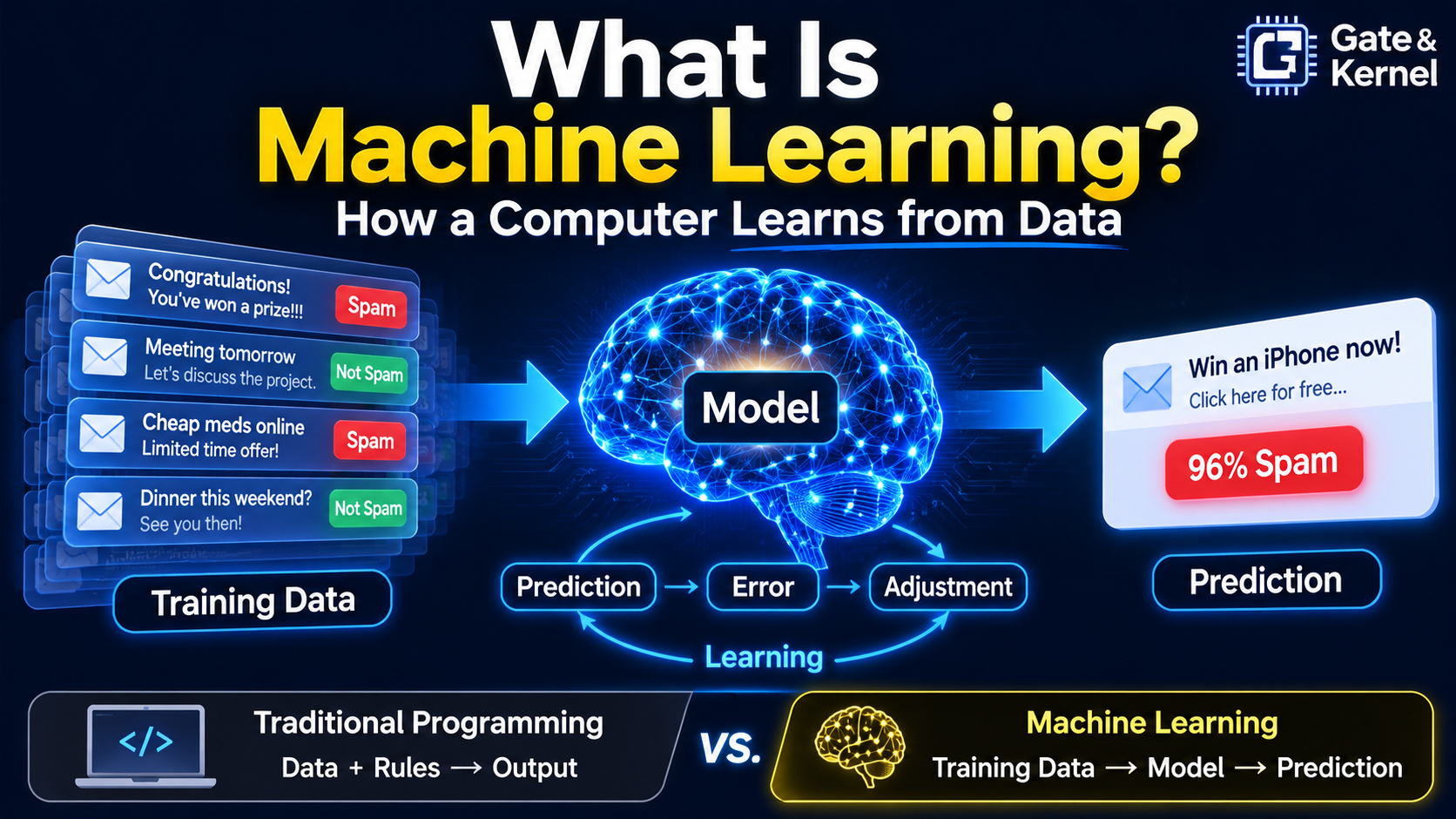
Data + Rules → Output
Suppose we want to determine whether a number is even.
A programmer can write a simple rule:
If the number can be divided by 2 with no remainder, it is even.
The computer executes that rule.
There is no learning involved.
The programmer already knows the rule and tells the computer exactly what to do.
This approach works extremely well when the rules are clear.
But many real-world problems are not so easy.
2. Some Problems Are Difficult to Describe with Rules
Imagine that we want to build a program that detects spam email.
We could try writing thousands of rules.
For example:
If an email contains certain words, increase its spam score.
If it contains many suspicious links, increase the score again.
If the sender is unknown, perhaps increase it further.
But real email is complicated.
Spammers constantly change their messages.
Legitimate emails can also contain words that look suspicious.
Writing enough rules to cover every possible situation becomes extremely difficult.
This is where machine learning becomes useful.
Instead of trying to describe every rule ourselves, we can allow an algorithm to discover patterns from data.
3. Machine Learning Learns from Examples
Suppose we collect thousands or millions of emails.
Some are labeled:
Spam
Others are labeled:
Not Spam
These examples become training data.
A machine learning algorithm examines the data and looks for patterns that help distinguish the two groups.
Conceptually:
Training Data → Learning Algorithm → Model
The important result of training is the model.
The model contains numerical relationships learned from the training data.
Once training is complete, we can give the model an email it has never seen before.
The process now becomes:
New Data → Model → Prediction
For example:
New Email → Model → 96% Probability of Spam
The program did not need a programmer to explicitly write every possible spam rule.
Instead, the model learned useful patterns from examples.
That is the central idea behind machine learning.
4. What Does “Learning” Actually Mean?
The word learning can sometimes make machine learning sound mysterious.
But a computer does not learn in exactly the same way a human does.
At a basic level, machine learning is a mathematical optimization process.
During training, a model makes predictions.
Those predictions are compared with the expected results.
If the prediction is wrong, the system measures the error.
It then adjusts numerical values inside the model to try to reduce that error.
The basic cycle looks like this:
Prediction → Error → Adjustment → New Prediction
This process may repeat thousands, millions, or even billions of times.
Gradually, the model becomes better at producing useful predictions.
The numerical values being adjusted are often called parameters.
So when we say that a machine learning system is “learning,” we usually mean that it is adjusting parameters based on data so that its predictions become better.
There is no magic involved.
It is computation, mathematics, data, and optimization.
5. Training and Using a Model Are Different
There are two important stages in machine learning.
The first is training.
During training, the system processes training data and adjusts the model.
Training can require a large amount of computation because the system may process enormous datasets and repeatedly update many parameters.
The second stage is usually called inference.
Inference happens after the model has been trained.
Now we provide new input and ask the model to produce a prediction.
For our spam example:
Training:
Millions of labeled emails → Learning → Spam Detection Model
Inference:
New email → Trained Model → Spam or Not Spam
This distinction between training and inference appears throughout modern machine learning.
6. Major Types of Machine Learning
Machine learning includes several different approaches.
One of the most common is supervised learning.
In supervised learning, training examples include expected answers.
Our spam example is supervised learning because the training emails are labeled as spam or not spam.
Another approach is unsupervised learning.
Here, the data does not necessarily contain predefined answers.
Instead, the algorithm tries to discover useful structures, similarities, or groups within the data.
A third approach is reinforcement learning.
In reinforcement learning, a system learns through actions and feedback.
Actions that produce desirable results can receive rewards, while poor actions may receive lower rewards.
These approaches solve different kinds of problems, but they share the same broad idea:
The system improves its behavior by learning from data or experience rather than depending entirely on manually written rules.
7. Machine Learning, Deep Learning, and AI
The terms artificial intelligence, machine learning, and deep learning are often used as if they mean the same thing.
They do not.
Artificial intelligence is the broadest concept.
It describes computer systems designed to perform tasks that we associate with intelligent behavior.
Machine learning is one approach to building artificial intelligence.
Instead of manually programming every behavior, machine learning systems learn patterns from data.
Deep learning is a further category within machine learning.
Deep learning generally uses neural networks with many layers to learn complex patterns.
Conceptually:
Artificial Intelligence
↓
Machine Learning
↓
Deep Learning
Large language models, modern image-generation systems, speech recognition systems, and many other modern AI technologies rely heavily on deep learning.
But the fundamental machine learning idea remains the same:
Learn useful patterns from data and use those patterns to make predictions or decisions.
8. Why Machine Learning Matters
Traditional programming is still essential.
If a problem has clear and reliable rules, writing those rules directly may be the best solution.
Machine learning becomes especially useful when the patterns are too complicated to describe manually.
Consider tasks such as:
Recognizing a face.
Understanding spoken language.
Detecting unusual financial transactions.
Recommending a movie.
Identifying objects in an image.
Predicting whether an email is spam.
For these problems, writing every possible rule manually can be extremely difficult.
Machine learning provides another approach.
Instead of asking:
What rules should the programmer write?
we can ask:
What patterns can the computer learn from the data?
That change in thinking is one of the most important ideas behind modern artificial intelligence.
Conclusion
Machine learning may sound complicated, but its fundamental idea is straightforward.
In traditional programming:
Data + Rules → Output
The programmer provides the rules.
In machine learning:
Training Data → Learning Algorithm → Model
The algorithm uses examples to build a model.
Once the model has been trained:
New Data → Model → Prediction
Learning does not mean that the computer suddenly thinks like a human.
It means that mathematical parameters inside a model are adjusted using data so that the model becomes better at performing a particular task.
From spam filters and recommendation systems to computer vision and modern generative AI, this simple idea has become one of the foundations of modern computing.
And once we understand this basic idea, we can begin asking the next question:
What exactly is a machine learning model?