==================================================
1. Registers
Registers are tiny, very fast storage locations inside the CPU.
RV32I has 32 integer registers:
- x0 to x31
Each register is 32 bits wide.
You can think of registers as named boxes that hold values the CPU is actively using.
==================================================
2. Register Diagram
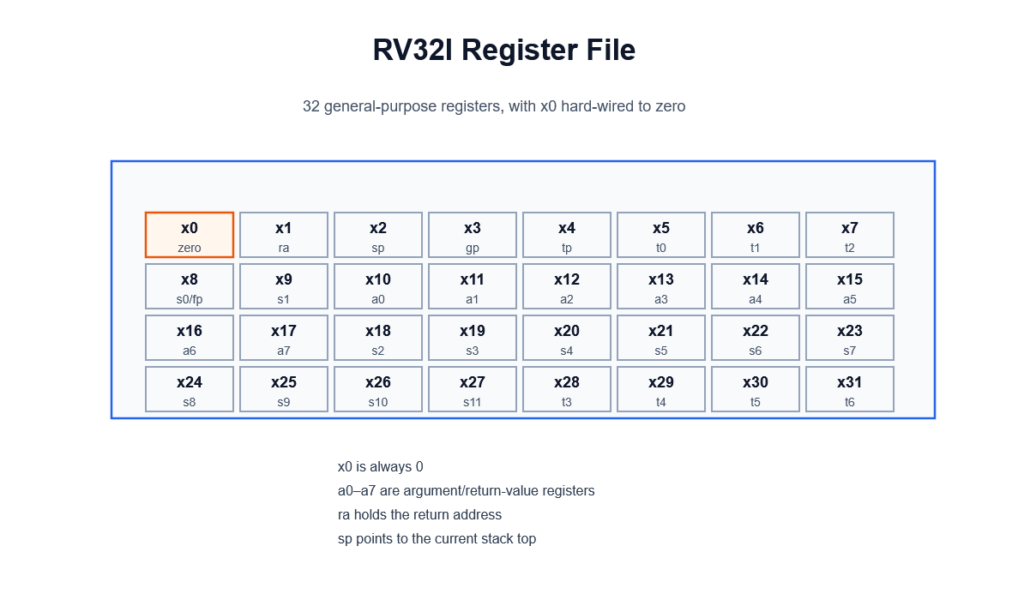
+---------------------------------------------+
| Register File                               |
+---------------------------------------------+
| x0  | x1  | x2  | x3  | ... | x30 | x31    |
+---------------------------------------------+
Each box stores one 32-bit value.
==================================================
3. Important Rule: x0 is Always Zero
x0 is special.
- Reading x0 always gives 0
- Writing to x0 has no effect
Examples:
addi x5, x0, 9     # x5 = 9
addi x0, x0, 7     # ignored, x0 stays 0
This makes x0 extremely useful.
==================================================
4. ABI Names
Registers also have ABI names used by programmers and compilers.
Common ones:
x0 = zero constant zero
x1 = ra return address
x2 = sp stack pointer
x5 = t0 temporary
x6 = t1 temporary
x7 = t2 temporary
x8 = s0/fp saved register / frame pointer
x9 = s1 saved register
x10 = a0 function argument / return value
x11 = a1 function argument / return value
x12 = a2
x13 = a3
x14 = a4
x15 = a5
x16 = a6
x17 = a7
You can write either x10 or a0 depending on style.
==================================================
5. Register Roles
Very simplified categories:
- zero register:
x0 - temporaries:
t0-t6
used for temporary calculations - saved registers:
s0-s11
preserved across function calls - argument / return registers:
a0-a7
used to pass inputs and outputs - special:
ra, sp
==================================================
6. CPU Datapath Idea
A simplified view:
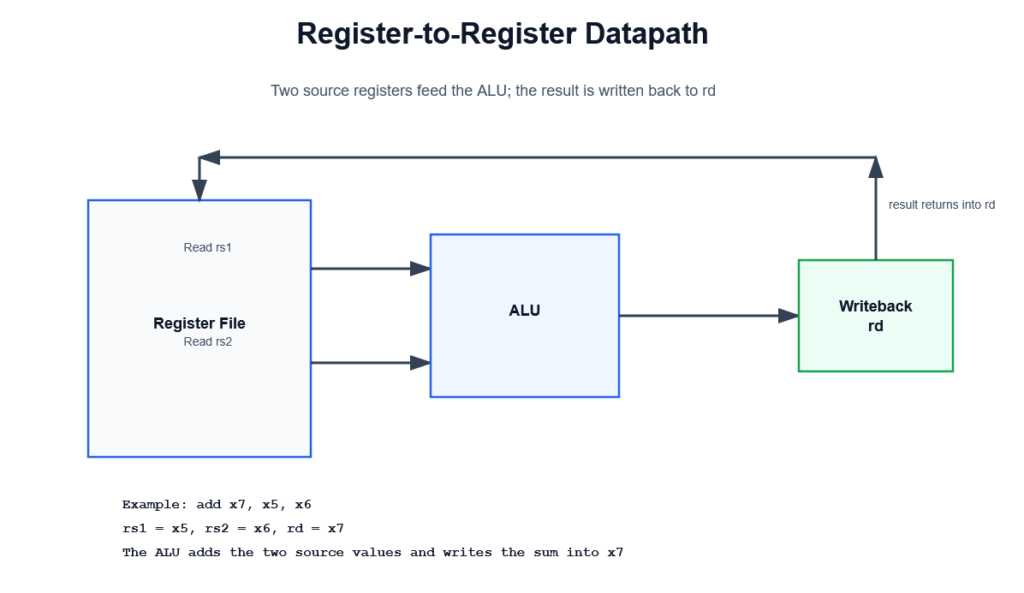
The CPU reads source registers, performs an operation, then may write the result back to a destination register.
==================================================
7. Example: Using Registers
Code:
addi x5, x0, 3
addi x6, x0, 7
add  x7, x5, x6
Meaning:
- x5 = 3
- x6 = 7
- x7 = 10
==================================================
8. Step-by-Step Execution Trace
Initial:
x0 = 0
x5 = 0
x6 = 0
x7 = 0
Step 1
Instruction = addi x5, x0, 3
Read:
- x0 = 0
Compute: - 0 + 3 = 3
Write: - x5 = 3
Step 2
Instruction = addi x6, x0, 7
Read:
- x0 = 0
Compute: - 0 + 7 = 7
Write: - x6 = 7
Step 3
Instruction = add x7, x5, x6
Read:
- x5 = 3
- x6 = 7
Compute: - 3 + 7 = 10
Write: - x7 = 10
==================================================
9. Register Data Dependency
Notice the third instruction depends on earlier results.
addi x5, x0, 3
addi x6, x0, 7
add  x7, x5, x6
The add instruction needs the values produced by the first two instructions.
This idea becomes important later in pipeline hazards.
==================================================
10. Signed Integers
RV32I registers hold 32-bit patterns.
Those patterns may be interpreted as:
- signed integers
- unsigned integers
- memory addresses
- bit patterns
For signed values, two’s complement is used.
Examples:
- 0x00000005 = 5
- 0xFFFFFFFF = -1
- 0xFFFFFFFE = -2
==================================================
11. Common Beginner Mistakes
Mistake 1:
Thinking x0 can store a value.
It cannot.
Mistake 2:
Confusing register names and memory addresses.
Registers are inside the CPU; memory is outside the register file.
Mistake 3:
Assuming all registers are automatically preserved across function calls.
Only some are saved by convention.
==================================================
12. Exercises
- How many integer registers are in RV32I?
- What value is always read from x0?
- What happens if you execute:
addi x0, x0, 12 - Which register is the stack pointer?
- Which register usually stores a return address?
- What is the value of x7 after:
addi x5, x0, 8
addi x6, x0, 2
sub x7, x5, x6 - Write a 2-instruction sequence that puts 20 into x9 using x0.
- Why are registers faster than memory?
==================================================
13. Exercise Answers
- 32
- 0
- Nothing changes; x0 stays 0.
- x2, also called sp
- x1, also called ra
- 6
- Example:
addi x9, x0, 10
addi x9, x9, 10 - Because registers are built directly into the CPU and are designed for very fast access.