Operating systems are the fundamental layer that connects hardware and software in any computing system. From personal computers to cloud servers and embedded devices, every modern system relies on an operating system to function correctly. Among all operating systems, Linux and Windows represent two dominant yet fundamentally different approaches to system design. Rather than simply asking “which one is better,” it is far more valuable to understand how they evolved, how they are built, and why they dominate different parts of the computing world today.
This article provides a structured, teaching-oriented explanation that combines historical context, system architecture, and engineering practice, helping readers build a deep and practical understanding of Linux and Windows.
1. Historical Origins: Two Completely Different Paths
To truly understand the differences between Linux and Windows, we must begin with their origins, because design philosophy is often shaped by history.
Windows traces its roots back to the 1980s, when Microsoft introduced graphical environments on top of MS-DOS. Over time, Windows evolved into a fully integrated operating system, with Windows 11 representing the latest stage of this development. From the very beginning, Windows was designed as a commercial product, focused on providing a consistent and user-friendly graphical interface for the mass market. Compatibility, ease of use, and application support have always been its primary goals.
Linux, on the other hand, began as a personal project. In 1991, Linus Torvalds started developing a Unix-like kernel as a learning exercise. What made Linux unique was not just the code itself, but the decision to release it as open-source software. Over time, it evolved into a global collaborative project, supported by thousands of developers worldwide. Unlike Windows, Linux was not designed for commercial dominance, but for freedom, flexibility, and technical excellence.
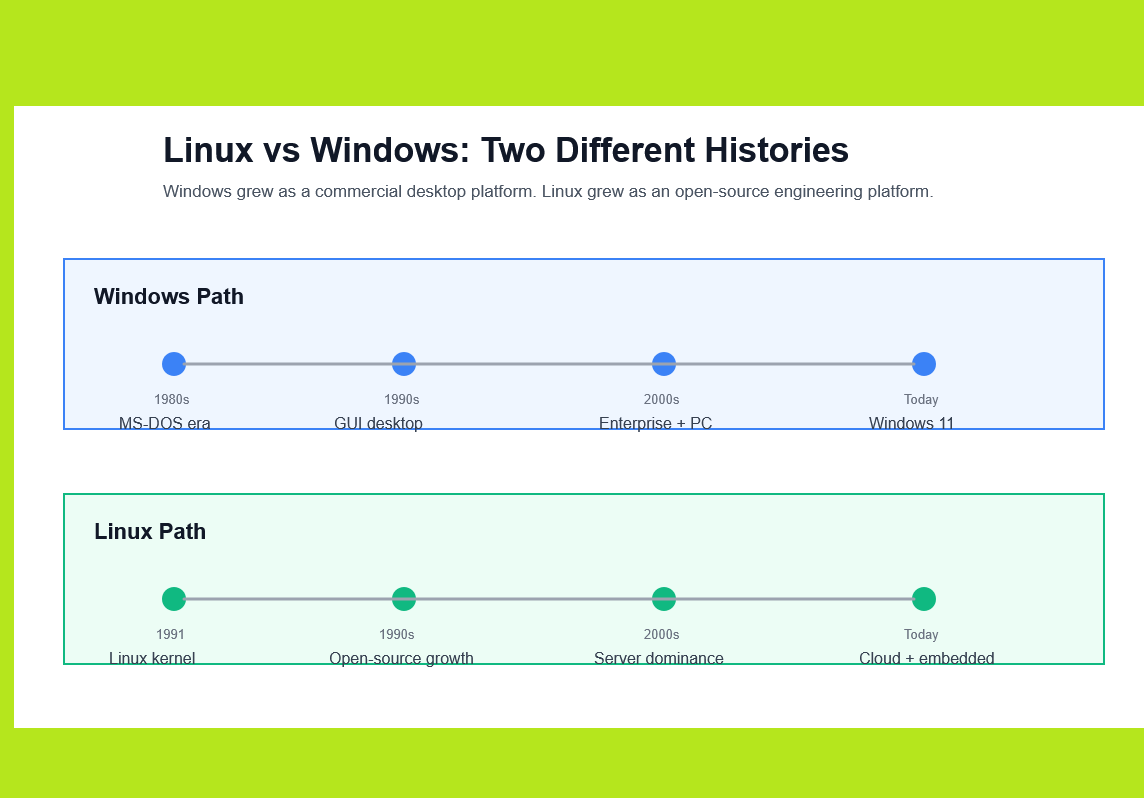
This divergence in origin led to two very different ecosystems:
- Windows → commercially driven, tightly controlled
- Linux → community-driven, open and extensible
2. Kernel Architecture: The Foundation of Everything
At the core of any operating system lies the kernel, which manages hardware resources and system operations. The architectural design of the kernel has profound implications for performance, stability, and flexibility.
Linux uses a monolithic kernel architecture, where core system services such as device drivers, file systems, and networking are all integrated into a single kernel space. This design allows for high performance and efficient communication between system components, making Linux particularly well-suited for servers and high-performance environments.
Windows, in contrast, employs a hybrid kernel architecture, combining elements of both monolithic and microkernel designs. This approach emphasizes modularity and compatibility, allowing Windows to support a wide range of hardware and software configurations.
Linux relies on a monolithic kernel, while Windows follows a structure closer to microkernel concepts.
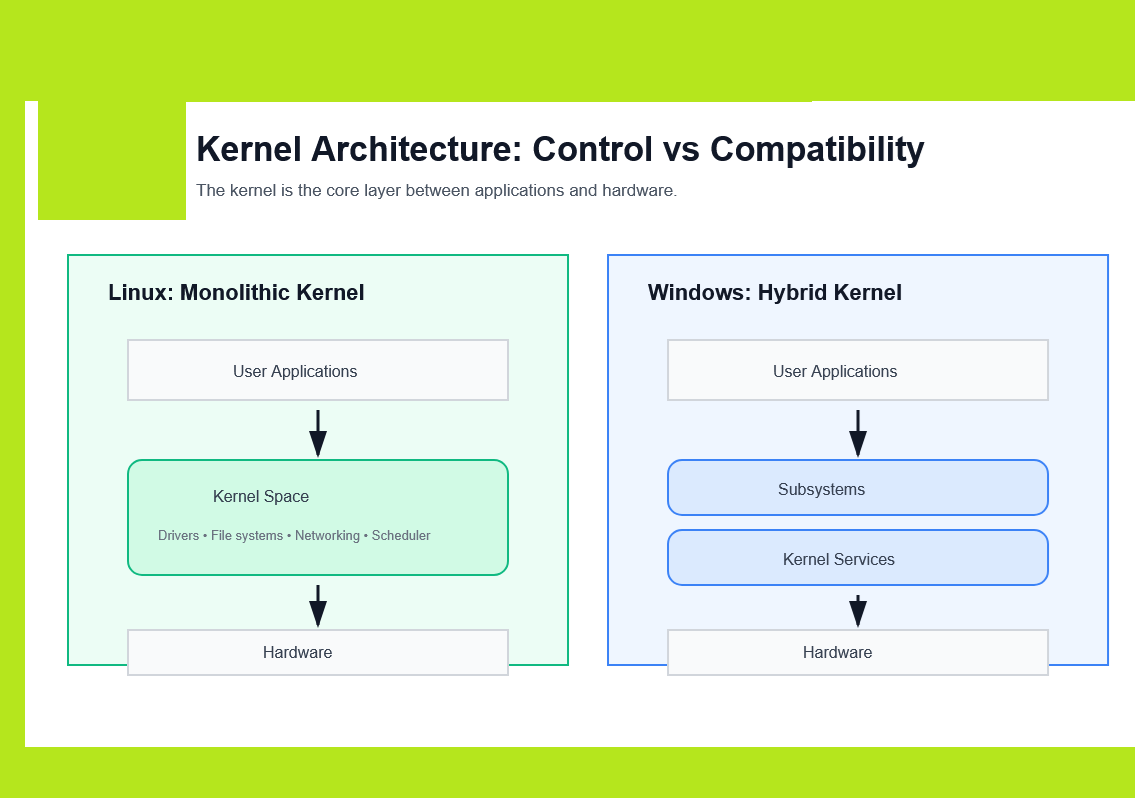
From an engineering perspective, this leads to an important insight:
Linux is optimized for performance and control,
while Windows is optimized for compatibility and usability.
3. Open Source vs Proprietary: Who Controls the System?
One of the most defining differences between Linux and Windows is their source model.
Linux is fully open-source, meaning that anyone can view, modify, and redistribute its source code. This allows users and organizations to tailor the operating system to their specific needs, whether that means building a lightweight embedded system or customizing a server environment.
Windows, by contrast, is proprietary software. Its source code is owned and controlled by Microsoft, and users have no access to modify the system at its core level. Updates, features, and system behavior are determined by the vendor.
Linux allows full system modification, while Windows does not permit changes to system files.
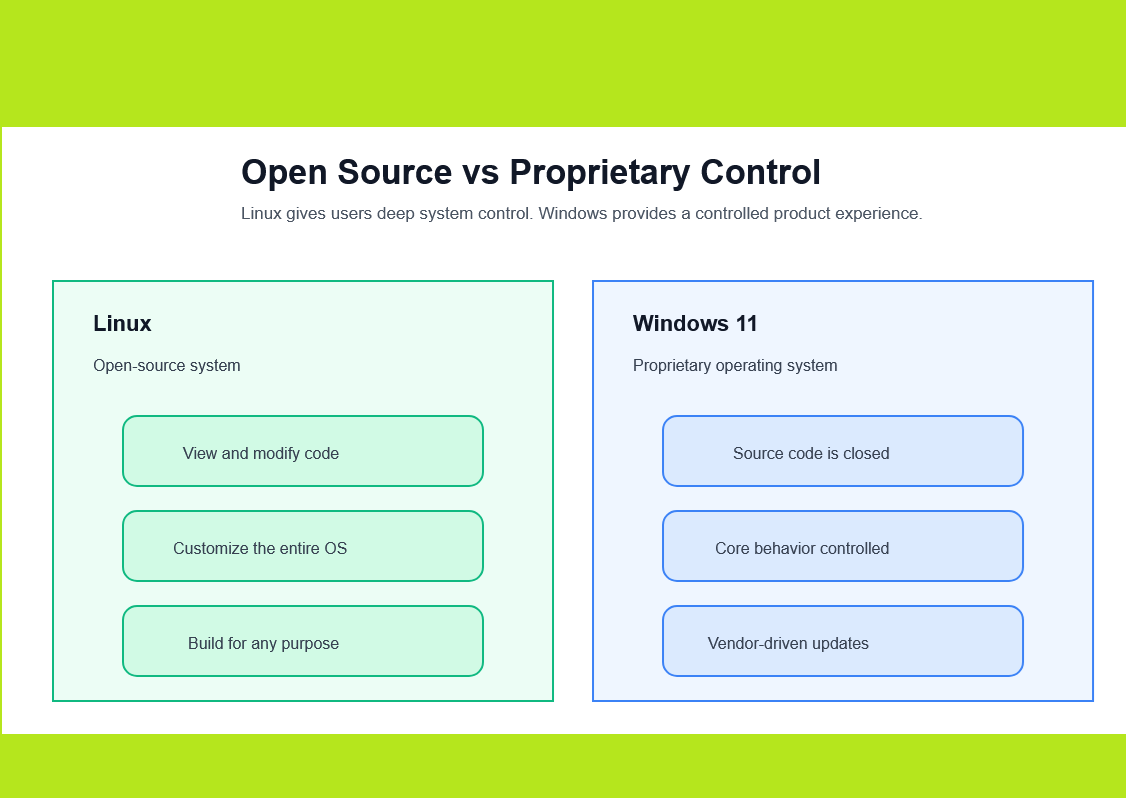
From a teaching standpoint, this difference can be summarized as:
Linux gives you control over the system,
Windows gives you a ready-to-use system.
4. Performance and Resource Efficiency
Performance is another area where Linux often demonstrates clear advantages, particularly in technical and server environments.
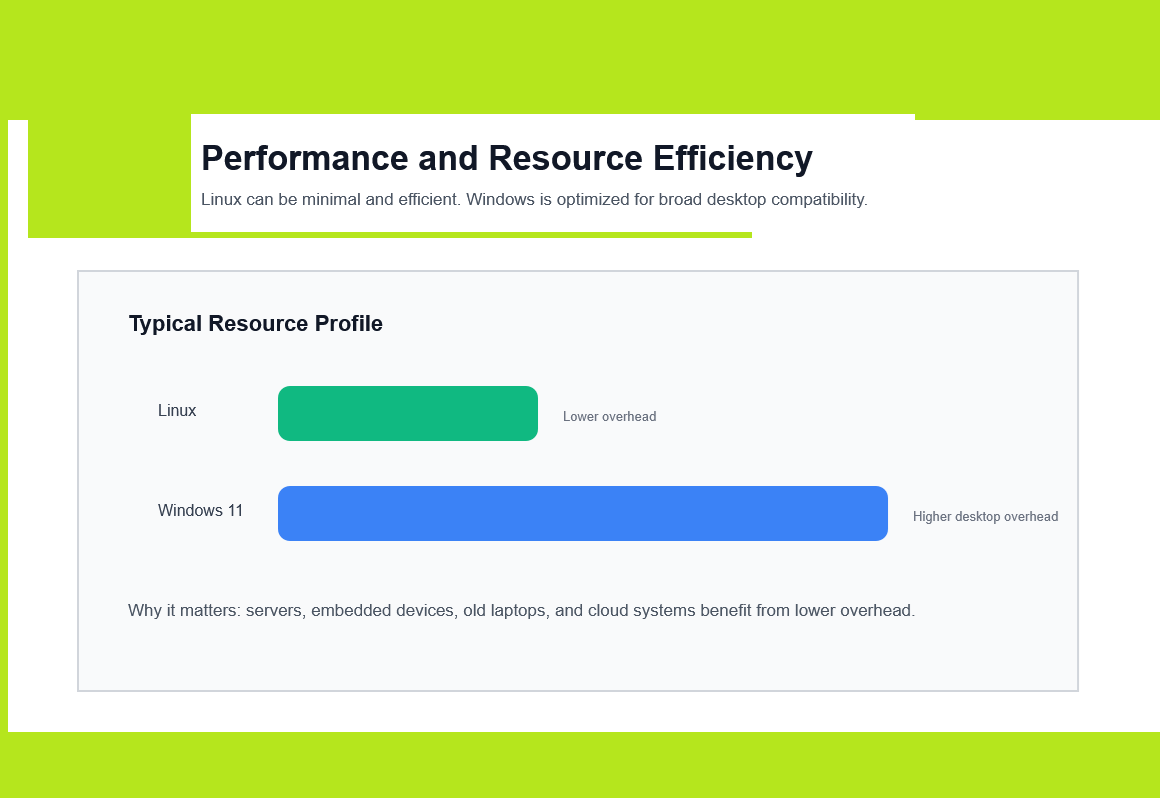
Linux can be highly optimized and stripped down to run on minimal hardware, making it ideal for:
- older computers
- embedded systems
- servers and cloud infrastructure
- high-performance computing clusters
Windows 11, while optimized for modern hardware, generally requires more system resources due to its graphical interface, background services, and broad compatibility requirements.
Your material also points out that Linux uses fewer resources and operates more efficiently, while Windows tends to consume more system resources.
This explains why:
- nearly all supercomputers run Linux
- most web servers run Linux
- many networking devices rely on Linux
5. Command-Line Philosophy: A Key Engineering Advantage
One of the most important conceptual differences between Linux and Windows lies in how users interact with the system.

Linux treats the command-line interface (CLI) as a central component of the operating system. Tools like Bash and Zsh allow users to automate tasks, manage systems, and build powerful workflows through scripting.
Windows, on the other hand, is primarily designed around the graphical user interface (GUI). While tools like PowerShell exist, they are not as deeply integrated into everyday usage as the Linux command line.
As your material indicates, the Linux CLI plays a critical role in system administration, while Windows relies more heavily on graphical tools.
From an educational perspective, this distinction is crucial:
Mastering the Linux CLI builds engineering capability,
while relying on GUI tools focuses on usability.
6. Security and Permission Model

Security is deeply influenced by system design, and Linux and Windows take different approaches.
Linux is built around a strict permission-based model, where:
- users operate with limited privileges by default
- administrative actions require explicit authorization
- file access is tightly controlled through permission bits
Windows has significantly improved its security over time, incorporating features like Windows Defender and regular updates. However, due to its widespread use and historical design decisions, it has traditionally been a more frequent target for malware.
Your material reflects this distinction, noting that Linux is generally considered more secure, while Windows has historically been more vulnerable.
This difference can be summarized as:
Linux prioritizes security by design,
Windows prioritizes accessibility and compatibility.
7. Software Ecosystem and User Experience
Despite Linux’s technical advantages, Windows remains dominant in desktop computing. This is largely due to its software ecosystem.
Windows supports a vast range of applications, including:
- Microsoft Office
- Adobe Creative Suite
- a wide variety of commercial software
- modern PC gaming (DirectX ecosystem)
Linux, while offering a rich collection of open-source tools, may lack native support for certain commercial applications, often requiring compatibility layers such as Wine.
Your material also highlights that Windows has broader software availability, especially for games and professional tools.
Thus, from a practical standpoint:
Linux excels in system-level capabilities,
Windows excels in application-level support.
8. Conclusion: Choosing the Right Tool
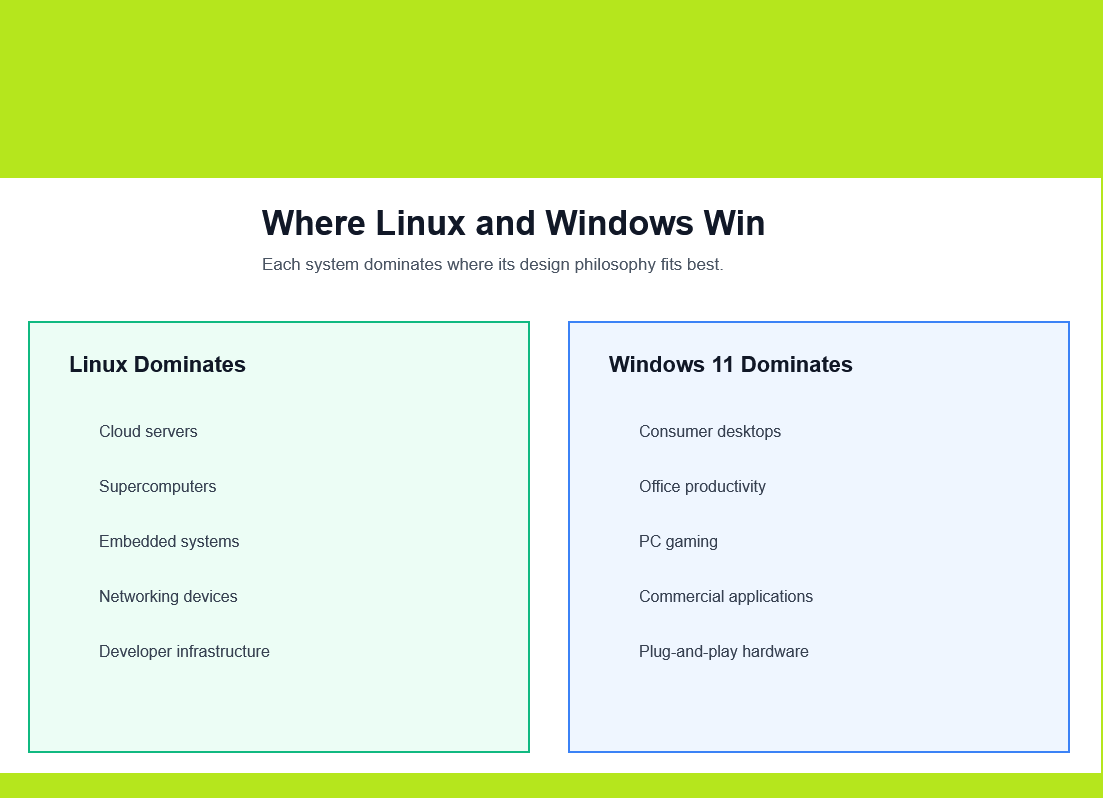
After examining history, architecture, performance, and ecosystem, it becomes clear that the question is not which operating system is universally better, but which one is more suitable for a given purpose.
Linux is the preferred choice for:
- developers and engineers
- server and cloud environments
- embedded systems and FPGA development
- users who value control and customization
Windows is better suited for:
- general desktop users
- office productivity
- gaming and multimedia
- users who prefer ease of use and compatibility
Ultimately, the difference reflects two contrasting philosophies:
Linux emphasizes freedom, control, and efficiency,
while Windows emphasizes usability, consistency, and ecosystem support.