Modern computing is largely built around two major processor architecture families.
Traditional desktop computers, gaming PCs, workstations, and many servers primarily use x86 processors. Smartphones, tablets, routers, development boards, and embedded systems mostly use ARM processors.
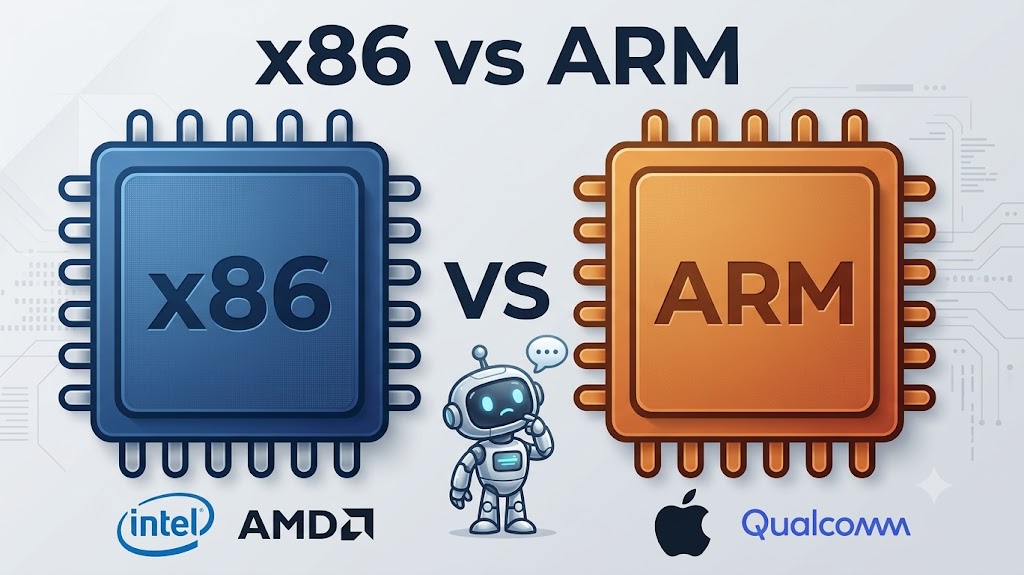
However, this boundary is becoming increasingly blurred.
Apple has moved the entire Mac product line to Apple Silicon. Qualcomm is promoting ARM-based Windows PCs. Amazon is deploying its own Graviton processors across its cloud infrastructure. At the same time, Intel and AMD continue to improve the power efficiency of x86 processors while integrating performance cores, efficiency cores, graphics processors, and neural processing units into increasingly sophisticated chips.
Therefore, the difference between x86 and ARM can no longer be summarized as:
x86 delivers high performance but consumes more power, while ARM is slower but more efficient.
That statement once contained some truth, but it no longer accurately describes modern processors.
To understand the real differences between x86 and ARM, we need to examine instruction sets, microarchitecture, chip integration, software ecosystems, compatibility, and business models.
1. What Is an Instruction Set Architecture?
A processor cannot directly understand C, C++, Python, Java, or other high-level programming languages.
A program must eventually be translated into machine instructions that the processor can execute.
These instructions may tell the processor to:
- Load data from memory into a register
- Add two numbers
- Compare two values
- Jump to another instruction
- Store a result back into memory
The specification that defines these instructions, registers, data types, memory-access rules, privilege levels, and exception behavior is called an Instruction Set Architecture, or ISA.
An ISA can be understood as a contract between software and hardware.
A compiler generates machine code according to this contract, and the processor executes that machine code according to the same contract.
x86 and ARM are different ISA families. A program compiled into x86 machine code normally cannot run directly on an ARM processor. Likewise, a native ARM executable cannot normally run directly on an x86 processor.
It is important to understand that:
An instruction set architecture is not the same thing as a processor chip.
x86 is an architecture family. Intel Core, Intel Xeon, AMD Ryzen, and AMD EPYC are processor families that implement versions of the x86 architecture.
ARM is also an architecture family. Apple M-series processors, Qualcomm Snapdragon chips, MediaTek processors, AWS Graviton CPUs, and many microcontrollers can all execute ARM instructions, but their internal designs and performance characteristics may be dramatically different.
2. How Did x86 Develop?
The history of x86 is usually traced back to Intel’s 8086 processor, introduced in 1978.
It was followed by the 8088, 80286, 80386, 80486, Pentium, and later Intel Core processors. AMD also developed compatible processors and introduced the 64-bit extension that became known as AMD64 or x86-64.
The defining characteristic of x86 is not merely that it has complex instructions.
Its most important characteristic is its strong commitment to backward compatibility.
For decades, Intel and AMD have added new registers, execution modes, and instruction extensions while attempting to preserve behavior required by older software.
This backward compatibility created the strongest advantage of x86: an enormous software ecosystem.
It includes:
- Windows desktop applications
- PC games
- Enterprise management systems
- Industrial control software
- CAD and engineering applications
- Virtualization platforms
- Long-running server applications
- Legacy business systems
However, compatibility also creates complexity.
Modern x86 processors must understand instruction formats, execution modes, and special behaviors that were introduced across several decades.
x86 instructions do not have a fixed length. An instruction can be as short as one byte and as long as 15 bytes.
The processor front end must identify and decode:
- Instruction prefixes
- Operation codes
- Register fields
- Addressing modes
- Displacements
- Immediate values
As a result, instruction fetching and decoding in a modern x86 processor can be highly complex.
3. How Did ARM Develop?
The ARM architecture originated at Acorn Computers in the United Kingdom during the 1980s.
Acorn engineers wanted a processor that was relatively simple, efficient, and practical to implement. The original name was Acorn RISC Machine. After ARM became a separate company, the name was reinterpreted as Advanced RISC Machines.
ARM followed a different path from x86.
x86 first built its ecosystem around personal computers. ARM became widely used in:
- Microcontrollers
- Smartphones
- Tablets
- Routers
- Smart televisions
- Automotive electronics
- Industrial equipment
- Internet of Things devices
These systems are often constrained by battery capacity, silicon area, thermal limits, and manufacturing cost.
For this reason, the ARM ecosystem has historically placed great emphasis on performance per watt.
Modern high-performance ARM processors commonly use the AArch64 execution state and the A64 instruction set.
A64 instructions use a fixed 32-bit encoding.
The term AArch64 refers to a 64-bit execution environment. It does not mean that every instruction is 64 bits long.
It is also incorrect to say that all ARM instructions throughout history have always been 32 bits wide.
Earlier ARM architectures included:
- A32 instructions
- T32 instructions, also associated with Thumb and Thumb-2
T32 supports both 16-bit and 32-bit instruction encodings.
4. What Do CISC and RISC Mean?
x86 is usually classified as a Complex Instruction Set Computer, or CISC architecture.
ARM is usually classified as a Reduced Instruction Set Computer, or RISC architecture.
Historically, the distinction was relatively clear.
CISC architectures attempted to make individual machine instructions perform more work. A single instruction might combine memory access, arithmetic, and result storage.
RISC architectures favored more regular instruction formats and often divided complicated operations into multiple simpler instructions.
However, the boundary between CISC and RISC is far less clear in modern processors.
A modern x86 processor usually translates complex x86 instructions into one or more internal operations called micro-operations, or micro-ops.
These micro-ops are then scheduled and executed by a sophisticated out-of-order execution engine.
Modern high-performance ARM processors are not internally simple either.
They may include:
- Wide instruction fetching
- Multiple instruction decoders
- Branch prediction
- Speculative execution
- Register renaming
- Out-of-order execution
- Large reorder buffers
- Multiple cache levels
- Vector-processing units
A more accurate explanation is:
x86 and ARM remain visibly different at the instruction-set level, but modern high-performance implementations use many similar internal execution techniques.
5. Major Technical Differences Between x86 and ARM
| Feature | x86 | ARM |
|---|---|---|
| Main 64-bit architecture | x86-64 | AArch64 |
| Instruction encoding | Variable length, up to 15 bytes | A64 uses fixed 32-bit instructions |
| General-purpose registers | Typically 16 in x86-64 | 31 general-purpose registers in AArch64 |
| Memory operations | Many instructions can directly use memory operands | Usually follows a load/store model |
| Decoding complexity | Relatively high | More regular instruction format |
| Backward compatibility burden | Very heavy | Generally lighter, although multiple architecture generations exist |
| Traditional market | PCs and servers | Mobile, embedded systems, and SoCs |
| Main licensing model | Primarily controlled by Intel and AMD | ARM licenses architecture and processor IP |
| Customization | Manufacturers usually buy completed processor products | Licensees can build highly customized SoCs |
These differences influence processor design, but they do not directly determine overall performance.
The speed of a processor also depends on:
- Manufacturing process
- Clock frequency
- Core width
- Branch prediction
- Cache size and latency
- Memory bandwidth
- Thermal design
- Power limits
- Compiler quality
- Operating-system optimization
- Application design
Therefore, an ARM processor should not automatically be considered slow, and an x86 processor should not automatically be considered fast.
6. Why Is ARM Often Associated With High Power Efficiency?
ARM processors have a strong reputation for power efficiency, but this advantage does not come from a single factor.
More Regular Instruction Encoding
A64 instructions use a fixed 32-bit format, and the positions of instruction fields are relatively regular.
This can make instruction fetching and decoding easier to design.
It does not mean that a high-performance ARM processor has a simple decoder. It means the processor does not have to handle the same level of historical instruction-encoding complexity found in x86.
Long-Term Focus on Low-Power Systems
The ARM ecosystem has spent decades serving smartphones, microcontrollers, and embedded devices.
Chip designers often begin with strict limits on:
- Power consumption
- Battery capacity
- Silicon area
- Heat generation
- Manufacturing cost
Historically, x86 processors were primarily developed for desktops and servers, where larger cooling systems and higher power budgets were acceptable.
The design priorities were different.
High SoC Integration
An ARM processor is often part of a complete system-on-a-chip, or SoC.
A single SoC may contain:
- CPU cores
- GPU cores
- Neural processing units
- Image signal processors
- Video encoders and decoders
- Memory controllers
- Security processors
- USB controllers
- Network interfaces
A specialized hardware unit can often perform a specific task more efficiently than a general-purpose CPU.
Device-Specific Customization
Computer manufacturers, smartphone companies, and cloud providers can design ARM-based processors around their own workloads.
Apple can optimize Apple Silicon for macOS and its application frameworks.
Amazon can design Graviton processors for cloud computing.
Smartphone chip manufacturers can optimize their SoCs for cameras, wireless communication, artificial intelligence, and battery life.
The strength of ARM is therefore not only its RISC heritage.
It also comes from:
A relatively regular architecture, a flexible licensing model, and the ability to create highly customized system-on-a-chip designs.
7. Why Is ARM Not Always More Power-Efficient Than x86?
This is one of the most common misunderstandings about processor architecture.
An instruction set can influence processor implementation, but it does not independently determine power consumption.
A large ARM processor designed for maximum performance may consume more power than a small x86 processor designed for low-power operation.
Processor power consumption is affected by:
- The number of transistors
- Operating voltage
- Clock frequency
- Switching activity
- Cache and memory traffic
- Manufacturing technology
- Chip temperature
- Workload behavior
- Power-management design
When comparing two processors, we should compare specific products performing the same task under similar performance and system conditions.
A more accurate statement is:
The ARM ecosystem has a long history of designing low-power and highly integrated chips, so many ARM processors offer excellent performance per watt. However, actual efficiency depends on the complete microarchitecture and system design.
8. Why Did Apple Move Away From Intel Processors?
Apple’s transition from Intel processors to Apple Silicon is one of the most important examples in the x86-versus-ARM discussion.
However, Apple did not simply replace an Intel CPU with an ordinary ARM CPU.
Apple Silicon is the result of complete system engineering.
Apple Controls the Entire Product
Apple controls:
- Processor design
- macOS
- Compiler tools
- Application frameworks
- Laptop and desktop hardware
- Battery design
- Thermal management
This level of vertical integration allows Apple to optimize the entire computer rather than treating the processor and operating system as separate products.
Apple Designs Its Own High-Performance CPU Cores
Apple Silicon executes the ARM instruction set, but Apple designs its own CPU microarchitectures.
Apple does not simply purchase a generic ARM core and place it inside a Mac.
It uses an ARM architectural license to build highly customized CPU cores.
This means Apple Silicon’s performance cannot be explained by the word “ARM” alone.
Unified Memory Reduces Data Movement
Apple Silicon integrates CPU cores, GPU cores, and other accelerators within a shared system architecture.
These components can access a unified pool of memory.
In many traditional systems, the CPU uses main memory while a discrete GPU uses separate video memory. Data may need to be copied across a bus.
Unified memory can reduce unnecessary data transfers for suitable workloads, improve bandwidth utilization, and reduce latency.
However, unified memory is not exclusive to ARM. An x86 system can also use highly integrated processors and shared-memory designs.
Specialized Accelerators Handle Important Workloads
Apple Silicon also integrates:
- GPU cores
- Neural Engine
- Video encoders
- Video decoders
- Image-processing hardware
- Security processors
When a Mac plays video, processes images, or performs machine-learning operations, the CPU does not necessarily perform all the work.
Specialized hardware can deliver high performance while consuming less energy.
The success of Apple Silicon therefore comes from a combination of:
- ARM architecture
- Apple-designed CPU cores
- Advanced manufacturing
- System-on-a-chip integration
- Unified memory
- Specialized accelerators
- Close hardware and software integration
9. Why Is ARM Expanding Into Servers?
Data centers care about more than the maximum performance of one processor.
They also care about:
- The number of workloads that can run on each server
- The number of cores that can fit in a rack
- Power consumption
- Cooling requirements
- Hardware cost
- Performance per dollar
- Performance per watt
A small reduction in power consumption per processor can become extremely important when multiplied across tens of thousands of servers.
Amazon’s Graviton processors are a major example.
Amazon does not need Graviton to run every piece of old PC software.
It needs processors that work efficiently for cloud workloads such as:
- Web servers
- Containers
- Microservices
- Data processing
- Java applications
- Linux services
- Cloud-native software
Open-source Linux software can often be recompiled for ARM more easily than closed-source legacy Windows software can be migrated.
This makes ARM especially attractive for controlled data-center environments.
10. Why Is x86 Still Difficult to Replace?
ARM is expanding rapidly, but x86 retains several powerful advantages.
A Massive Software Ecosystem
Many applications, drivers, plugins, and games have been developed and tested on x86 systems for decades.
Even when source code can theoretically be recompiled, migration may still be difficult because:
- A third-party library has no ARM version
- A hardware driver is unavailable
- A plugin is distributed only as an x86 binary
- The program contains handwritten x86 assembly
- Anti-cheat software does not support ARM
- Existing virtual-machine images are x86-based
- The application is closed source
- The software vendor no longer supports the product
PC Gaming
Most PC games are still developed and tested primarily for Windows on x86-64.
Windows on ARM can translate or emulate many x86 and x64 applications, but compatibility and performance can vary.
Games may also depend on:
- Graphics drivers
- Anti-cheat software
- Launchers
- Modding tools
- Hardware peripherals
For high-end PC gaming, x86 remains the dominant platform.
Slow Enterprise Migration
Businesses do not choose computers based only on processor efficiency.
They also consider:
- Software certification
- Device drivers
- IT management
- Security policies
- Virtualization systems
- Staff training
- Vendor support
- Long-term maintenance
A system that has operated reliably for many years will not be replaced simply because another architecture offers better power efficiency.
x86 Continues to Improve
Modern x86 processors use many techniques to reduce power consumption and improve system efficiency, including:
- Dynamic voltage and frequency scaling
- Deep sleep states
- Chiplet designs
- Advanced packaging
- Performance and efficiency cores
- Integrated graphics
- Neural processing units
- Improved manufacturing processes
x86 is not standing still.
11. Why Can Software Not Run Directly Across Architectures?
Consider this simple C function:
int add(int a, int b)
{
    return a + b;
}
The same C source code can be compiled for x86-64 or AArch64.
However, the resulting machine instructions will be different.
This leads to three important concepts.
Source-Code Portability
The same source code may be compiled separately for x86 and ARM.
Binary Incompatibility
An executable containing x86 machine instructions normally cannot be directly executed as ARM instructions.
Instruction Translation
A software layer can translate instructions from one architecture into instructions for another architecture.
For example, Apple uses Rosetta 2 to help Apple Silicon Macs run many applications originally compiled for Intel-based Macs.
Windows on ARM also supports translation or emulation for many x86 and x64 applications.
However, translation is not magic.
It can create:
- Additional performance overhead
- Increased memory usage
- Compatibility problems
- Difficulty with drivers
- Problems with specialized instructions
- More complicated debugging and profiling
A native application compiled for the target architecture is usually the preferred solution.
12. Which Is Faster: x86 or ARM?
There is no universal answer.
A useful performance comparison must specify:
- Single-core or multi-core performance
- Short bursts or sustained workloads
- Battery-powered or plugged-in operation
- Laptop, desktop, or server
- CPU, GPU, or accelerator workload
- Integer, floating-point, vector, or AI processing
- Whether specialized hardware is being used
- Whether the software is optimized for the platform
- The processor’s power and thermal limits
A high-end x86 desktop processor can provide exceptional sustained performance under a large power budget.
Apple Silicon can provide strong performance with excellent battery life, integrated graphics, and efficient media processing.
ARM server processors may use large numbers of efficient cores to improve rack density.
x86 servers continue to offer mature software, virtualization, and enterprise support.
The correct question is not:
Is x86 faster than ARM?
The better question is:
Which specific processor is better for a particular workload, software environment, and power budget?
13. When Should You Choose x86?
x86 is often the better choice when:
- You need maximum Windows software compatibility
- You primarily play PC games
- You use professional applications with x86-only plugins
- You depend on older software
- You need mature discrete-GPU and expansion-card support
- Your organization already uses an x86 infrastructure
- You need to run existing x86 virtual machines
- You depend on specialized x86 drivers or tools
14. When Should You Choose ARM?
ARM may be the better choice when:
- Battery life is a priority
- Low noise and low heat are important
- You use the Apple Mac ecosystem
- You develop smartphones, tablets, or embedded devices
- You deploy Linux applications that can be recompiled
- You need a customized system-on-a-chip
- Your data center values performance per watt
- Your device has strict thermal or battery limitations
- Your workload benefits from integrated accelerators
15. Will ARM Replace x86?
The competition between x86 and ARM is unlikely to end with one architecture completely eliminating the other.
Several trends are more likely.
Their Internal Designs Will Continue to Converge
High-performance x86 and ARM processors will both use advanced techniques such as:
- Out-of-order execution
- Speculative execution
- Branch prediction
- Multi-level caches
- Wide execution pipelines
- Vector-processing units
Computing Will Become More Heterogeneous
Future processor competition will involve more than the CPU.
Modern systems increasingly depend on:
- GPUs
- NPUs
- Video engines
- Security processors
- Memory architecture
- Chip interconnects
- Advanced packaging
- Software frameworks
ARM Will Continue Expanding Into PCs and Servers
ARM has already demonstrated that it can power high-performance laptops and large-scale cloud systems, not just smartphones.
x86 Will Continue to Defend Its Core Markets
PC gaming, enterprise software, high-performance desktops, and traditional servers will not abandon x86 overnight.
Its software ecosystem and compatibility remain powerful advantages.
RISC-V Will Become a Third Major Variable
x86 is primarily controlled by Intel and AMD.
ARM uses a commercial licensing model.
RISC-V provides an open instruction-set specification that companies can use to develop processors under a different model.
However, an open ISA alone does not guarantee successful processors.
RISC-V must also develop:
- Competitive microarchitectures
- Mature operating-system support
- Compilers and development tools
- Application ecosystems
- High-quality chip implementations
- Manufacturing and packaging capabilities
Conclusion
The most fundamental difference between x86 and ARM is that they provide two different software-visible instruction-set architectures.
Over several decades, they have also developed different technical traditions, software ecosystems, and business models.
The major strengths of x86 include:
- Strong backward compatibility
- A mature PC and server ecosystem
- Broad software support
- Powerful high-performance processor designs
- Established gaming, enterprise, and virtualization platforms
The major strengths of ARM include:
- Relatively regular instruction encoding
- Flexible intellectual-property licensing
- Highly customizable system-on-a-chip designs
- Decades of low-power design experience
- Strong positions in mobile, embedded, and cloud computing
However, x86 and ARM should not be reduced to a simple comparison between complex and reduced instruction sets.
The instruction set alone does not determine processor performance or power consumption.
Apple Silicon succeeded because of the combination of ARM architecture, Apple-designed CPU cores, advanced manufacturing, SoC integration, unified memory, specialized accelerators, and close coordination between hardware and software.
Modern processor competition is no longer merely an instruction-set war.
It is a competition involving CPUs, GPUs, NPUs, memory systems, packaging technologies, software ecosystems, operating systems, compilers, and complete system design.
Understanding that broader picture is the key to understanding the real difference between x86 and ARM.