The Building Blocks of Every Computer
Chapter 1 — Introduction
Every computer on Earth, from a smartphone to a supercomputer, is built from a surprisingly simple foundation.
Logic gates.
These tiny electronic circuits make decisions.
They answer questions such as:
- Is this signal ON?
- Are both signals ON?
- Is at least one signal ON?
By combining millions and billions of these simple decisions, computers can perform calculations, run operating systems, display videos, and even power artificial intelligence.
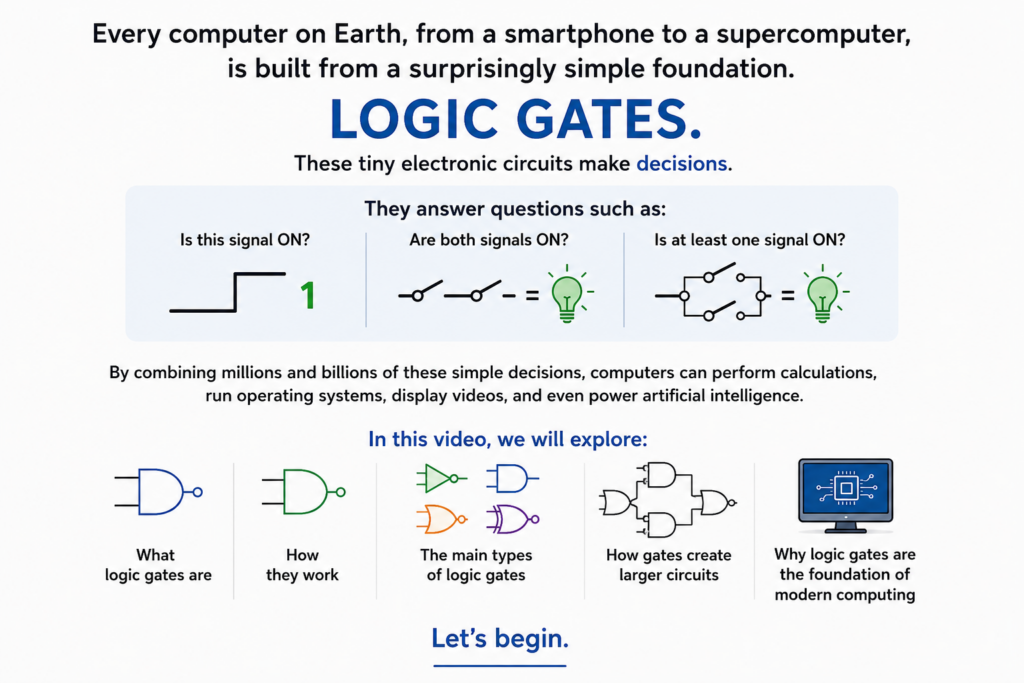
In this video, we will explore:
- What logic gates are
- How they work
- The main types of logic gates
- How gates create larger circuits
- Why logic gates are the foundation of modern computing
Let’s begin.
Chapter 2 — From Electricity to Binary
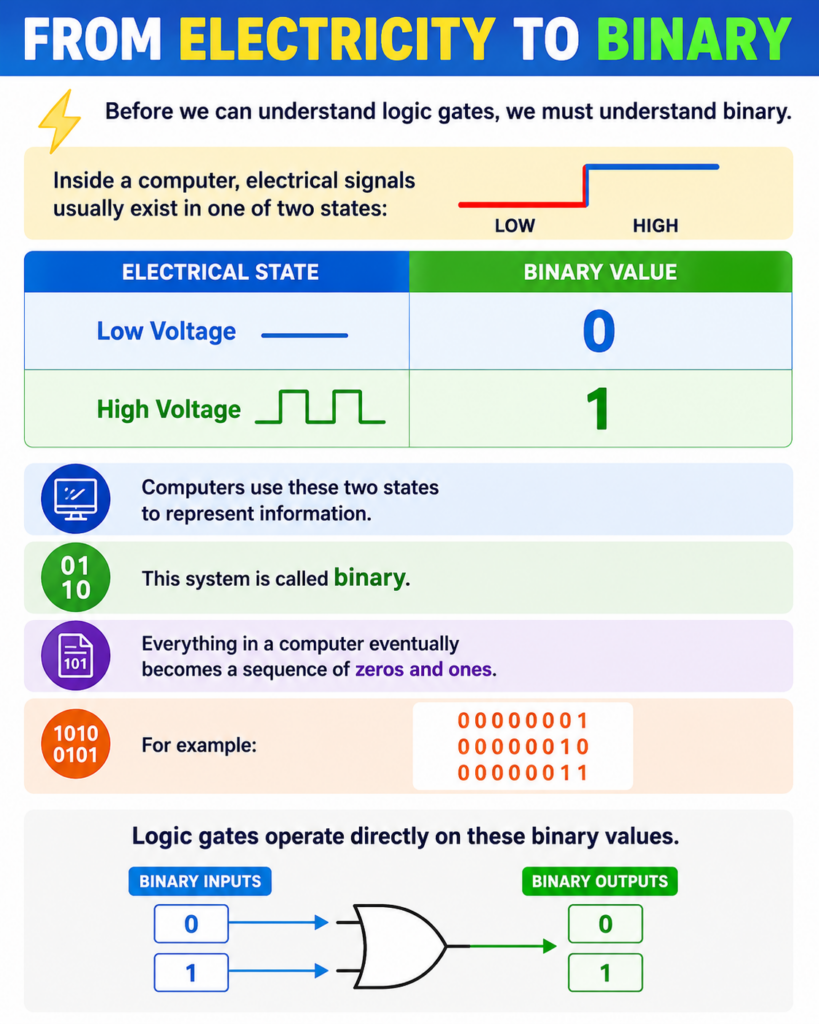
Before we can understand logic gates, we must understand binary.
Inside a computer, electrical signals usually exist in one of two states:
| Electrical State | Binary Value |
|---|---|
| Low Voltage | 0 |
| High Voltage | 1 |
Computers use these two states to represent information.
This system is called binary.
Everything in a computer eventually becomes a sequence of zeros and ones.
For example:
00000001
00000010
00000011
Logic gates operate directly on these binary values.
They take binary inputs.
They produce binary outputs.
Chapter 3 — Logic Gates Are Electronic Decision Makers
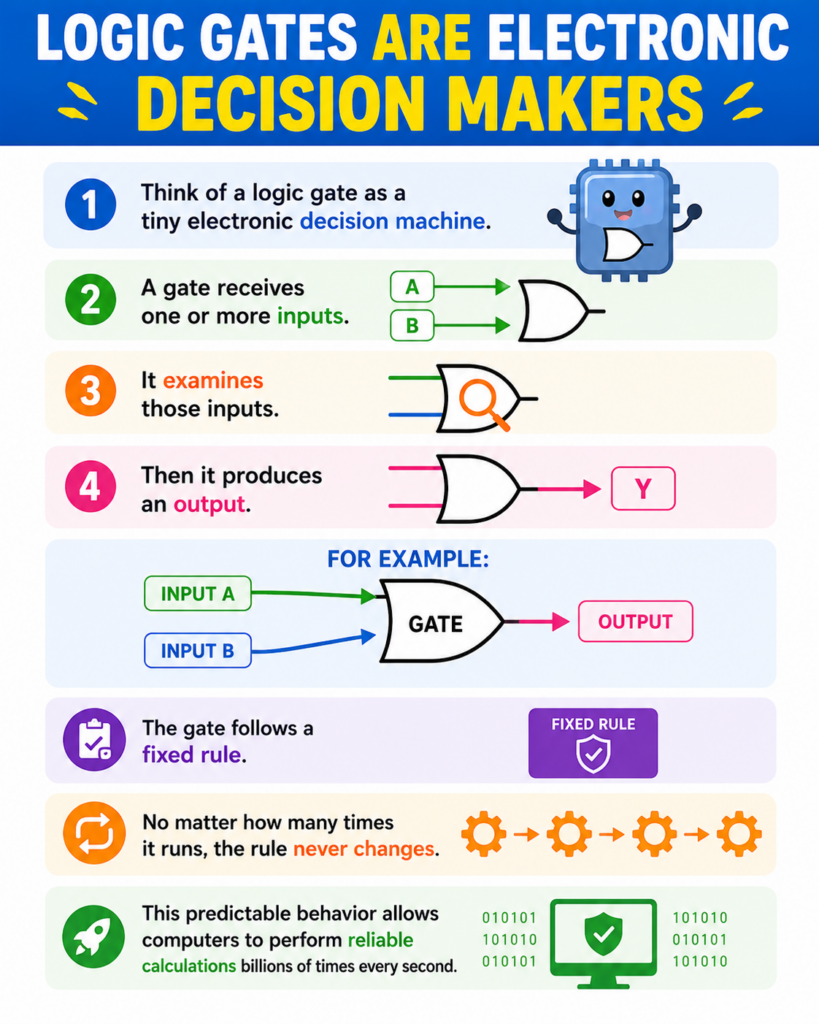
Think of a logic gate as a tiny electronic decision machine.
A gate receives one or more inputs.
It examines those inputs.
Then it produces an output.
For example:
Input A → Gate → Output
Input B ↗
The gate follows a fixed rule.
No matter how many times it runs, the rule never changes.
There are only two possible inputs.
When the input is zero, the output becomes one.
When the input is one, the output becomes zero.
In other words, the NOT gate always produces the opposite value.
This predictable behavior allows computers to perform reliable calculations billions of times every second.
Chapter 4 — The NOT Gate
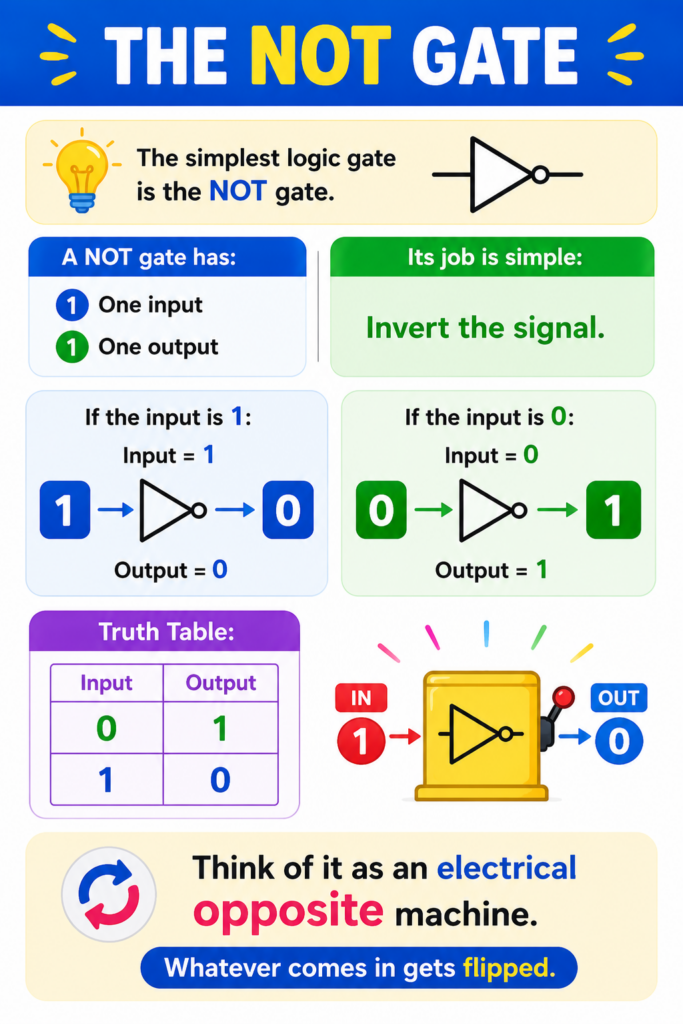
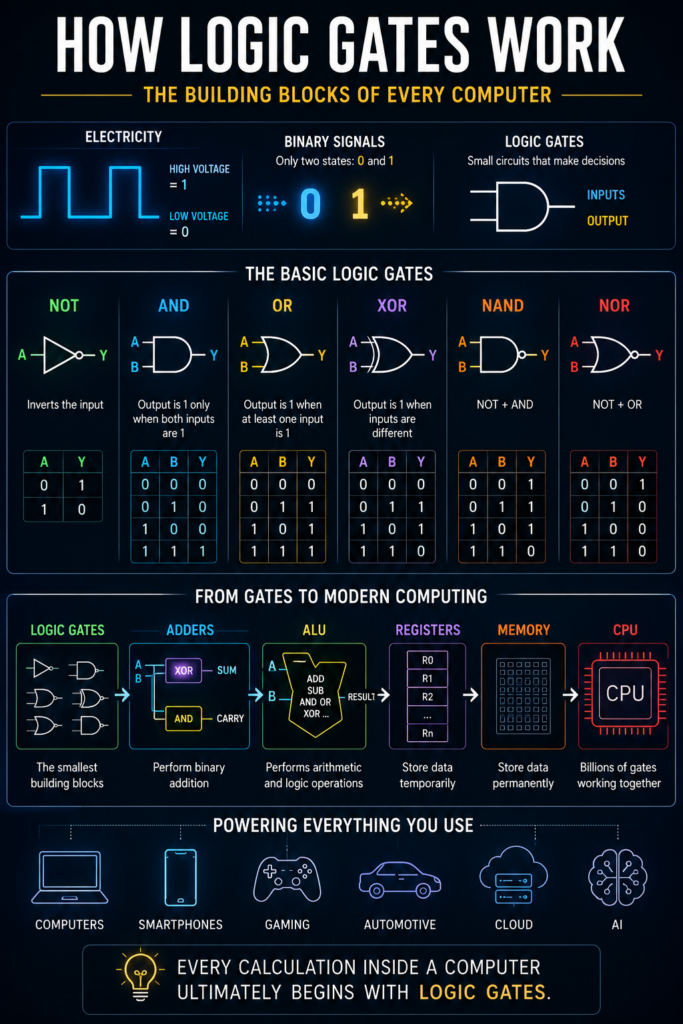
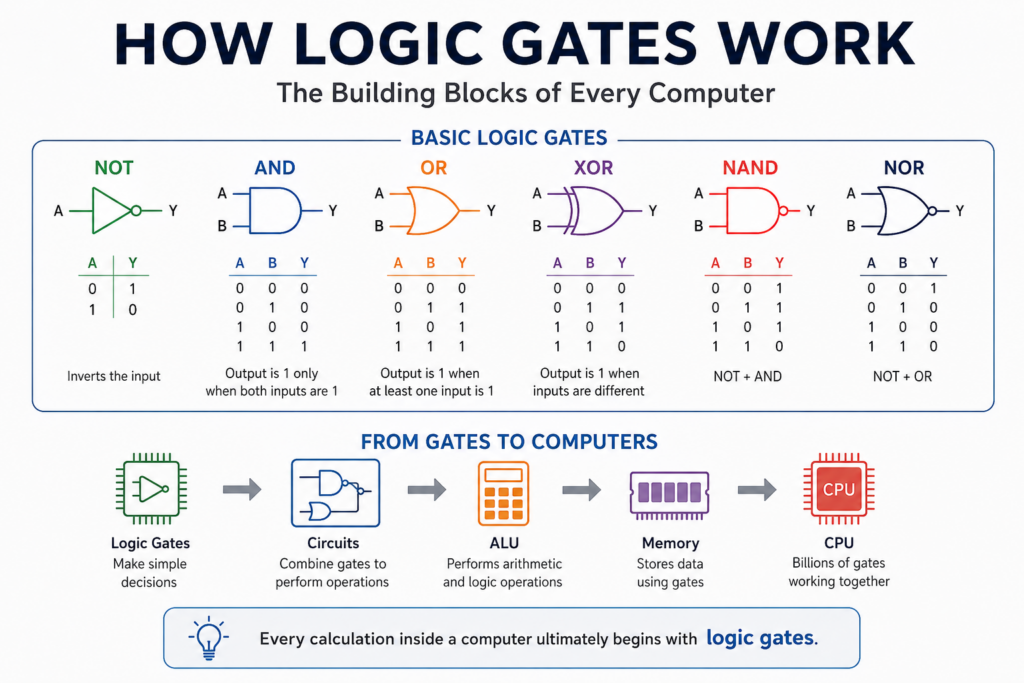
The simplest logic gate is the NOT gate.
A NOT gate has:
- One input
- One output
Its job is simple:
Invert the signal.
If the input is 1:
Input = 1
Output = 0
If the input is 0:
Input = 0
Output = 1
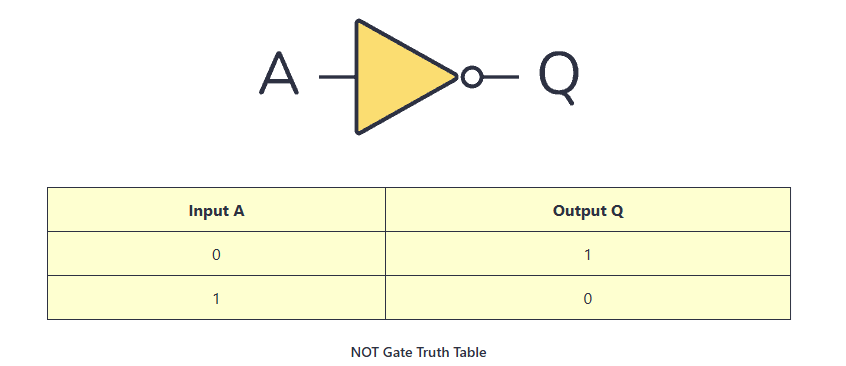
Truth Table:
| Input | Output |
|---|---|
| 0 | 1 |
| 1 | 0 |
Think of it as an electrical opposite machine.
There are only two possible inputs.
When the input is zero, the output becomes one.
When the input is one, the output becomes zero.
In other words, the NOT gate always produces the opposite value.
Whatever comes in gets flipped.
Chapter 5 — The AND Gate

The AND gate requires two inputs.
Its rule is:
The output becomes 1 only when BOTH inputs are 1.
Truth Table:
| A | B | Output |
|---|---|---|
| 0 | 0 | 0 |
| 0 | 1 | 0 |
| 1 | 0 | 0 |
| 1 | 1 | 1 |
Imagine two switches controlling a light.
Both switches must be ON.
Otherwise the light stays OFF.
This is exactly how an AND gate behaves.
AND Gate Truth Table:
- A is zero, B is zero, output is zero.
- A is zero, B is one, output is zero.
- A is one, B is zero, output is zero.
- A is one, B is one, output is one.
Chapter 6 — The OR Gate

The OR gate is less strict.
Its rule is:
If either input is 1, the output becomes 1.
Truth Table:
| A | B | Output |
|---|---|---|
| 0 | 0 | 0 |
| 0 | 1 | 1 |
| 1 | 0 | 1 |
| 1 | 1 | 1 |
Imagine two emergency buttons.
Press either button and the alarm activates.
That is the behavior of an OR gate.
OR Gate Truth Table:
- A is zero, B is zero, output is zero.
- A is zero, B is one, output is one.
- A is one, B is zero, output is one.
- A is one, B is one, output is one.
Chapter 7 — The XOR Gate

XOR stands for Exclusive OR.
Its rule is:
Output becomes 1 only when the inputs are different.
Truth Table:
| A | B | Output |
|---|---|---|
| 0 | 0 | 0 |
| 0 | 1 | 1 |
| 1 | 0 | 1 |
| 1 | 1 | 0 |
Notice:
Different = 1
Same = 0
XOR gates are extremely important.
They are the foundation of binary addition.
Every CPU uses XOR gates inside its arithmetic circuits.

XOR Gate Truth Table:
- A is zero, B is zero, output is zero.
- A is zero, B is one, output is one.
- A is one, B is zero, output is one.
- A is one, B is one, output is zero.
Chapter 8 — NAND Gate

The NAND gate is actually more important than many people realize.
NAND means:
NOT + AND
First perform AND.
Then invert the result.
Truth Table:
| A | B | Output |
|---|---|---|
| 0 | 0 | 1 |
| 0 | 1 | 1 |
| 1 | 0 | 1 |
| 1 | 1 | 0 |
Only one situation produces 0:
1 AND 1
Everything else becomes 1.

NAND Gate Truth Table:
- A is zero, B is zero, output is one.
- A is zero, B is one, output is one.
- A is one, B is zero, output is one.
- A is one, B is one, output is zero.
NAND gates are special because an entire computer can be built using only NAND gates.
Chapter 9 — NOR Gate

NOR means:
NOT + OR
First perform OR.
Then invert the result.
Truth Table:
| A | B | Output |
|---|---|---|
| 0 | 0 | 1 |
| 0 | 1 | 0 |
| 1 | 0 | 0 |
| 1 | 1 | 0 |
NOR gates are also universal gates.

NOR Gate Truth Table:
- A is zero, B is zero, output is one.
- A is zero, B is one, output is zero.
- A is one, B is zero, output is zero.
- A is one, B is one, output is zero.
Like NAND gates, they can be combined to create every other logic gate.
Chapter 10 — How Gates Are Built from Transistors

Logic gates do not magically exist.
They are built from transistors.
A transistor acts like a tiny electronic switch.
Switch ON
Current flows

Switch OFF
Current stops
 By connecting multiple transistors together, engineers create:
- NOT gates
- AND gates
- OR gates
- XOR gates
- NAND gates
- NOR gates
Modern processors contain billions of transistors.
Those billions of transistors form billions of logic gates.
Chapter 11 — Combining Gates into Larger Circuits

A single gate is not very useful.
The real power comes from combining many gates.
For example:
Inputs
   ↓
Logic Gates
   ↓
Adder Circuit
   ↓
Arithmetic Unit
   ↓
CPU
 Thousands of gates form:
- Adders
- Comparators
- Multiplexers
- Decoders
Millions of gates form:
- Registers
- Caches
- Control units
Billions of gates form:
- Modern CPUs
- GPUs
- AI accelerators
Chapter 12 — Logic Gates and Binary Addition

Let’s add:
1 + 1
In binary:
1 + 1 = 10
Result:
Sum = 0
Carry = 1
A simple circuit called a Half Adder performs this operation.
The Half Adder uses:
- XOR Gate → Sum
- AND Gate → Carry
A ---- XOR ---- Sum
 \
  \
   AND ---- Carry
 /
B

How to Read This Circuit
A goes into the XOR gate and produces the sum.
A and B also go into the AND gate and produce the carry.
This is one of the most important circuits in computer science.
This circuit is called a half adder.
This is one of the most important circuits in computer science.
Every CPU arithmetic operation starts from this idea.
Chapter 13 — Logic Gates Create the ALU

The Arithmetic Logic Unit (ALU) is the calculator inside a CPU.
The ALU performs:
- Addition
- Subtraction
- Comparisons
- Logical operations
Internally, the ALU is built from huge networks of logic gates.
Transistors
    ↓
Logic Gates
    ↓
Adders
    ↓
ALU
Whenever a CPU calculates:
5 + 3
100 × 20
Address + Offset
Logic gates are doing the actual work.
Chapter 14 — Logic Gates Create Memory

Logic gates are not only used for calculations.
They are also used to store information.
Special combinations of gates form:
- Latches
- Flip-Flops
- Registers
For example:
Logic Gates
    ↓
Flip-Flop
    ↓
Register
Registers are the fastest storage locations inside a CPU.
Without logic gates, memory would not exist.
Chapter 15 — Conclusion

Logic gates are the fundamental building blocks of digital electronics.
They take simple binary inputs.
They apply simple rules.
They generate simple outputs.
Yet by combining billions of them together, engineers create:
- Registers
- Memory
- ALUs
- CPUs
- GPUs
- Entire computers
The next time you use a computer, remember:
Underneath the operating system,
underneath the applications,
underneath the CPU,
billions of tiny logic gates are making decisions every nanosecond.
And from those simple decisions, all modern computing emerges.