Apple Wants a Federal Judge to Stop OpenAI Before It’s Too Late
The artificial intelligence industry may have just entered one of its most important legal battles.
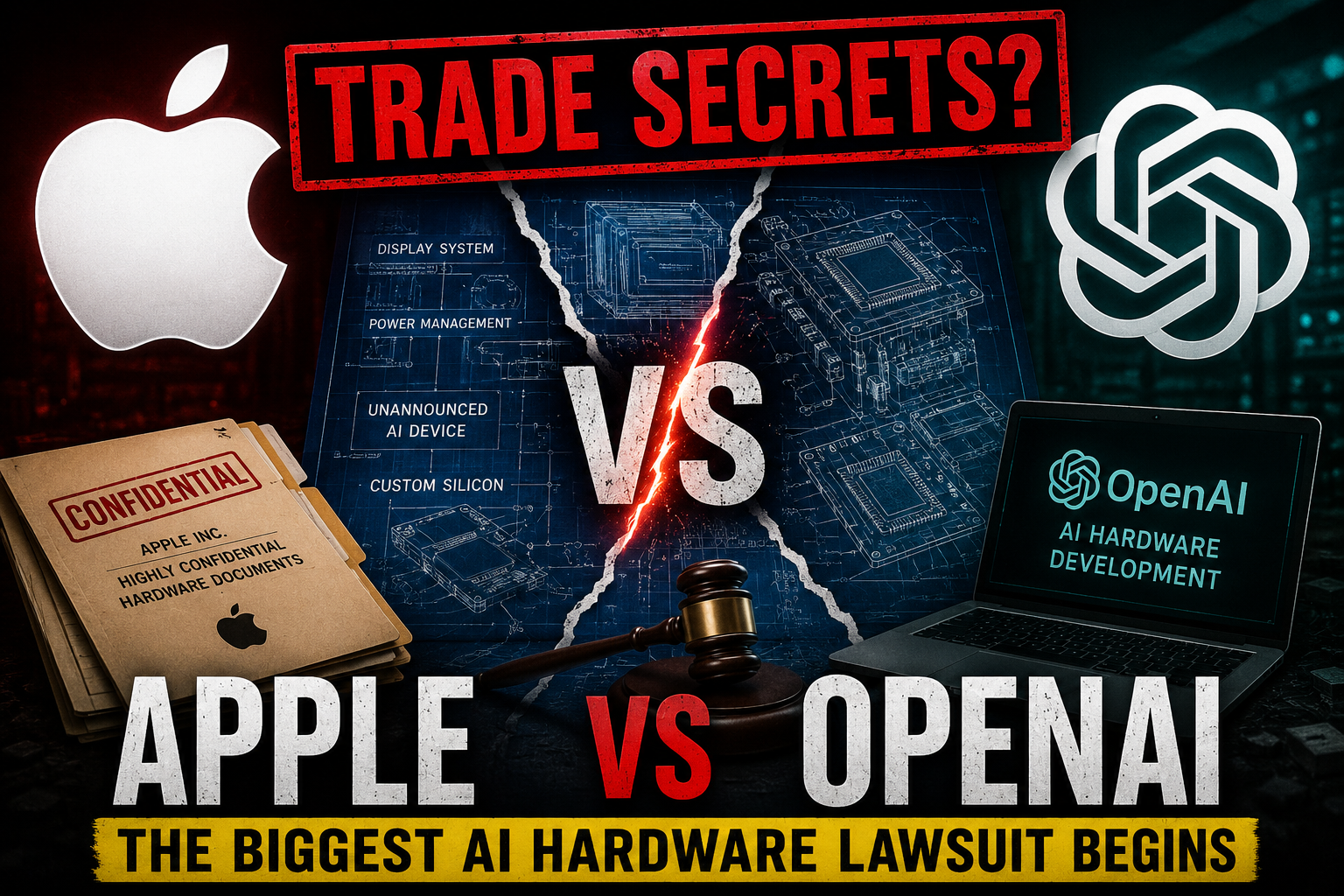
Apple has asked a U.S. federal court for a preliminary injunction against OpenAI, alleging that confidential Apple hardware information was repeatedly taken by former employees who later joined OpenAI.
If Apple’s allegations are ultimately proven in court, this would not simply be another lawsuit over employee recruiting. It could become one of the largest trade-secret cases ever involving an AI company.
At the same time, it is important to remember one critical fact.
These are allegations made by Apple.
OpenAI disputes the claims, and no court has determined that the allegations are true.
That distinction matters.
Why This Lawsuit Is Different
Technology companies sue each other all the time.
Patent disputes.
Copyright disputes.
Employment disputes.
Those are common.
This case is different because Apple is asking the court for immediate intervention before the case even reaches trial.
Apple argues that every day without an injunction creates additional risk because confidential engineering knowledge could become embedded inside OpenAI’s hardware development programs.
That is why Apple requested a preliminary injunction rather than simply seeking monetary damages later.
What Apple Is Alleging
According to Apple’s court filings, former Apple engineer Chang Liu downloaded thousands of pages of confidential engineering documents while employed by Apple.
Apple alleges that these files included information related to:
- Display technologies
- Power-management systems
- Internal architecture studies
- Manufacturing decisions
- Testing results
- Unannounced hardware projects
Apple further alleges that Liu encouraged another Apple employee to obtain additional internal files while she was still working inside Apple and advised using encrypted communications to avoid detection.
The lawsuit also names Tang Tan, Apple’s former Vice President of Product Design, who is now OpenAI’s Chief Hardware Officer.
Apple claims that internal Apple project codenames were referenced during recruiting conversations to encourage candidates to discuss confidential work.
OpenAI has denied wrongdoing and says Apple’s accusations misrepresent the facts.
Those competing claims will now be tested in federal court.
Why Apple Wants Digital Forensics
Perhaps the most extraordinary part of Apple’s request is not the damages.
It is the forensic inspection.
Apple is asking the court to authorize examination of OpenAI devices, cloud storage, Slack communications, emails, and even deleted data that may previously have contained Apple information.
Digital forensics has become increasingly important in trade-secret litigation.
Modern investigations often recover deleted files, cloud synchronization records, access logs, timestamps, USB activity, and message histories.
Whether Apple’s request will be granted remains for the court to decide.
This Is Really About AI Hardware
Many people immediately associate OpenAI with ChatGPT.
That is only part of the story.
OpenAI has been investing heavily in AI hardware.
The company has recruited numerous engineers with deep experience in consumer hardware, silicon, manufacturing, and product design.
Industry observers expect OpenAI to develop dedicated AI devices in addition to its software platform.
From Apple’s perspective, hardware expertise may be just as valuable as artificial intelligence algorithms.
This lawsuit therefore extends far beyond chatbots.
It concerns the future competition over AI hardware itself.
Why Trade Secrets Matter
Some readers may wonder why engineering documents receive so much legal protection.
The answer is simple.
A finished product only reveals what was ultimately built.
Internal engineering documents reveal why those decisions were made.
They explain:
- which designs failed,
- which suppliers were evaluated,
- why one architecture was selected over another,
- which manufacturing techniques proved successful,
- and which approaches were abandoned after years of expensive research.
Those decisions often represent billions of dollars in accumulated engineering experience.
That is precisely why companies protect trade secrets so aggressively.
What Happens Next?
The court is expected to consider Apple’s request for a preliminary injunction during an upcoming hearing.
The judge will not decide the entire lawsuit at that hearing.
Instead, the court will determine whether Apple has presented sufficient evidence that immediate judicial intervention is necessary before the case proceeds.
Possible outcomes include:
- granting the injunction,
- denying it,
- granting only limited restrictions,
- or ordering expedited discovery while the litigation continues.
Whatever the decision, the hearing will likely shape one of the most significant legal battles in the AI industry.
Final Thoughts
Artificial intelligence is no longer only a competition over large language models.
It is becoming a competition over hardware, manufacturing, supply chains, specialized silicon, and engineering talent.
The Apple–OpenAI dispute illustrates how valuable that expertise has become.
Whether Apple’s allegations ultimately succeed remains to be determined by the courts.
But one conclusion is already clear.
The next generation of AI competition will be fought not only in software—but also in hardware laboratories, engineering teams, and federal courtrooms.