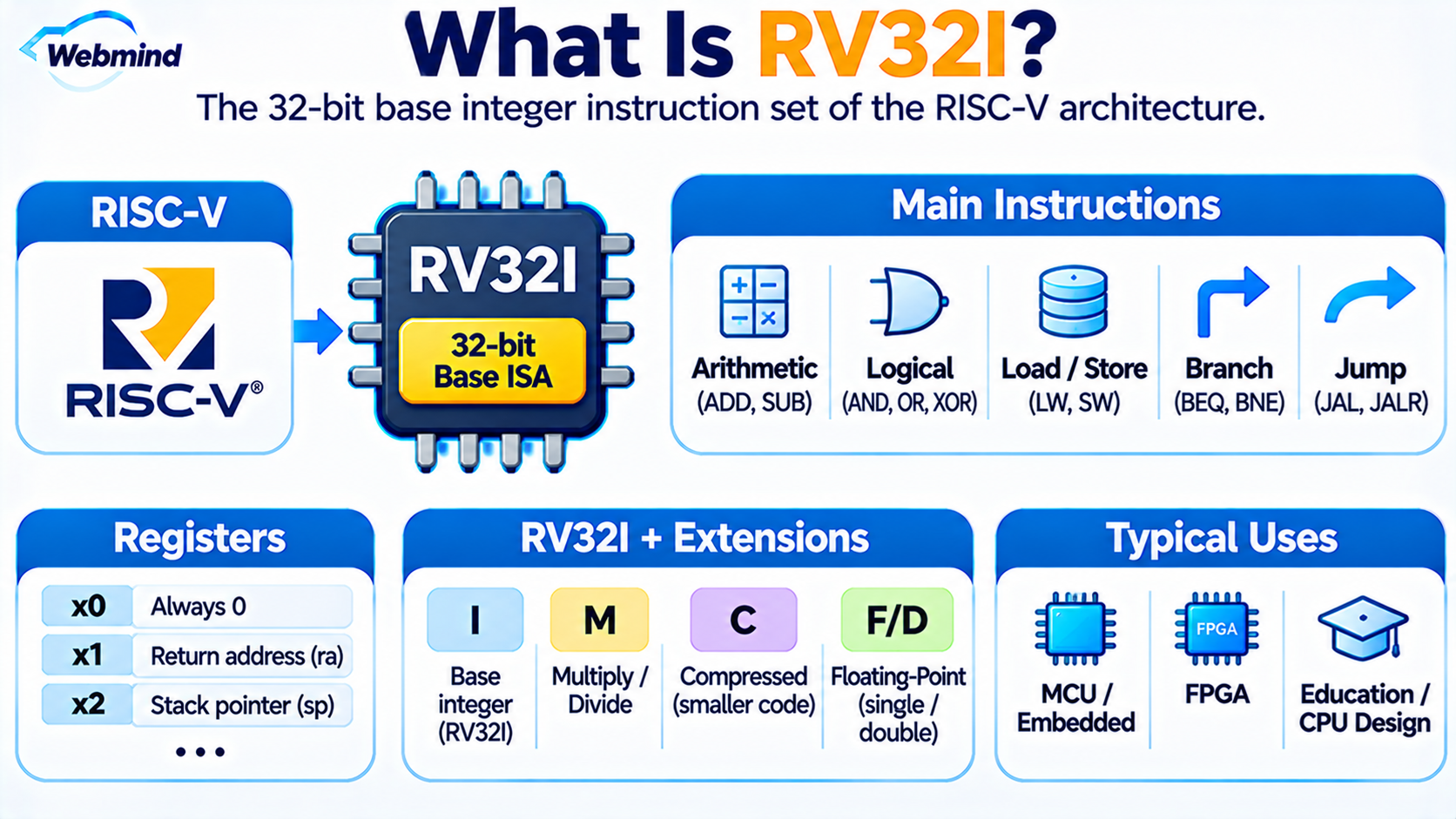
RV32I is the 32-bit base integer instruction set of the RISC-V architecture.
It defines a fundamental collection of machine instructions, processor registers, and execution rules used to build compatible 32-bit RISC-V processors.
RV32I provides the essential operations needed for integer arithmetic, logical calculations, memory access, conditional branching, and program control.
RV32I is particularly important in embedded systems, microcontrollers, processor education, and FPGA development.
Its relatively small and regular instruction set makes it suitable for understanding how a CPU operates internally.
Unlike a complete microcontroller or System-on-Chip (SoC), RV32I defines an instruction set architecture rather than a specific hardware implementation.
Different processor designs can execute the same RV32I instructions while using different pipelines, memory systems, and hardware resources.
What Does RV32I Mean?
The name RV32I contains three important parts.
RV stands for RISC-V, an open-standard Instruction Set Architecture based on Reduced Instruction Set Computer principles.
32 indicates that the architecture uses a 32-bit integer register width, commonly called XLEN.
General-purpose integer registers are 32 bits wide, and the architecture provides a 32-bit address space.
I identifies the base integer instruction set, which provides the fundamental instructions required for general-purpose integer processing.
RV32I is one of the foundational configurations of RISC-V.
Additional capabilities, such as multiplication, floating-point arithmetic, atomic operations, and compressed instructions, can be provided through standardized extensions.
How Does an RV32I Processor Work?
An RV32I processor executes instructions by fetching them from memory, decoding their binary representation, and performing the specified operations.
For example, an addition instruction tells the processor to read two registers, add their values, and write the result into a destination register.
A load instruction reads data from memory into a register, while a store instruction writes register data into memory.
Branch instructions allow the processor to change program execution based on comparisons between register values.
The basic execution process is:
Instruction Fetch → Decode → Execute → Memory Access → Write Back
This represents a common conceptual processor datapath.
A simple RV32I implementation may execute these operations sequentially, while a pipelined processor can overlap multiple instructions.
RV32I defines the architectural behavior of instructions but does not require a particular pipeline structure.
RV32I Registers
RV32I defines 32 general-purpose integer registers, named x0 through x31.
Each register is 32 bits wide.
Register x0 always contains the value zero.
Reading x0 returns zero, and instructions that attempt to write to x0 do not change its value.
The remaining registers are available for storing integer values, addresses, and intermediate calculation results.
The architecture also includes a Program Counter (PC), which identifies the address of the instruction being executed according to the processor’s control flow.
Software calling conventions assign additional meanings to certain registers.
For example, x1 is commonly called ra and is used to store return addresses, while x2 is called sp and is used as the stack pointer.
Registers x10 through x17 are commonly used for function arguments and are named a0 through a7.
These naming conventions belong to the RISC-V Application Binary Interface (ABI), which defines how compiled software components interact.
How Many Instructions Does RV32I Have?
The commonly referenced RV32I base instruction set contains 40 unique instructions in the unprivileged base ISA, counting the basic system instructions defined in that set.
These instructions cover arithmetic, logical operations, data movement, branching, jumps, and system-related operations.
The instruction set includes operations such as ADD, SUB, AND, OR, XOR, LW, SW, BEQ, and JAL.
The exact instruction availability of a processor depends on its supported architecture and extensions.
A processor implementing RV32I does not automatically support multiplication, division, floating-point arithmetic, or atomic memory operations.
Those capabilities require additional architectural extensions or suitable software implementations.
Arithmetic Instructions in RV32I
RV32I provides basic integer arithmetic instructions.
ADD adds the contents of two registers and stores the result in a destination register.
For example, add x5, x6, x7 adds the values in registers x6 and x7 and writes the result into x5.
SUB subtracts one register value from another.
ADDI adds a sign-extended immediate constant to a register value.
For example, addi x5, x0, 10 places the value 10 into register x5.
RV32I arithmetic operations produce 32-bit results.
Arithmetic overflow does not automatically generate an exception; the result follows the architectural rules for 32-bit integer computation.
Multiplication and division are not part of RV32I. They are provided by the optional M extension.
Logical and Shift Instructions
RV32I includes bitwise logical instructions used to manipulate binary values.
AND performs bitwise AND, while OR performs bitwise OR.
XOR performs exclusive OR, which is useful in bit manipulation, masking, and certain arithmetic operations.
RV32I also includes immediate forms such as ANDI, ORI, and XORI.
Shift instructions move bits within a register.
SLL performs a logical left shift, while SRL performs a logical right shift.
SRA performs an arithmetic right shift that preserves the sign information of signed values.
These instructions are widely used in embedded programming, hardware register manipulation, and low-level algorithms.
Load and Store Instructions
RV32I follows a load/store architecture, meaning arithmetic instructions operate primarily on register values rather than directly performing arithmetic on memory operands.
Load instructions transfer data from memory into registers.
Store instructions transfer data from registers into memory.
The base integer instruction set includes several load operations, such as LB, LH, LW, LBU, and LHU.
These instructions load bytes, halfwords, or 32-bit words, applying sign extension or zero extension where appropriate.
Store instructions include SB, SH, and SW, which store bytes, halfwords, and words.
For example, lw x5, 0(x6) loads a 32-bit value from the memory address contained in x6 into register x5.
The instruction sw x5, 0(x6) stores the 32-bit value from x5 into memory at the address contained in x6.
Memory access behavior also depends on alignment requirements and the hardware environment.
Branch Instructions
Branch instructions allow RV32I programs to make decisions and implement loops.
BEQ (Branch if Equal) changes program execution if two register values are equal.
BNE (Branch if Not Equal) branches when two register values differ.
Other branch instructions support signed and unsigned comparisons.
For example, BLT performs a signed less-than comparison, while BLTU performs an unsigned less-than comparison.
These instructions allow programs to implement conditional statements such as if, while, and for loops.
The branch instruction encodes a relative offset that determines the target location when the branch condition is satisfied.
This makes branching an essential part of processor control flow.
Jump and Function Call Instructions
RV32I includes instructions for unconditional jumps and function calls.
JAL (Jump and Link) changes the Program Counter and stores a return address in a destination register.
JALR (Jump and Link Register) calculates a jump target using a register and an immediate offset, while also providing return-address functionality when required.
These instructions support function calls, returns, and indirect control transfers.
For example, function calls commonly use register x1, also known as ra, to hold the return address.
The assembler may provide convenient pseudoinstructions such as call and ret, which are translated into appropriate machine instructions.
Understanding JAL and JALR helps explain how function calls work at the processor instruction level.
RV32I Instruction Formats
One of the important design features of RV32I is its regular instruction encoding.
The standard RV32I base instructions are 32 bits long and use several defined formats.
R-type instructions commonly operate on register operands, such as ADD and SUB.
I-type instructions include an immediate value, as used by ADDI and many load instructions.
S-type instructions are used for store operations.
B-type instructions encode conditional branches.
U-type instructions contain larger immediate fields, while J-type instructions support jump offsets.
Each instruction contains fields identifying the operation, registers, immediate values, or other required information.
This regular structure helps simplify instruction decoding and makes RV32I useful for processor architecture education.
RV32I and the Program Counter
The Program Counter (PC) tracks the address associated with the processor’s instruction execution flow.
In a basic RV32I processor without compressed instructions, ordinary sequential execution generally advances the PC by four bytes because each instruction occupies 32 bits.
Branch and jump instructions can modify the PC to execute instructions at another address.
For example, a conditional branch may skip several instructions when its condition is satisfied.
The processor must calculate the correct next PC value according to the current instruction.
This next-PC selection logic is one of the fundamental components of an RV32I CPU implementation.
RV32I vs. RV32IM
RV32I provides the base integer instruction set.
RV32IM adds the M extension, which provides integer multiplication and division instructions.
For example, the MUL instruction multiplies two integer operands, while DIV and REM support integer division and remainder operations.
Without the M extension, multiplication and division may need to be implemented using sequences of other instructions or software library routines.
Adding the M extension can improve performance for applications requiring frequent arithmetic operations.
However, hardware multiplication and division units consume additional logic resources and may increase implementation complexity.
The choice depends on processor performance requirements and available hardware resources.
RV32I vs. RV32E vs. RV64I
RV32I, RV32E, and RV64I are related RISC-V base integer architectures.
RV32I uses 32-bit integer registers and provides 32 general-purpose registers.
RV32E is a reduced-register variant intended for resource-constrained embedded processors. It provides 16 general-purpose integer registers.
RV64I uses 64-bit integer registers and provides a larger address width suitable for more capable computing systems.
RV32E can reduce certain hardware requirements, while RV64I supports larger integer values and address spaces.
RV32I offers a practical balance of architectural simplicity and general-purpose functionality.
It is particularly suitable for learning processor design and implementing embedded soft-core CPUs.
RV32I in Microcontrollers
RV32I is a foundation for many RISC-V embedded processor designs.
A microcontroller may combine an RV32I-compatible CPU with flash memory, RAM, GPIO, UART, SPI, I2C, timers, and other peripherals.
The processor executes firmware that configures hardware interfaces and performs application-specific operations.
For example, an RV32I microcontroller can control LEDs, read sensor values, process interrupts, and communicate through serial interfaces.
Some applications use bare-metal firmware, while others run a small Real-Time Operating System (RTOS).
However, compatibility depends on the processor’s actual extensions, interrupt architecture, memory organization, and supporting software.
RV32I in FPGA Development
RV32I is particularly valuable for FPGA education because it provides a manageable instruction set for implementing a CPU from digital logic.
An FPGA-based RV32I processor can be built using components such as a Program Counter, instruction decoder, register file, arithmetic logic unit, control logic, and memory interfaces.
The processor can be described using Verilog, SystemVerilog, or VHDL.
A basic educational implementation might execute instructions from FPGA block RAM and use another memory region for data.
The CPU fetches instructions, decodes register and immediate fields, performs arithmetic or memory operations, and updates the Program Counter.
Developers can then compile simple C or assembly programs for the processor.
This provides a direct connection between software instructions and the digital circuits that execute them.
Building a Simple RV32I CPU
A beginner-friendly RV32I processor project can be divided into several functional blocks.
The Program Counter identifies the next instruction address.
The Instruction Memory stores machine-code instructions.
The Instruction Decoder extracts instruction fields and identifies the operation to perform.
The Register File stores the architectural integer registers.
The Arithmetic Logic Unit (ALU) performs addition, subtraction, logical operations, comparisons, and shifts.
The Control Unit selects the required operations and determines how results move through the processor.
The Data Memory Interface supports load and store instructions.
A single-cycle processor may execute one instruction per clock cycle using a relatively simple control structure, although the combinational path can limit clock frequency.
More advanced implementations introduce pipelining to improve instruction throughput.
RV32I and Software Development Tools
RV32I software can be developed using standard RISC-V toolchains.
GCC and LLVM/Clang can generate machine code for supported RISC-V targets.
GNU Assembler converts assembly instructions into object code, while the linker combines object files into an executable.
GDB can help debug RISC-V programs and examine processor state.
Instruction set simulators such as Spike and system emulators such as QEMU can support development and testing, depending on the selected platform configuration.
For FPGA-based processors, developers may use simulation tools to verify instruction execution before implementing the design on hardware.
The compiler and linker settings must match the target processor’s supported instruction set and ABI.
Can RV32I Run Linux?
A basic RV32I processor does not automatically provide the hardware capabilities required for conventional Linux operation.
Linux generally requires suitable privilege modes, memory-management facilities, interrupt handling, timers, and sufficient system memory.
Many simple RV32I processor implementations are designed for bare-metal applications rather than a full operating system.
An RV32I-based processor may run small firmware applications or an RTOS when the required platform support is available.
More capable RISC-V processors implementing appropriate privilege and virtual-memory features are used for Linux systems, commonly with a 64-bit architecture.
This distinction is important because an instruction set alone does not determine whether an operating system can run on a particular processor.
Advantages of RV32I
RV32I offers several benefits for embedded processor design.
Its instruction set is relatively small, regular, and well documented.
The fixed-length base instruction encoding simplifies many aspects of instruction decoding.
Its load/store organization and register-based arithmetic model are suitable for educational CPU implementations.
RV32I also provides a standardized software interface that can be implemented by different processor microarchitectures.
Because RISC-V is an open-standard ISA, RV32I can be used in research, education, and commercial processor implementations without a proprietary ISA licensing fee.
These characteristics make RV32I a useful starting point for learning CPU design.
Limitations of RV32I
RV32I does not include every instruction needed for high-performance computing.
Multiplication, division, floating-point arithmetic, compressed instructions, and atomic operations require additional extensions.
A basic RV32I processor may therefore require software routines to perform operations that more advanced processors execute directly in hardware.
Its 32-bit address space also limits the directly addressable memory range compared with 64-bit architectures.
Performance depends on the processor’s microarchitecture, memory system, clock frequency, and supported extensions.
RV32I defines compatibility at the instruction-set level, but it does not guarantee a particular execution speed or energy efficiency.
Why Is RV32I Important?
RV32I provides one of the clearest ways to understand how a modern processor executes machine instructions.
It connects fundamental concepts such as binary encoding, registers, arithmetic logic, memory access, branching, and program control.
For software developers, RV32I helps explain how compilers translate C and assembly programs into machine instructions.
For hardware engineers, it provides a practical foundation for implementing CPUs using FPGA resources.
For embedded developers, RV32I demonstrates how firmware interacts with processor registers and memory-mapped peripherals.
Its simplicity and standardized architecture make it valuable for learning both hardware and software design.
Conclusion
RV32I is the 32-bit base integer instruction set of the RISC-V architecture.
It defines the fundamental instructions, registers, and execution rules needed for compatible 32-bit processor implementations.
The architecture provides arithmetic, logical, load/store, branch, and jump operations through a compact and regular instruction set.
Additional RISC-V extensions can provide multiplication, floating-point arithmetic, compressed instructions, and other capabilities.
RV32I is especially important in embedded systems, microcontroller development, processor education, and FPGA-based CPU design.
Understanding RV32I provides a strong foundation for studying RISC-V assembly language, processor datapaths, instruction decoding, CPU pipelines, and the relationship between software instructions and digital hardware.