Introduction
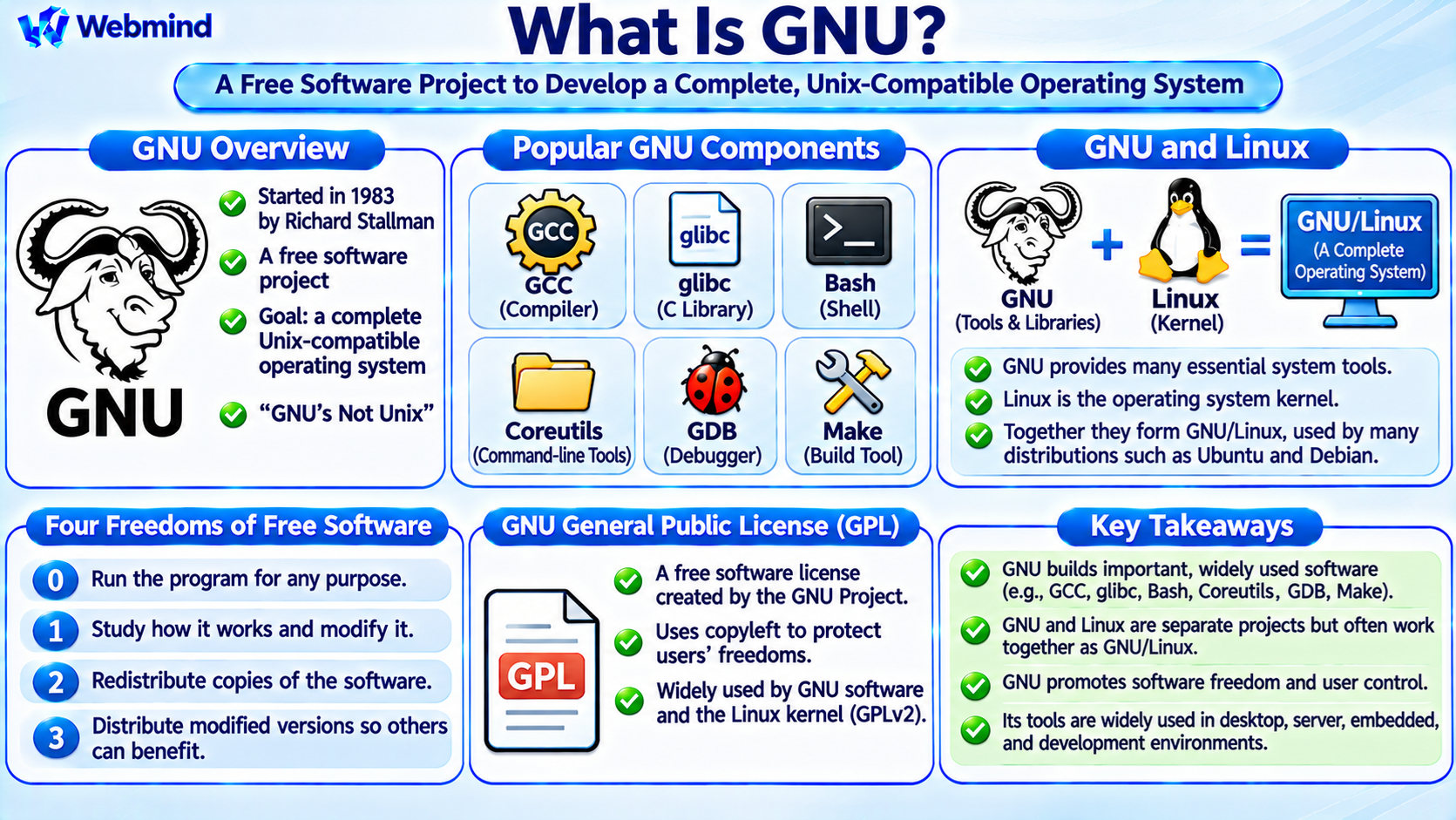
GNU is a free software project launched by Richard Stallman in 1983 to develop a complete Unix-compatible operating system.
The name GNU is a recursive acronym meaning “GNU’s Not Unix.”
The GNU Project aims to provide software that users are free to run, study, modify, and redistribute.
It has produced many important tools, including the GNU Compiler Collection (GCC), GNU C Library (glibc), Bash shell, GNU Coreutils, and GNU Debugger (GDB).
GNU has played a major role in the development of Linux-based operating systems.
Many Linux distributions combine the Linux kernel with GNU software to provide a complete computing environment.
Understanding GNU is important for studying Linux, operating systems, compilers, open-source software, and software development.
How Did the GNU Project Begin?
Richard Stallman announced the GNU Project in September 1983, and development began in 1984.
At that time, proprietary software was becoming increasingly common, restricting users’ ability to examine, modify, and share programs.
The GNU Project was created to build a Unix-compatible operating system composed of free software.
The word “free” refers primarily to freedom rather than price.
The project gradually developed essential operating-system components, including compilers, shells, libraries, text editors, and command-line utilities.
By the early 1990s, GNU had produced many important system components, but its planned kernel was not yet ready to provide a complete, widely used operating system.
What Does Free Software Mean?
GNU promotes four essential software freedoms.
Freedom 0: Run the program for any purpose.
Freedom 1: Study how the program works and modify it to meet your needs.
Freedom 2: Redistribute copies of the software.
Freedom 3: Distribute modified versions so others can benefit from improvements.
Access to source code is necessary for the freedoms to study and modify software.
Free software can be distributed commercially. The concept does not require software to be available without charge.
These principles form the foundation of the Free Software Movement.
What Is the Relationship Between GNU and Linux?
GNU and Linux originated as separate projects.
GNU began in 1983 with the goal of developing a complete free operating system.
In 1991, Linus Torvalds began developing the Linux kernel.
A kernel manages essential hardware resources, processes, memory, and device communication.
GNU provided many tools that could operate with the Linux kernel, including compilers, libraries, shells, and basic system utilities.
Combining these components made it possible to create complete Linux-based operating systems.
For this reason, the GNU Project advocates the name GNU/Linux for systems that combine GNU components with the Linux kernel.
However, not every operating system using the Linux kernel includes GNU software.
For example, Android uses the Linux kernel but has a different user-space software environment.
Alpine Linux commonly uses musl libc and BusyBox rather than the GNU C Library and the complete GNU Coreutils collection.
What Are the Main GNU Components?
GNU has developed many important software packages.
GNU Compiler Collection (GCC)
GCC is a compiler collection supporting languages such as C, C++, and Fortran.
It translates source code into machine code that a processor can execute.
GCC is widely used in Linux development, embedded systems, operating-system kernels, and other software projects.
GNU C Library (glibc)
glibc provides core C library functions and interfaces used by many applications on GNU/Linux systems.
It supports operations such as input/output, memory allocation, string processing, threading, and access to operating-system services.
Many Linux applications rely on glibc, although alternative C libraries are also available.
GNU Bash
Bash, or Bourne Again Shell, is a command-line shell and scripting language.
It allows users to execute commands, automate tasks, and interact with the operating system.
Bash is widely used on Linux servers and development systems.
GNU Coreutils
GNU Coreutils provides fundamental command-line utilities for file, text, and system operations.
Examples include ls, cp, mv, rm, cat, and sort.
These utilities are frequently used in Linux administration and shell scripts.
GNU Debugger (GDB)
GDB is a debugging tool that allows developers to examine program execution, inspect variables, set breakpoints, and investigate software errors.
It is widely used in C and C++ development and embedded debugging.
GNU Make
GNU Make is a build automation tool that determines which commands are needed to compile and update software projects.
It is commonly used with Makefiles to organize compilation and build dependencies.
What Is the GNU General Public License?
The GNU General Public License (GPL) is a free software license created to protect users’ rights to use, study, modify, and redistribute software.
An important feature of the GPL is copyleft.
Copyleft requires that covered modified versions, when distributed under circumstances specified by the license, preserve the applicable software freedoms.
This differs from permissive open-source licenses such as MIT and BSD licenses, which generally impose fewer conditions on redistribution.
GNU software packages use different licenses, including versions of the GPL and Lesser General Public License (LGPL).
The Linux kernel is licensed under GPL version 2, with additional details described in its licensing documentation.
Not every GNU package uses exactly the same license.
What Is GNU Hurd?
GNU Hurd is the GNU Project’s collection of servers intended to provide operating-system functionality on top of the GNU Mach microkernel.
Unlike the Linux kernel, which follows a largely monolithic architecture, GNU Hurd uses a microkernel-oriented design.
Many operating-system services are implemented through separate components rather than being placed entirely inside one large kernel.
GNU Hurd remains an active development project but has not achieved the widespread adoption of the Linux kernel.
Most commonly used GNU/Linux distributions therefore use Linux rather than GNU Hurd as their kernel.
GNU vs. Linux: What Is the Difference?
GNU and Linux are closely related but technically distinct.
GNU: A software project that develops operating-system components, programming tools, libraries, shells, and other free software.
Linux: An operating-system kernel that manages hardware resources and provides fundamental services to applications.
A typical GNU/Linux distribution combines the Linux kernel with GNU tools and software from many other projects.
For example, a Linux desktop system may use GCC for software development, glibc for application interfaces, Bash for command-line interaction, and Coreutils for file operations.
The kernel and user-space software work together to provide a functional operating system.
GNU vs. Open Source
Free software and open-source software share many practical characteristics, including source-code availability and permission to modify and redistribute software.
However, the two movements emphasize different ideas.
The GNU Free Software Movement focuses on users’ freedoms and the ethical importance of controlling the software they use.
The Open Source movement generally emphasizes practical benefits such as collaboration, code review, reliability, and development efficiency.
Many licenses and software projects are recognized by both communities.
The terms are often used together, but they are not identical in philosophy.
How Is GNU Used in Modern Linux Systems?
GNU tools remain important in Linux administration and software development.
For example, a developer may use Bash to execute commands, GCC to compile a program, GDB to debug it, and GNU Make to automate the build process.
System administrators frequently use GNU utilities to inspect files, manage directories, and process text.
Many Linux distributions also depend on glibc to provide standard programming interfaces.
However, Linux systems can use alternative tools.
For example, BusyBox combines many command-line utilities into one executable, while musl provides an alternative C standard library implementation.
This flexibility demonstrates that the Linux kernel does not depend on every component of the GNU Project.
Why Is GNU Important?
GNU helped establish the free software ecosystem that supports much of modern computing.
Its compilers, libraries, shells, and development tools made it possible to build and maintain complete operating-system environments using freely available source code.
GNU also helped popularize software licensing models that protect users’ rights to modify and redistribute programs.
Today, GNU software is used in desktop computing, servers, software development, embedded systems, and research.
Its influence extends beyond Linux into programming tools, software licensing, and collaborative development practices.
Conclusion
GNU is a free software project launched in 1983 to develop a complete Unix-compatible operating system.
It has produced essential tools such as GCC, glibc, Bash, GNU Coreutils, GDB, and GNU Make.
GNU and Linux are separate projects, but their components are frequently combined in GNU/Linux operating systems.
The GNU Project also introduced influential free software principles and licensing practices, including the GNU General Public License.
Understanding GNU provides an important foundation for studying Linux architecture, operating systems, compilers, system libraries, software licensing, and the history of free and open-source software.