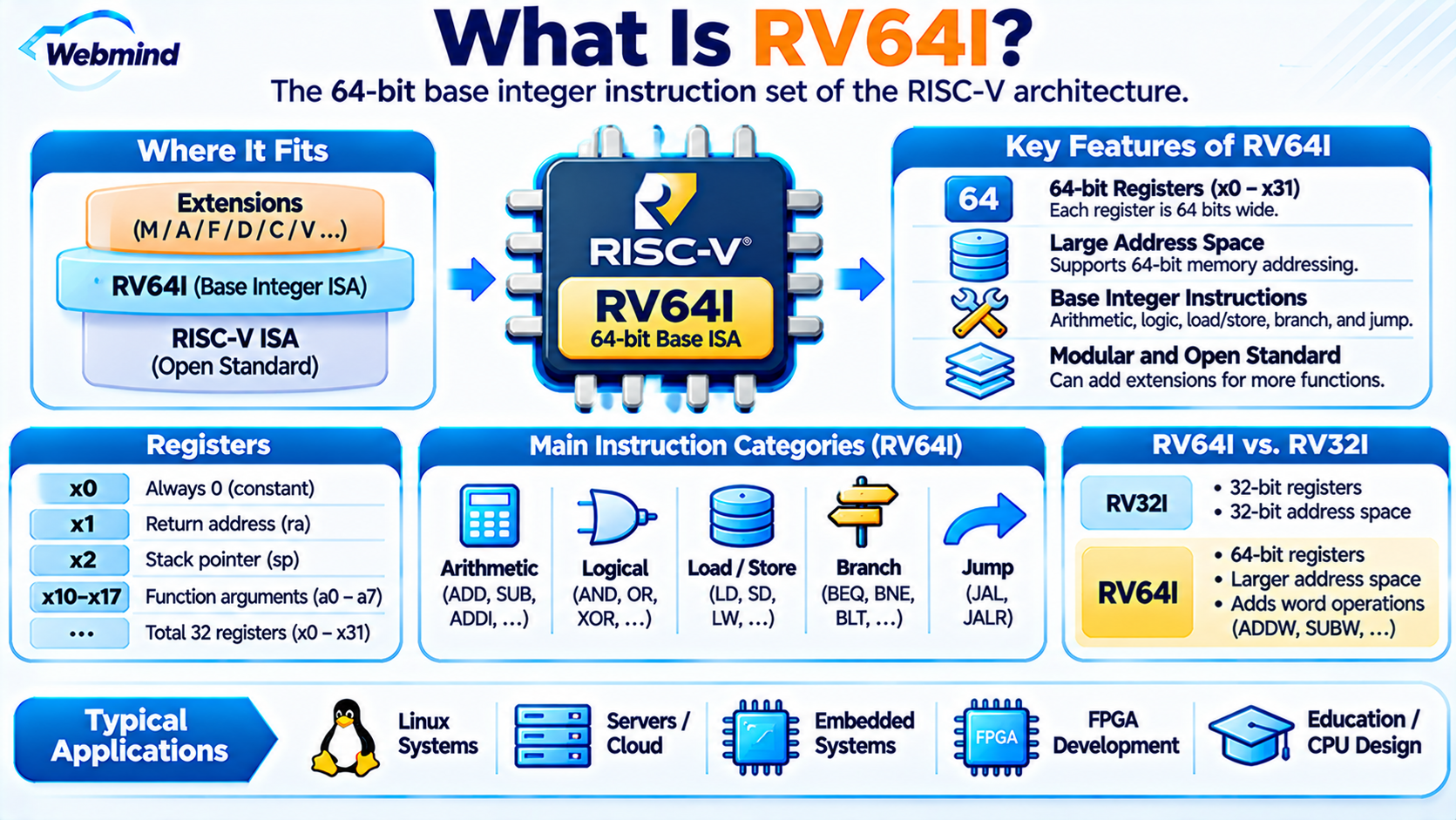
RV64I is the 64-bit base integer instruction set of the RISC-V architecture.
It defines the fundamental instructions, registers, and execution rules used by compatible 64-bit RISC-V processors.
RV64I supports integer arithmetic, logical operations, memory access, conditional branches, and program control while providing 64-bit general-purpose registers.
RV64I is an important foundation for RISC-V processors used in embedded Linux systems, application processors, servers, research platforms, and FPGA-based computer designs.
Compared with the 32-bit RV32I architecture, RV64I supports wider integer calculations and a larger architectural address space.
However, RV64I is not a particular processor chip.
It is an Instruction Set Architecture (ISA) that different processor designs can implement using different hardware structures, pipelines, caches, and memory systems.
What Does RV64I Mean?
The name RV64I contains three parts.
RV stands for RISC-V, an open-standard Instruction Set Architecture based on Reduced Instruction Set Computer principles.
64 indicates that the processor uses a 64-bit integer register width, known as XLEN.
General-purpose registers hold 64-bit values, allowing the processor to perform integer operations using this width.
I represents the base integer instruction set, which provides the fundamental operations required for general-purpose integer processing.
RV64I defines the basic integer architecture.
Additional functionality, including multiplication, floating-point arithmetic, atomic operations, and vector processing, is provided through optional or separately specified extensions.
How Does an RV64I Processor Work?
An RV64I processor executes machine instructions according to the RISC-V specification.
The processor fetches instructions from memory, decodes their fields, performs the required operations, and updates its architectural state.
For example, an ADD instruction reads two 64-bit register values, performs addition, and writes the result into a destination register.
Load instructions transfer information from memory into registers, while store instructions transfer register values into memory.
Branch and jump instructions control the execution sequence.
A simplified execution process is:
Instruction Fetch → Decode → Execute → Memory Access → Write Back
This sequence represents a common conceptual processor datapath.
Actual implementations may use single-cycle, multicycle, pipelined, superscalar, or out-of-order designs.
RV64I specifies the behavior of instructions but does not require a particular microarchitecture.
RV64I Registers
RV64I provides 32 general-purpose integer registers, named x0 through x31.
Each register is 64 bits wide.
Register x0 always reads as zero, and attempts to write to it do not change its value.
The remaining registers store integer values, addresses, and intermediate results.
The processor also maintains a Program Counter (PC), which identifies the address associated with instruction execution.
Software conventions assign particular roles to several registers.
For example, x1 is conventionally called ra and is used as the return-address register, while x2 is called sp and is used as the stack pointer.
Registers x10 through x17 are conventionally named a0 through a7 and are used to pass function arguments.
These register roles are defined by the RISC-V Application Binary Interface (ABI), which allows independently compiled software components to interact correctly.
RV64I vs. RV32I
RV32I and RV64I share many architectural principles, but they use different integer register widths.
RV32I provides 32-bit general-purpose registers and a 32-bit architectural address space.
RV64I provides 64-bit general-purpose registers and supports wider integer values and addresses.
For example, RV32I arithmetic instructions normally produce 32-bit results, while RV64I arithmetic instructions normally operate on 64-bit values.
RV64I also introduces instructions specifically designed for 32-bit operations within 64-bit registers.
These differences influence software compilation, data representation, memory addressing, and processor hardware design.
RV32I is often suitable for smaller embedded processors, while RV64I is commonly selected for more capable computing systems.
However, a 64-bit architecture does not automatically make a processor faster than a 32-bit design. Performance depends on the complete processor implementation.
Arithmetic Instructions in RV64I
RV64I includes fundamental integer arithmetic instructions.
ADD adds two 64-bit register values and stores the result in a destination register.
For example, add x5, x6, x7 adds the values in x6 and x7 and stores the result in x5.
SUB performs subtraction, while ADDI adds a sign-extended immediate value to a register.
RV64I arithmetic generally produces results modulo 2 to the power of 64. Integer overflow does not automatically generate an exception.
The architecture also includes 32-bit word arithmetic instructions such as ADDW, SUBW, and ADDIW.
These instructions operate on 32-bit values and sign-extend their results to 64 bits.
Word arithmetic instructions are useful when processing 32-bit integers within a 64-bit execution environment.
Multiplication and division are not part of the RV64I base instruction set. They require the M extension or suitable software routines.
Logical and Shift Instructions
RV64I provides bitwise logical instructions for manipulating binary data.
AND, OR, and XOR perform the corresponding bitwise operations on register values.
Immediate forms such as ANDI, ORI, and XORI allow operations involving constants.
Shift instructions include SLL, SRL, and SRA.
SLL performs a logical left shift, SRL performs a logical right shift, and SRA performs an arithmetic right shift.
RV64I also provides word shift instructions such as SLLW, SRLW, and SRAW, which operate on 32-bit values and sign-extend the results.
These instructions are important in low-level software, bit manipulation, data processing, and hardware register operations.
Load and Store Instructions
RV64I follows a load/store architecture.
Arithmetic instructions generally operate on registers, while dedicated instructions move data between memory and registers.
RV64I supports byte, halfword, word, and doubleword memory accesses.
For example, LD (Load Doubleword) loads a 64-bit value from memory into a register.
SD (Store Doubleword) stores a 64-bit register value into memory.
The instruction ld x5, 0(x6) loads a 64-bit value from the memory address held in x6.
The instruction sd x5, 0(x6) stores the 64-bit value in x5 to that memory address.
RV64I also includes LW and LWU for loading 32-bit words.
LW sign-extends a 32-bit value to 64 bits, while LWU zero-extends it.
These differences matter when software processes signed and unsigned integer values.
Branch and Jump Instructions
RV64I supports conditional branches and unconditional jumps.
BEQ branches when two registers contain equal values, while BNE branches when the values differ.
Other instructions support signed and unsigned comparisons.
For example, BLT performs a signed less-than comparison, while BLTU performs an unsigned less-than comparison.
RV64I also supports JAL and JALR instructions for jumps and function calls.
JAL can save a return address while transferring execution to another instruction location.
JALR supports indirect jumps, including common function-return operations.
These instructions form the foundation of loops, conditional statements, function calls, and other program control structures.
RV64I Instruction Formats
RV64I inherits the regular instruction encoding approach used by the RISC-V base architecture.
The base instructions use 32-bit instruction encodings, even though the processor’s general-purpose registers are 64 bits wide.
This distinction is important: a 64-bit processor does not necessarily use 64-bit-long machine instructions.
RV64I uses instruction formats including R-type, I-type, S-type, B-type, U-type, and J-type.
These formats organize fields such as opcodes, register identifiers, and immediate values.
For example, R-type instructions commonly operate on register operands, while I-type instructions include an immediate field.
Load, store, branch, and jump instructions use formats appropriate for their operations.
Additional RISC-V extensions may introduce other instruction encodings, including compressed 16-bit instructions when the C extension is supported.
RV64I and Memory Addressing
One of the major advantages of RV64I is its support for 64-bit architectural addresses.
A 64-bit register can represent a much larger range of address values than a 32-bit register.
However, this does not mean every RV64I processor implements a complete physical or virtual address space covering all possible 64-bit addresses.
Actual physical address support depends on the processor implementation.
Virtual memory support depends on the privileged architecture and implemented memory-management features.
For example, RISC-V systems may support virtual-memory schemes such as Sv39, Sv48, and other specified modes.
These mechanisms are important for operating systems that require virtual address spaces, process isolation, and memory protection.
A basic RV64I processor without appropriate privileged features or an MMU does not automatically support virtual memory.
RV64I and the RISC-V ABI
An Application Binary Interface (ABI) defines low-level conventions used by compiled software.
It specifies how function arguments are passed, how return values are represented, how registers are preserved, and how data types are organized.
For RV64I processors, the LP64 ABI is a common choice for software that uses 64-bit pointers and long integers.
Other ABI variants support different floating-point calling conventions.
For example, LP64D is commonly used on 64-bit RISC-V Linux systems with the required floating-point extensions.
Software compiled for one ABI may not be compatible with libraries built for a different ABI.
Therefore, compilers, linkers, runtime libraries, and operating-system components must use compatible settings.
RV64I Instruction Set Extensions
RV64I provides the base integer architecture, while extensions add specialized capabilities.
The M extension adds integer multiplication and division.
The A extension adds atomic memory operations used in synchronization and concurrent programming.
The F extension provides single-precision floating-point operations, while the D extension provides double-precision floating-point operations.
The C extension supports compressed instruction encodings that can reduce program size.
The V extension provides vector processing instructions suitable for data-parallel workloads.
Other extensions support bit manipulation, cryptographic operations, and additional processor functionality.
A processor supporting RV64I does not automatically implement all these extensions.
Software must be compiled for the specific features supported by the target processor.
RV64I and Linux
RV64I is an important foundation for processors running 64-bit Linux.
However, RV64I alone does not provide everything required by a conventional Linux operating system.
A Linux-capable processor generally needs suitable privilege modes, virtual-memory support, timers, interrupt handling, and sufficient memory.
The RISC-V privileged architecture defines mechanisms for operating-system execution.
A typical RISC-V Linux platform may use Machine Mode for low-level firmware, Supervisor Mode for the Linux kernel, and User Mode for applications.
Boot environments may include OpenSBI and U-Boot, depending on platform architecture.
Once Linux starts, it provides process scheduling, virtual memory, device drivers, networking, and filesystem services.
RV64I supplies the underlying integer instruction-set foundation on which these software components execute.
RV64I in Embedded Systems
Although RV32I is commonly associated with smaller embedded processors, RV64I can also be used in embedded systems.
High-performance embedded devices may require larger memory spaces, wider integer operations, or the ability to run complex operating systems.
Examples include industrial computing platforms, networking equipment, edge-computing devices, and embedded Linux boards.
An RV64I-based processor can execute firmware or operating-system software depending on its hardware capabilities.
Some systems use a small real-time operating system, while others run Linux.
The appropriate software environment depends on memory capacity, peripheral support, processor features, and application requirements.
RV64I in FPGA Development
RV64I can be implemented as a soft-core processor inside an FPGA.
An FPGA is a programmable integrated circuit capable of implementing custom digital logic.
A soft-core CPU is a processor built using the FPGA’s programmable logic resources rather than a fixed processor circuit.
An RV64I soft-core implementation typically includes a 64-bit register file, arithmetic logic unit, instruction decoder, Program Counter, control logic, and memory interfaces.
Compared with a simple RV32I implementation, an RV64I design generally requires wider datapaths and registers.
This can increase logic resource usage and influence timing performance.
For example, a 64-bit ALU processes wider values than a 32-bit ALU, potentially requiring more FPGA logic resources.
FPGA implementations allow engineers to experiment with processor pipelines, caches, memory controllers, and architectural extensions.
Building an RV64I Processor
A basic RV64I CPU can be organized into several hardware blocks.
The Program Counter tracks instruction execution addresses.
The Instruction Memory supplies machine instructions.
The Instruction Decoder extracts opcodes, register identifiers, and immediate values.
The Register File stores 32 general-purpose registers, each 64 bits wide.
The Arithmetic Logic Unit (ALU) performs 64-bit arithmetic and logical operations.
The Control Unit coordinates instruction execution and determines how data moves through the processor.
The Load/Store Unit handles memory accesses.
A simple processor may execute instructions using a multicycle datapath, while a more advanced design may use pipelining.
Designers must also implement correct handling of instruction alignment, branches, exceptions, and other architectural requirements.
A fully compliant processor requires more than simply building an ALU and register file.
RV64I and Compiler Toolchains
Software for RV64I processors can be developed using standard RISC-V toolchains.
GCC and LLVM/Clang support 64-bit RISC-V targets.
The compiler generates machine instructions according to the selected architecture and ABI.
The assembler converts assembly instructions into object code, while the linker combines object files and libraries into an executable program.
For example, a toolchain configuration may select rv64imac as the target architecture and an appropriate ABI for its execution environment.
The resulting executable can run on a processor supporting the required instruction extensions and platform interfaces.
Developers can use GDB for debugging and tools such as QEMU or Spike for supported simulation and emulation tasks.
These tools are valuable for software development before physical hardware becomes available.
RV64I and High-Performance Computing
RV64I provides the architectural foundation for more advanced 64-bit RISC-V processor implementations.
High-performance processors may add multiple execution units, branch prediction, out-of-order execution, large caches, and multicore capabilities.
They may also implement vector and floating-point extensions to accelerate scientific calculations, signal processing, and other workloads.
However, RV64I itself does not guarantee high performance.
The instruction set defines software-visible behavior, while the processor’s microarchitecture determines how efficiently instructions are executed.
Memory bandwidth, cache design, compiler optimization, and manufacturing technology also influence performance.
This distinction is important when comparing RISC-V processors with ARM and x86 systems.
Advantages of RV64I
RV64I offers several important advantages.
It provides 64-bit integer registers and supports larger architectural address spaces than RV32I.
Its instruction formats are relatively regular, helping simplify aspects of instruction decoding.
Its modular design allows processor manufacturers to select additional features according to their requirements.
The open-standard RISC-V architecture also allows organizations to create compatible processor implementations without proprietary ISA licensing fees.
RV64I supports software development across embedded systems, Linux platforms, research processors, and advanced computer architectures.
These characteristics make it a useful foundation for both commercial processor development and computer engineering education.
Limitations of RV64I
RV64I also has limitations.
A 64-bit processor may require more register storage, wider datapaths, and additional hardware resources than a comparable 32-bit design.
Programs using 64-bit pointers may also consume more memory for certain data structures.
The base RV64I instruction set does not include multiplication, floating-point arithmetic, atomic operations, or vector instructions without additional extensions.
Furthermore, RV64I alone does not define a complete operating-system platform, memory controller, or peripheral system.
These components must be provided by the processor implementation and surrounding hardware.
For small microcontrollers with strict power and memory constraints, RV32I or RV32E may be more appropriate.
Why Is RV64I Important?
RV64I demonstrates how RISC-V scales from embedded 32-bit processors to more capable 64-bit computing systems.
It provides a standardized instruction-set foundation for processor designers, compiler developers, operating-system engineers, and hardware researchers.
Understanding RV64I helps explain 64-bit registers, memory addressing, calling conventions, instruction decoding, and software compatibility.
It is also valuable for FPGA engineers who want to design more advanced processor cores or study the hardware costs of wider datapaths.
For students familiar with RV32I, learning RV64I provides a natural next step toward understanding Linux-capable RISC-V processors and modern computer architecture.
Conclusion
RV64I is the 64-bit base integer instruction set of the RISC-V architecture.
It defines the fundamental machine instructions, 64-bit general-purpose registers, and execution behavior needed for compatible processor implementations.
Compared with RV32I, RV64I supports wider integer operations and a larger architectural address space while maintaining the modular RISC-V design philosophy.
Additional extensions provide multiplication, floating-point arithmetic, atomic operations, compressed instructions, and vector processing.
RV64I is an important foundation for embedded Linux systems, advanced RISC-V processors, and FPGA-based CPU development.
Understanding RV64I provides essential knowledge for studying 64-bit processor design, instruction set architecture, memory management, operating systems, and modern computing hardware.