Introduction
An MMU, or Memory Management Unit, is a hardware component that manages memory address translation and helps enforce memory protection in a computer system.
It is commonly integrated into modern CPUs and plays an essential role in operating systems such as Linux, Windows, and macOS.
The MMU allows software to use virtual memory addresses instead of directly accessing physical RAM addresses.
This provides isolation between processes, improves memory management, and enables multiple applications to run safely on the same computer.
MMUs are widely used in desktop processors, servers, smartphones, embedded systems, and advanced Systems-on-Chip (SoCs).
How Does an MMU Work?
When a program accesses memory, it typically uses a virtual address.
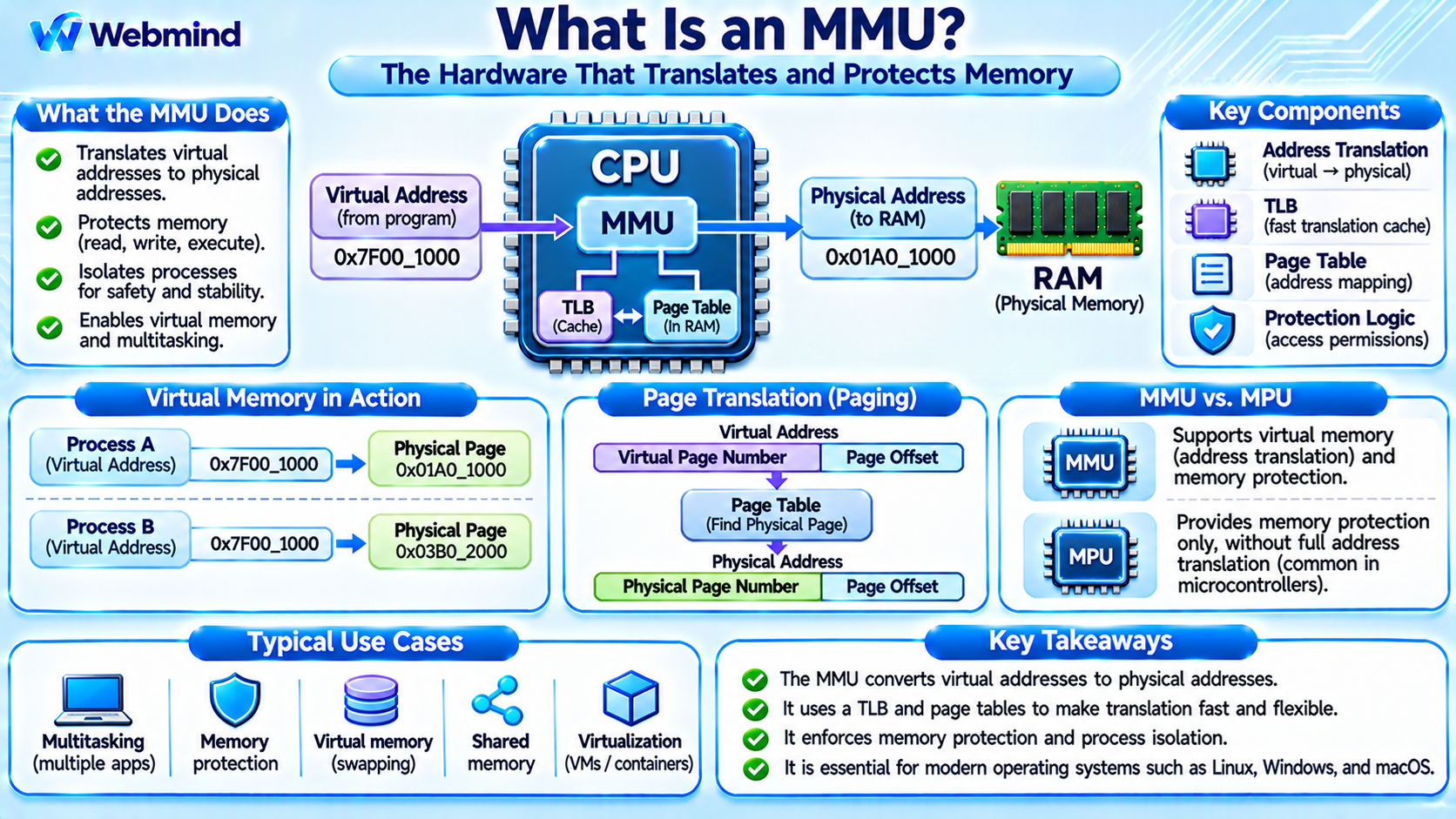
The MMU translates this virtual address into a physical address that identifies a location in the system’s physical address space.
For example, two applications may both use the same virtual memory address, but the operating system can configure their address mappings to point to different physical memory locations.
The MMU performs address translation using information maintained by the operating system, commonly stored in structures called page tables.
During a memory access, the processor checks whether the requested virtual address has a valid mapping and whether the operation is permitted.
If the mapping is valid, the memory access can continue using the translated address.
If the mapping is missing or violates access permissions, the processor may generate an exception called a page fault.
This mechanism allows operating systems to provide separate virtual address spaces for different processes.
Main Components of an MMU
A modern memory management system typically involves several important hardware components and data structures.
Address Translation Logic: Converts virtual addresses into physical addresses according to the active memory mapping.
Translation Lookaside Buffer (TLB): A small, high-speed cache that stores recently used address translations, reducing the need for repeated page-table lookups.
Page Table Walker: Hardware that reads page-table entries from memory when the required translation is not available in the TLB. Some architectures also support software-assisted translation mechanisms.
Access Permission Logic: Checks whether a memory operation is allowed, including read, write, execute, and privilege-related permissions.
Control Registers: Store configuration information such as the active page-table location and memory translation settings.
Fault Detection Logic: Identifies invalid translations and memory protection violations, allowing the processor to generate the appropriate exception.
The exact implementation depends on the processor architecture.
What Is Virtual Memory?
Virtual memory is a memory-management mechanism that gives processes their own virtual address spaces.
Instead of allowing applications to directly manage physical RAM locations, the operating system controls mappings between virtual addresses and physical memory.
This provides several advantages.
Process Isolation: Applications can operate in separate address spaces, reducing the risk that one program accidentally modifies another program’s memory.
Memory Protection: The operating system can restrict access to selected memory regions.
Flexible Memory Allocation: Programs can use virtual address ranges without requiring corresponding physical pages to be contiguous.
Shared Memory: Multiple processes can map selected physical memory pages into their respective virtual address spaces.
Demand Paging: The operating system can allocate or load physical memory pages when they are needed.
Virtual memory also enables techniques such as swapping, where selected memory contents can be moved between RAM and secondary storage.
However, virtual memory does not mean that all allocated virtual memory must always exist in physical RAM.
How Does Address Translation Work?
Modern MMUs commonly use paging to translate memory addresses.
Memory is divided into fixed-size blocks called pages. Physical memory is organized into corresponding blocks called page frames.
A commonly supported page size is 4 KiB, although many architectures also support larger pages.
A virtual address can be divided into two main parts:
Virtual Page Number: Identifies the virtual page that the program wants to access.
Page Offset: Identifies the exact byte location within that page.
The MMU translates the virtual page number into a physical page frame number while preserving the page offset.
For example, if a virtual page maps to a particular physical page frame, the same offset is used to identify the corresponding byte within that physical frame.
Modern processors often use multilevel page tables to manage large virtual address spaces efficiently.
What Is a Translation Lookaside Buffer (TLB)?
The Translation Lookaside Buffer is a specialized cache used to accelerate virtual-to-physical address translation.
Without a TLB, the processor might need to access page tables in memory repeatedly to translate addresses.
A TLB stores recently used mappings, allowing many address translations to complete quickly.
When the required mapping is present, a TLB hit occurs.
When the mapping is missing, a TLB miss occurs. The processor must obtain the translation through a page-table walk or another architecture-specific mechanism.
A TLB miss is not necessarily a page fault. If a valid mapping exists in the page tables, the translation can be loaded into the TLB and execution can continue.
Modern processors may contain separate instruction and data TLBs, along with multiple levels of translation caches.
What Is a Page Fault?
A page fault occurs when a memory access cannot be completed using the current virtual memory mapping or violates a relevant protection rule.
For example, a page fault may occur when a program accesses a virtual page that has not yet been mapped to physical memory.
The processor generates an exception, transferring control to an operating system handler.
The operating system then determines how to respond.
If the access is valid, the operating system may allocate a physical page, load data from storage, or update the relevant page-table entry.
The program can then resume execution.
If the access is invalid, the operating system may terminate the program or report an access violation.
In Linux, certain invalid memory accesses can result in a segmentation fault, commonly reported as SIGSEGV.
Not every page fault indicates a software error. Many page faults are normal parts of virtual memory management.
MMU vs. Memory Controller: What Is the Difference?
The MMU and memory controller are both important components of the memory system, but they perform different tasks.
Memory Management Unit (MMU): Translates virtual addresses into physical addresses and enforces memory access permissions.
Memory Controller: Manages communication with physical RAM, including DRAM commands, timing, scheduling, and data transfers.
For example, when a CPU executes a load instruction, the MMU-related translation hardware determines the physical address associated with the requested virtual address.
If the data must be retrieved from RAM, the memory controller coordinates the required DRAM access.
The MMU therefore manages address translation and protection, while the memory controller manages physical memory communication.
MMU vs. MPU: What Is the Difference?
An MPU, or Memory Protection Unit, is another hardware mechanism used to protect memory.
An MMU generally supports virtual-to-physical address translation and page-based memory protection.
An MPU typically provides memory access protection without full virtual memory address translation.
MPUs are commonly found in smaller microcontrollers, where applications may not require sophisticated virtual memory management.
For example, many Arm Cortex-M microcontrollers include an optional MPU that can define protected memory regions.
More powerful application processors, such as Arm Cortex-A devices, commonly include MMUs capable of supporting operating systems with virtual memory.
An MPU can provide important safety and security features with lower hardware complexity, but it does not offer the same virtual memory capabilities as a conventional MMU.
MMUs in Different Processor Architectures
Different CPU architectures implement memory management using different mechanisms.
x86-64: Supports paged virtual memory, multiple privilege levels, TLBs, and hardware-assisted page-table traversal. Modern implementations may support four-level or five-level paging.
Arm: Application-class Arm processors commonly support virtual memory through architectural translation tables and TLBs. Arm systems may also provide separate translation stages for virtualization.
RISC-V: The RISC-V privileged architecture defines virtual memory schemes such as Sv32, Sv39, Sv48, and Sv57. These provide different virtual address sizes and page-table structures.
Microcontrollers: Smaller embedded processors may use an MPU or operate without an MMU, depending on their intended applications.
The presence of an MMU is particularly important for operating systems that require process isolation and advanced virtual memory management.
What Is an IOMMU?
An IOMMU, or Input/Output Memory Management Unit, provides address translation and memory protection for certain hardware device accesses.
While a CPU MMU manages memory translations for processor-generated accesses, an IOMMU manages device-generated memory transactions, commonly involving Direct Memory Access (DMA).
For example, a PCIe device may use DMA to read or write system memory.
An IOMMU can restrict the memory regions that the device is permitted to access and translate device-visible addresses into system physical addresses.
This improves security, device isolation, and support for virtualization.
Technologies such as Intel VT-d and AMD IOMMU provide I/O memory-management capabilities on supported platforms.
MMU and Operating System Security
Memory protection is one of the MMU’s most important functions.
Modern operating systems rely on the MMU to separate application memory from kernel memory and to isolate processes from one another.
Page-table entries can specify whether a memory page is readable, writable, executable, or accessible only at particular privilege levels.
For example, executable code pages may be configured as non-writable, while certain data pages may be marked non-executable.
This supports security mechanisms such as Data Execution Prevention (DEP) and Write XOR Execute (W^X) policies.
The MMU also supports Address Space Layout Randomization (ASLR) by enabling flexible virtual address mappings.
However, memory protection depends on both hardware capabilities and correct operating system configuration.
An MMU alone cannot prevent every memory-related security vulnerability.
Why Is an MMU Important?
An MMU enables several important capabilities in modern computing.
Multitasking: Multiple applications can execute with separate virtual address spaces.
Memory Protection: Processes and operating system components can be protected from unauthorized memory accesses.
Efficient Memory Allocation: Virtual pages can map to physical memory without requiring large contiguous physical regions.
Shared Memory: Processes can share selected memory pages when permitted by the operating system.
Virtualization: Advanced MMU mechanisms support guest operating systems and virtual machines through additional address translation stages.
Operating System Support: Full-featured systems such as Linux, Windows, and macOS rely on MMU capabilities for their normal virtual memory operation.
These features make the MMU a fundamental component of modern processor architecture.
Conclusion
A Memory Management Unit is a hardware component responsible for virtual-to-physical address translation and memory access protection.
By working with page tables, TLBs, and operating system memory-management mechanisms, the MMU allows multiple applications to operate in separate virtual address spaces while efficiently using physical memory.
MMUs are essential in modern CPUs, servers, smartphones, and application-class embedded processors.
Simpler microcontrollers may instead use Memory Protection Units or operate without hardware memory protection.
Understanding MMUs provides an important foundation for studying CPU architecture, virtual memory, Linux memory management, page tables, operating system security, RISC-V processors, and computer hardware design.