Introduction
CMOS, or Complementary Metal-Oxide-Semiconductor, is a semiconductor technology widely used to manufacture modern digital integrated circuits.
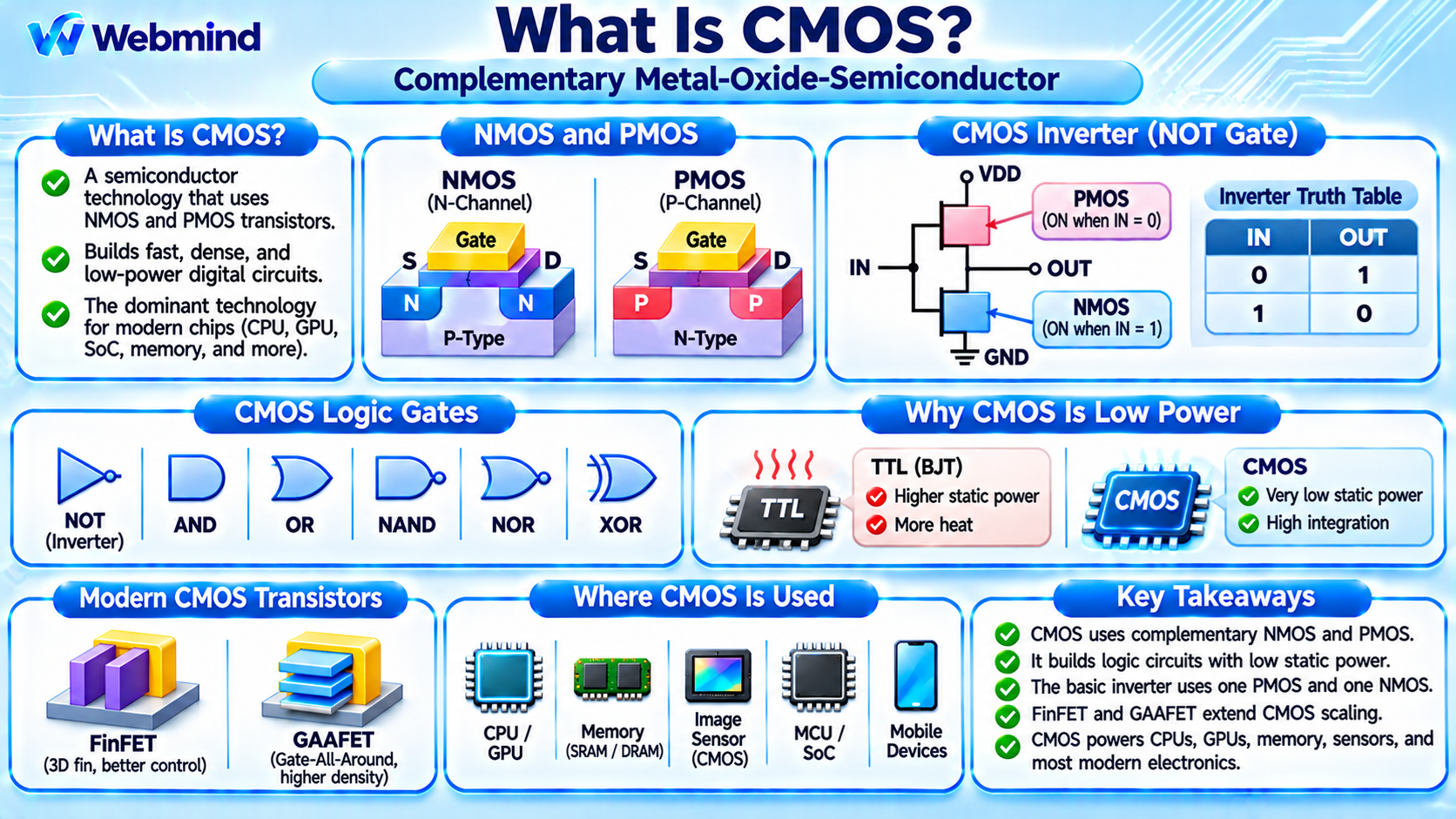
It combines two types of transistors, NMOS and PMOS, to create logic circuits that operate efficiently with relatively low power consumption.
CMOS technology forms the foundation of most modern CPUs, GPUs, microcontrollers, memory-related logic, Systems-on-Chip (SoCs), and many other semiconductor devices.
One of the most important advantages of CMOS is its ability to implement complex digital circuits while consuming relatively little static power during stable logic states.
This efficiency has made CMOS the dominant technology for modern digital chip design.
How Does CMOS Work?
CMOS circuits use complementary pairs of Metal-Oxide-Semiconductor Field-Effect Transistors (MOSFETs).
The two main types are NMOS and PMOS transistors.
NMOS (N-Channel MOSFET): Typically conducts when its gate voltage is sufficiently higher than its source voltage.
PMOS (P-Channel MOSFET): Typically conducts when its gate voltage is sufficiently lower than its source voltage.
In a typical static CMOS logic gate, NMOS and PMOS transistor networks work together to control the output voltage.
When the output is driven high, the PMOS network provides a connection toward the positive supply voltage. When the output is driven low, the NMOS network provides a connection toward ground.
During stable operation, one network is normally off, reducing direct current flow between the power supply and ground.
This complementary operation is the central principle behind CMOS digital logic.
How Does a CMOS Inverter Work?
The simplest CMOS logic circuit is an inverter, also called a NOT gate.
A CMOS inverter contains two transistors: one PMOS transistor connected toward the positive supply voltage (VDD) and one NMOS transistor connected toward ground (GND).
Both transistor gates receive the same input signal, and their drain terminals are connected to form the output.
When Input = 0:
The PMOS transistor turns on, while the NMOS transistor turns off. The output is pulled toward VDD, producing a logical one.
When Input = 1:
The PMOS transistor turns off, while the NMOS transistor turns on. The output is pulled toward ground, producing a logical zero.
Therefore, the output is always the logical opposite of the input under normal operating conditions.
This simple circuit demonstrates how CMOS transistors implement binary logic.
CMOS Logic Gates
CMOS technology can implement all fundamental digital logic operations.
NOT Gate: Uses a basic CMOS inverter to reverse the input logic value.
NAND Gate: Commonly uses two PMOS transistors in parallel and two NMOS transistors in series for a two-input implementation.
NOR Gate: Commonly uses two PMOS transistors in series and two NMOS transistors in parallel for a two-input implementation.
AND Gate: Can be implemented using a NAND gate followed by an inverter.
OR Gate: Can be implemented using a NOR gate followed by an inverter.
XOR Gate: Uses a more complex transistor arrangement to produce a high output when its inputs differ.
These logic gates are combined to build multiplexers, adders, decoders, registers, and other digital circuits.
Millions or billions of CMOS transistors can work together to execute the instructions of a modern processor.
Why Does CMOS Consume Less Power?
CMOS became popular largely because of its low static power consumption compared with many earlier logic technologies.
In an ideal CMOS circuit, little direct current flows between the power supply and ground when the inputs and outputs remain stable.
However, real CMOS circuits still consume power.
Dynamic Power: Energy is consumed when transistors switch and electrical capacitances are charged or discharged.
Leakage Power: Small currents flow through transistors even when they are intended to be off.
Short-Circuit Power: During switching, NMOS and PMOS networks may briefly conduct simultaneously.
A simplified relationship for dynamic CMOS power is:
P = α × C × V² × f
Where α represents switching activity, C represents effective capacitance, V is the supply voltage, and f is the clock frequency.
This relationship explains why reducing voltage, limiting unnecessary switching, and using clock gating can improve processor energy efficiency.
CMOS in Modern CPUs and GPUs
Modern CPUs and GPUs are built primarily using CMOS semiconductor technology.
Inside a CPU, CMOS circuits implement arithmetic logic units, control circuits, registers, cache memory, instruction decoders, and other processing components.
GPUs use CMOS technology to create large numbers of parallel execution units, memory interfaces, and specialized computing circuits.
A modern processor may contain tens of billions of transistors manufactured using advanced CMOS processes.
Although these processors operate at high frequencies and consume significant power under heavy workloads, CMOS makes their level of integration practical.
Without highly integrated CMOS technology, modern computing systems would be much larger and less energy-efficient.
CMOS and Semiconductor Manufacturing
CMOS devices are fabricated on semiconductor wafers using processes such as photolithography, deposition, etching, ion implantation, and metallization.
Engineers form NMOS and PMOS transistors in appropriately doped semiconductor regions and connect them through multiple layers of metal interconnects.
Historically, most CMOS transistors used planar MOSFET structures.
As transistor dimensions became smaller, manufacturers introduced advanced three-dimensional designs.
FinFET: Uses a fin-shaped semiconductor channel with the gate controlling multiple sides of the channel.
GAAFET (Gate-All-Around FET): Uses structures such as nanosheets or nanowires surrounded by the gate to improve electrostatic control.
These technologies extend CMOS scaling by improving transistor control and reducing certain leakage problems.
CMOS therefore refers to the complementary circuit technology, not one specific transistor shape.
CMOS vs. TTL: What Is the Difference?
TTL, or Transistor-Transistor Logic, is an older digital logic technology based primarily on bipolar junction transistors.
TTL was widely used in early computers and digital electronic systems.
CMOS uses complementary MOSFETs and typically provides much lower static power consumption and greater integration density.
TTL circuits historically offered competitive switching performance in many applications, but CMOS technology improved significantly over time.
Today, CMOS dominates modern digital integrated circuit manufacturing.
The terms TTL and CMOS may also describe logic voltage-level conventions in some electronic interfaces, although actual voltage compatibility depends on the specific devices and standards.
CMOS in SRAM and Memory Circuits
CMOS technology is essential for many semiconductor memory structures.
A conventional six-transistor SRAM cell uses CMOS transistor circuits to store one bit of information.
SRAM is commonly used in CPU caches because it provides fast data access without periodic refresh.
Modern DRAM devices also use CMOS peripheral circuitry for address decoding, control, and data interfaces, although conventional DRAM storage cells use a capacitor and an access transistor.
Flash memory chips also rely on CMOS-based logic for their control and interface circuits.
Thus, CMOS technology supports both computation and memory-system operation.
CMOS Sensors and Other Applications
CMOS technology is not limited to digital logic.
CMOS Image Sensors: Convert incoming light into electrical signals using arrays of pixels and integrated readout circuitry. They are widely used in smartphones, digital cameras, and automotive imaging systems.
Microcontrollers: Integrate CMOS processor cores, memory, and peripheral controllers into compact chips.
Communication Systems: Use CMOS circuits for digital processing and many radio-frequency functions.
Power Management: CMOS-based control circuits regulate and monitor electrical power in electronic devices.
Mixed-Signal Integrated Circuits: Combine analog and digital CMOS circuitry for applications such as data conversion and sensor processing.
The versatility of CMOS makes it one of the most important technologies in semiconductor engineering.
Challenges of CMOS Technology
Despite its advantages, CMOS presents several engineering challenges.
Leakage Current: As transistors become smaller, controlling unwanted current becomes increasingly difficult.
Power Density: High transistor density and switching activity can generate substantial heat.
Interconnect Delay: Signals traveling through chip wiring can become a major performance limitation.
Manufacturing Complexity: Advanced transistor structures require sophisticated fabrication equipment and precise process control.
Cost: Developing and manufacturing chips using leading-edge CMOS technologies can require substantial investment.
Engineers address these challenges through improvements in transistor structures, circuit design, power management, materials, and advanced semiconductor packaging.
Conclusion
CMOS is a semiconductor technology that combines complementary NMOS and PMOS transistors to implement efficient electronic circuits.
Its relatively low static power consumption, high integration density, and flexibility have made it the foundation of modern CPUs, GPUs, microcontrollers, memory-related logic, and many other integrated circuits.
From simple NOT gates to processors containing billions of transistors, CMOS enables the digital systems used throughout modern computing.
Understanding CMOS is an essential step toward studying MOSFETs, logic gates, digital circuit design, semiconductor manufacturing, FPGA and ASIC development, and modern processor architecture.