Introduction
A MOSFET, or Metal-Oxide-Semiconductor Field-Effect Transistor, is a semiconductor device that uses an electric field to control the flow of electrical current.
It is one of the most important components in modern electronics and the fundamental building block of most digital integrated circuits.
MOSFETs are widely used in CPUs, GPUs, memory chips, microcontrollers, FPGAs, ASICs, power supplies, and communication systems.
In digital circuits, MOSFETs operate primarily as electronic switches.
In analog and power electronics, they can control signals, regulate current, and switch electrical power.
Modern computer processors contain billions of MOSFET-based transistors working together to perform complex computing operations.
How Does a MOSFET Work?
A MOSFET controls current flow through a semiconductor channel using a voltage applied to its gate terminal.
Unlike a Bipolar Junction Transistor (BJT), which relies on charge-carrier injection controlled by a base-emitter junction, a MOSFET primarily uses an electric field to control the conductivity of its channel.
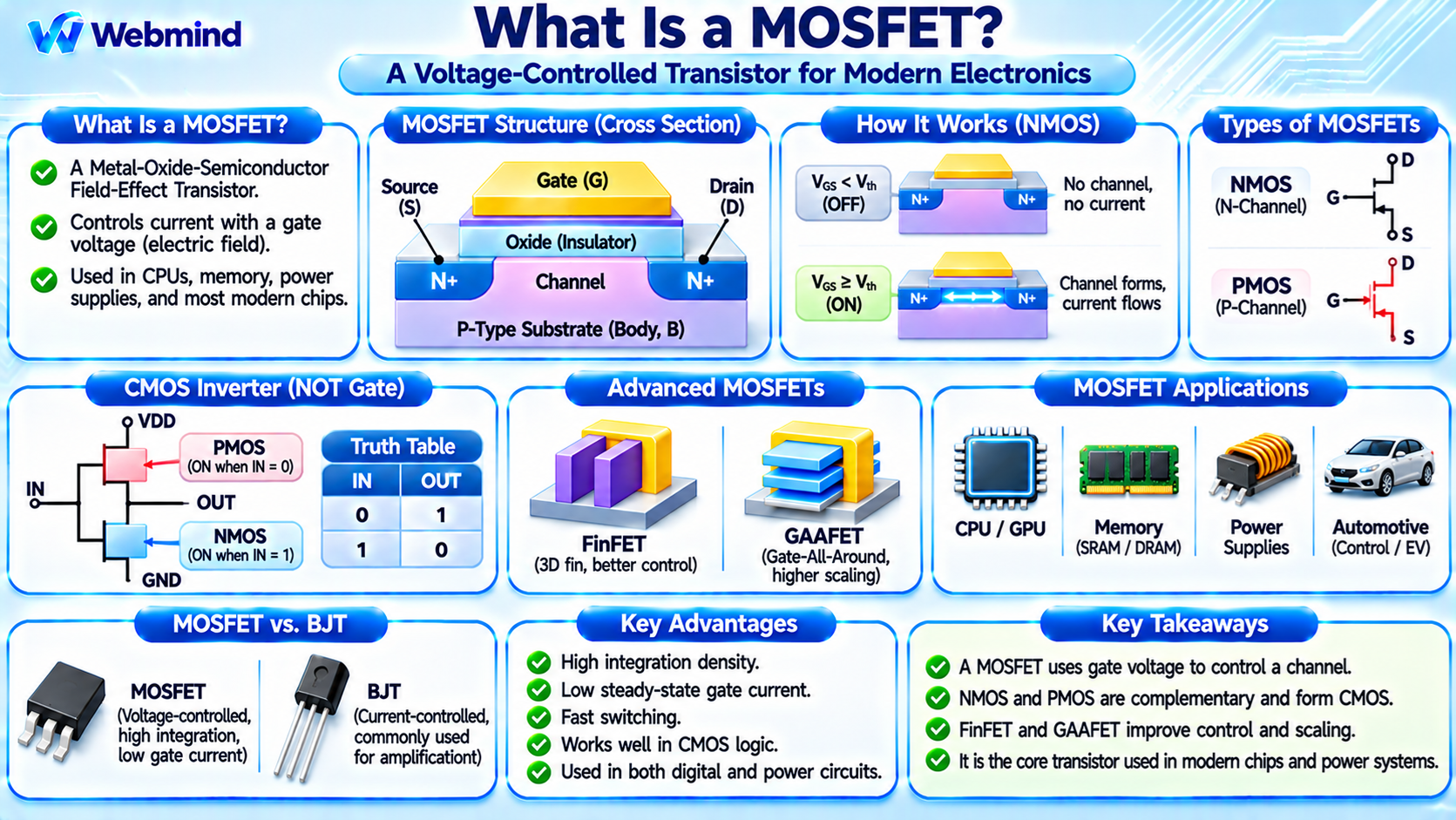
When an appropriate gate voltage is applied, a conducting channel can form between the source and drain terminals.
For example, in a typical enhancement-mode NMOS transistor, applying a sufficiently positive gate-to-source voltage creates a conducting channel, allowing current to flow between the drain and source when a suitable voltage is present.
When the gate voltage falls below the required threshold, the channel becomes much less conductive.
This ability to control conduction with voltage makes MOSFETs highly suitable for digital logic and electronic switching.
Main Components of a MOSFET
A MOSFET contains four electrical terminals, although the body terminal is often internally connected to the source in discrete devices.
Gate (G): The control terminal that uses an electric field to influence the conductivity of the channel.
Source (S): One terminal through which charge carriers enter or leave the channel, depending on device type and operating conditions.
Drain (D): The other main current-carrying terminal.
Body or Substrate (B): The semiconductor region in which the transistor is formed. Its voltage can influence the threshold voltage and other device characteristics.
Gate Dielectric: An insulating layer separating the gate electrode from the semiconductor channel. Traditional MOSFETs use silicon dioxide, while advanced devices may use high-k dielectric materials.
Channel: The semiconductor region between source and drain whose conductivity is controlled by the gate voltage.
Together, these structures allow the transistor to act as a voltage-controlled electronic device.
NMOS vs. PMOS: What Is the Difference?
MOSFETs are commonly classified into two major types.
NMOS (N-Channel MOSFET)
An NMOS transistor uses electrons as its primary charge carriers.
In a typical enhancement-mode NMOS device, a sufficiently positive gate-to-source voltage turns the transistor on.
NMOS transistors are commonly used to pull digital circuit outputs toward ground.
PMOS (P-Channel MOSFET)
A PMOS transistor uses holes as its primary charge carriers.
In a typical enhancement-mode PMOS device, a sufficiently negative gate-to-source voltage turns the transistor on.
PMOS transistors are commonly used to pull digital circuit outputs toward the positive supply voltage.
NMOS and PMOS devices are complementary and are commonly combined in CMOS digital logic circuits.
What Is MOSFET Threshold Voltage?
Threshold voltage, commonly represented as Vth, is an important MOSFET parameter.
It indicates the gate-to-source voltage associated with the onset of strong inversion in a conventional MOSFET model.
For a typical enhancement-mode NMOS device, increasing the gate-to-source voltage above the threshold produces a conducting inversion channel.
However, a MOSFET does not behave like an ideal switch that suddenly changes from zero current to maximum current at one exact voltage.
Some current may flow below the threshold voltage, known as subthreshold conduction.
The amount of current also depends on drain voltage, temperature, device dimensions, and semiconductor manufacturing characteristics.
Threshold voltage is therefore important for both switching performance and leakage power consumption.
Enhancement-Mode vs. Depletion-Mode MOSFETs
MOSFETs can also be classified according to their behavior when the gate-to-source voltage is zero.
Enhancement-Mode MOSFET: Normally off at zero gate-to-source voltage, assuming suitable terminal bias conditions. Applying an appropriate gate voltage creates or strengthens the conducting channel.
Depletion-Mode MOSFET: Normally conductive at zero gate-to-source voltage. Applying a suitable gate voltage can reduce channel conductivity and turn the device off.
Enhancement-mode MOSFETs are the most common type used in modern CMOS digital circuits and many power-switching applications.
How Are MOSFETs Used in CMOS Logic?
CMOS stands for Complementary Metal-Oxide-Semiconductor.
CMOS circuits combine NMOS and PMOS transistors to implement digital logic with relatively low static power consumption.
A simple CMOS inverter, also called a NOT gate, uses one PMOS transistor and one NMOS transistor.
When the input is low, the PMOS transistor conducts while the NMOS transistor is off. The output is pulled toward the positive supply voltage, representing logical one.
When the input is high, the NMOS transistor conducts while the PMOS transistor is off. The output is pulled toward ground, representing logical zero.
By combining additional MOSFETs, engineers construct NAND, NOR, AND, OR, XOR, and other logic gates.
These gates form larger circuits such as adders, multiplexers, registers, memory cells, and processor execution units.
MOSFETs in CPUs and GPUs
Modern processors rely heavily on MOSFET technology.
Inside a CPU, MOSFETs form arithmetic logic units, control circuits, registers, cache memory, and instruction-processing hardware.
A conventional SRAM memory cell commonly uses six transistors to store one bit of information.
GPUs use enormous networks of MOSFETs to create parallel processing units, memory interfaces, and specialized arithmetic hardware.
The high integration density and energy efficiency of CMOS MOSFETs make it possible to manufacture processors containing billions of transistors.
However, processor performance depends not only on transistor count but also on circuit architecture, clock frequency, memory organization, and power constraints.
MOSFETs in Power Electronics
MOSFETs are also widely used to control electrical power.
Power MOSFETs are designed to handle substantially higher currents or voltages than the tiny transistors used in digital logic.
Common applications include switching power supplies, DC-DC converters, battery-management systems, motor controllers, and automotive electronics.
For example, a DC-DC converter may rapidly switch a MOSFET on and off to control energy transfer through an inductor.
A MOSFET’s on-state resistance, commonly called RDS(on), is an important parameter because it contributes to conduction losses.
Switching speed, gate charge, voltage rating, and thermal performance also influence power MOSFET efficiency.
Silicon power MOSFETs remain widely used, while silicon carbide (SiC) and gallium nitride (GaN) devices provide advantages in selected high-voltage and high-frequency applications.
What Are FinFETs and GAAFETs?
Traditional MOSFETs use planar structures in which the channel lies near the surface of a semiconductor substrate.
As transistor dimensions became smaller, maintaining effective control of the channel became increasingly difficult.
Advanced semiconductor manufacturers developed new transistor structures to address these challenges.
FinFET
A FinFET uses a narrow, fin-shaped semiconductor channel.
The gate controls multiple sides of the fin, improving electrostatic control compared with conventional planar MOSFETs.
FinFETs became an important technology for advanced CPUs, GPUs, and SoCs.
GAAFET
A Gate-All-Around Field-Effect Transistor, or GAAFET, surrounds the semiconductor channel with the gate on all sides.
Modern implementations often use stacked nanosheets or nanowires.
This structure improves gate control and can reduce certain leakage effects, supporting continued transistor scaling.
FinFETs and GAAFETs are advanced field-effect transistor structures that extend the principles of MOSFET operation.
MOSFET vs. BJT: What Is the Difference?
MOSFETs and Bipolar Junction Transistors are both semiconductor devices used for switching and amplification, but their operating principles differ.
MOSFET: Controls channel conductivity through an electric field generated by gate voltage. Its insulated gate generally requires very little steady-state input current, although switching requires charging and discharging gate capacitance.
BJT: Uses charge-carrier injection across semiconductor junctions. In common operating configurations, a base current controls a larger collector current.
MOSFETs are particularly well suited for high-density CMOS digital circuits and many efficient power-switching applications.
BJTs remain useful in analog circuits, amplification, and applications requiring particular electrical characteristics.
Neither device type is universally better. The appropriate choice depends on voltage, current, switching frequency, gain, efficiency, and circuit requirements.
Advantages of MOSFETs
MOSFET technology offers several important advantages.
High Integration Density: Extremely small MOSFETs can be manufactured in large quantities on a single semiconductor chip.
Low Steady-State Gate Current: The insulated gate requires little direct current during normal operation.
Fast Switching: MOSFETs can support high-speed switching in digital and power-electronic circuits.
CMOS Compatibility: Complementary NMOS and PMOS devices enable efficient digital logic.
Scalability: Advanced transistor structures support continued improvements in semiconductor integration.
Versatility: MOSFETs are used in digital logic, analog circuits, power management, and communication systems.
Limitations of MOSFETs
MOSFETs also present several engineering challenges.
Gate Oxide Reliability: Excessive gate voltage or electrical stress can damage the gate dielectric.
Leakage Current: Small transistors may experience unwanted current even when nominally off.
Switching Losses: Charging and discharging gate and device capacitances consumes energy.
Heat Generation: Power MOSFETs can dissipate substantial power through conduction and switching losses.
Short-Channel Effects: Very small transistors experience electrostatic effects that complicate device scaling and leakage control.
Modern semiconductor design addresses these limitations through improved materials, transistor structures, fabrication processes, and circuit techniques.
Where Are MOSFETs Used?
MOSFETs are found in nearly every major category of electronic technology.
Computer Processors: CPUs, GPUs, NPUs, and SoCs use MOSFET-based CMOS circuits for computation and control.
Semiconductor Memory: SRAM, DRAM peripheral circuits, and Flash memory systems depend on MOSFET technology.
Embedded Systems: Microcontrollers and digital controllers use MOSFET-based logic and peripheral circuits.
Power Supplies: MOSFETs regulate electrical energy through high-frequency switching.
Automotive Electronics: Power MOSFETs control motors, lighting, battery systems, and power converters.
Communication Equipment: MOSFETs support switching, amplification, and radio-frequency circuit functions.
Industrial Automation: MOSFETs are used in motor drivers, power-management circuits, and embedded electronic equipment.
Conclusion
A MOSFET is a voltage-controlled semiconductor device that regulates electrical current through an electric field.
NMOS and PMOS transistors form the foundation of CMOS technology, enabling efficient digital logic circuits and highly integrated computer processors.
MOSFETs are also essential in power electronics, memory devices, embedded systems, and communication equipment.
Advanced structures such as FinFETs and GAAFETs continue to improve transistor scaling, performance, and energy efficiency.
Understanding MOSFET operation is a fundamental step toward studying CMOS logic, semiconductor physics, CPU architecture, power electronics, FPGA and ASIC development, and modern chip manufacturing.