Introduction
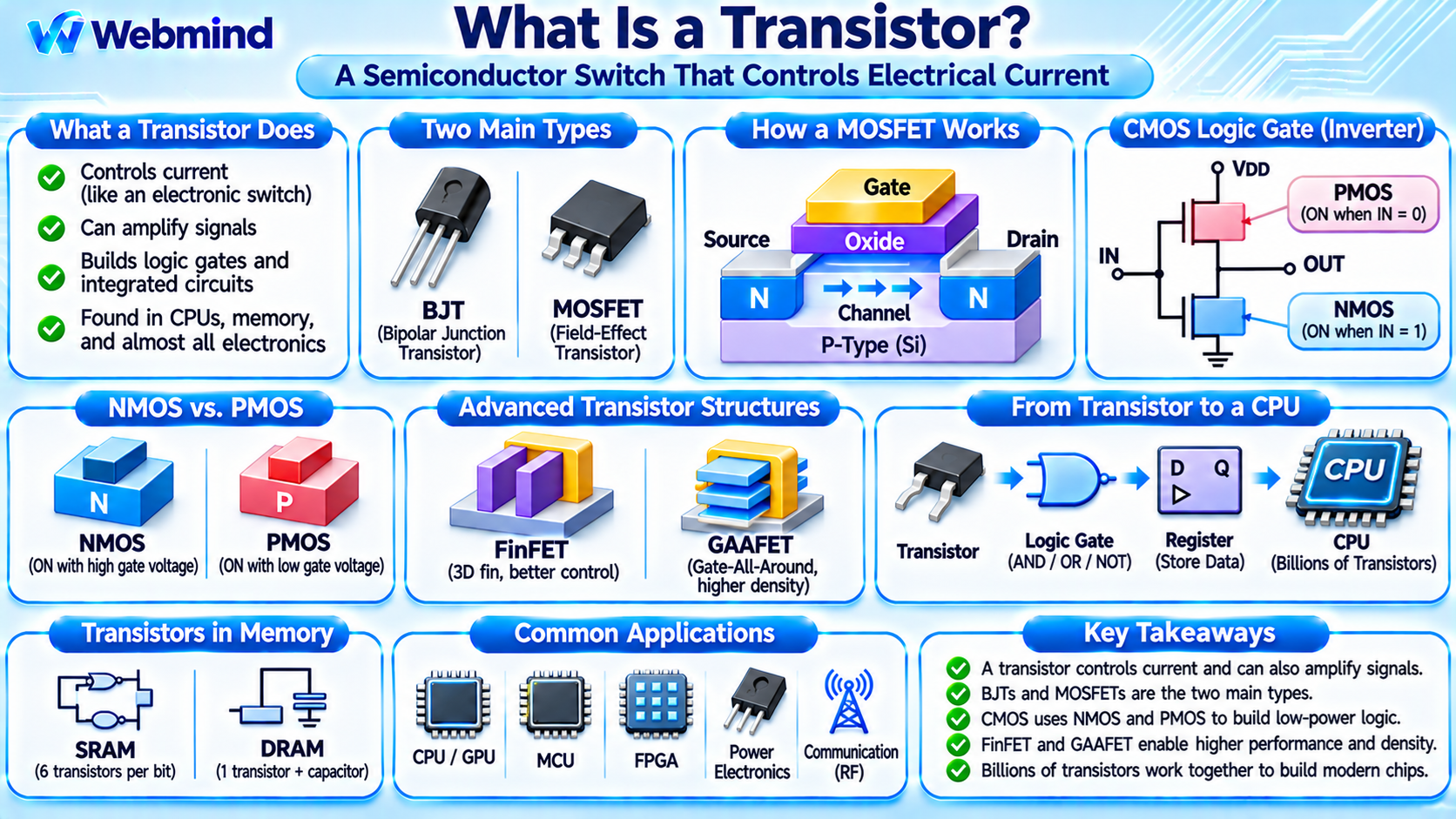
A transistor is a semiconductor device used to control electrical current or amplify electrical signals.
It is one of the most important inventions in modern electronics and the fundamental building block of integrated circuits.
Transistors are found in CPUs, GPUs, memory chips, microcontrollers, FPGAs, ASICs, and nearly every modern electronic device.
In digital circuits, transistors operate primarily as electronic switches, representing binary values of zero and one.
By combining millions or billions of transistors, engineers create logic gates, registers, arithmetic circuits, and complete processors.
Modern high-performance computer chips can contain tens of billions of transistors, allowing extremely complex computing operations to take place inside a small piece of silicon.
How Does a Transistor Work?
A transistor controls the flow of electrical current through a semiconductor structure.
Unlike a mechanical switch, which physically opens or closes an electrical connection, a transistor uses electrical signals to control conduction.
For example, a small voltage applied to a control terminal can determine whether current flows through another part of the transistor.
In digital electronics, this behavior allows transistors to switch between conducting and non-conducting states.
These states form the basis of binary logic, although actual digital circuits use voltage ranges rather than representing binary values directly through the presence or absence of current.
Transistors can also operate in analog circuits, where they continuously control signals rather than simply switching between two states.
Main Types of Transistors
Two major transistor families are widely used in electronic systems.
Bipolar Junction Transistor (BJT)
A Bipolar Junction Transistor is a current-controlled semiconductor device with three terminals: emitter, base, and collector.
A relatively small base current can control a larger current flowing between the collector and emitter.
BJTs are commonly used in analog amplifiers, signal-processing circuits, and certain switching applications.
Two common types are NPN and PNP transistors.
Field-Effect Transistor (FET)
A Field-Effect Transistor uses an electric field to control current flow.
One of the most important types is the Metal-Oxide-Semiconductor Field-Effect Transistor, or MOSFET.
A MOSFET has three main terminals: gate, source, and drain. Many devices also have a body or substrate connection.
Applying voltage to the gate changes the conductivity of the channel between the source and drain.
MOSFETs are particularly important because they can be manufactured at extremely small dimensions and integrated into complex semiconductor chips.
What Are NMOS and PMOS Transistors?
MOSFETs used in digital integrated circuits are commonly divided into NMOS and PMOS devices.
NMOS Transistor: An N-channel MOSFET conducts when an appropriate positive gate-to-source voltage creates a conducting channel.
PMOS Transistor: A P-channel MOSFET conducts when the gate-to-source voltage is sufficiently negative relative to its operating conditions.
These devices are often used together in Complementary Metal-Oxide-Semiconductor technology, commonly called CMOS.
CMOS is the dominant circuit technology used in modern digital processors and memory-related logic.
Its major advantage is relatively low static power consumption during stable logic states.
How Do Transistors Create Logic Gates?
Logic gates perform basic Boolean operations such as AND, OR, NOT, and XOR.
These gates are built using interconnected transistors.
For example, a CMOS inverter, also called a NOT gate, uses one PMOS transistor and one NMOS transistor.
When the input is low, the PMOS transistor conducts and pulls the output toward the supply voltage, producing a logical one.
When the input is high, the NMOS transistor conducts and pulls the output toward ground, producing a logical zero.
Thus, the inverter produces the opposite logical value of its input.
More complex combinations of transistors implement NAND, NOR, AND, OR, XOR, and other logic functions.
These gates can then be combined to create adders, multiplexers, registers, and processor control circuits.
How Are Transistors Used in CPUs?
A CPU contains large numbers of transistors organized into functional circuits.
Arithmetic Logic Unit (ALU): Uses transistor-based logic circuits to perform arithmetic and Boolean operations.
Control Unit: Uses digital circuitry to decode instructions and coordinate processor operations.
Registers: Use transistor-based storage circuits to hold temporary data and processor state.
Cache Memory: Commonly uses SRAM cells constructed from multiple transistors to store frequently accessed data.
Clock and Control Circuits: Use transistors to distribute timing signals and coordinate digital operations.
By combining these components, a processor can fetch, decode, and execute machine instructions.
Although a transistor is a simple building block, billions of interconnected transistors can implement an entire computing system.
What Is a CMOS Transistor?
CMOS stands for Complementary Metal-Oxide-Semiconductor.
CMOS technology uses complementary NMOS and PMOS transistors to implement digital logic.
In a typical CMOS logic gate, one transistor network connects the output toward the positive supply voltage, while another connects it toward ground.
During stable operation, ideally only one of these networks conducts, reducing direct current flow between the power supply and ground.
However, real CMOS circuits still consume power through leakage currents and transistor switching activity.
A simplified relationship for dynamic switching power is:
P ∝ C × V² × f
Here, C represents switched capacitance, V represents supply voltage, and f represents switching frequency.
This relationship helps explain why lower operating voltages and efficient transistor designs are important for modern processors.
What Are FinFET and GAAFET Transistors?
As semiconductor manufacturing technology advanced, conventional planar MOSFET structures became increasingly difficult to scale.
Modern semiconductor manufacturers developed three-dimensional transistor structures to improve electrostatic control and reduce unwanted leakage.
FinFET
A FinFET, or Fin Field-Effect Transistor, uses a narrow, fin-shaped semiconductor channel.
The gate surrounds multiple sides of the fin, providing better control over the channel than traditional planar transistor designs.
FinFET technology became widely used in advanced CPU, GPU, and SoC manufacturing.
GAAFET
A Gate-All-Around Field-Effect Transistor, or GAAFET, surrounds the semiconductor channel with the gate on all sides.
Modern implementations may use vertically stacked nanosheets or nanowires.
This structure can provide improved channel control and support further transistor scaling.
GAAFET technology is used in advanced semiconductor manufacturing processes, although specific implementations vary between manufacturers.
Transistor Size and Moore’s Law
Moore’s Law describes the historical observation that the number of transistors integrated onto a chip tends to increase rapidly over time.
For decades, improvements in semiconductor manufacturing allowed engineers to build smaller transistors and integrate more of them onto a single chip.
Smaller transistors can improve density and potentially reduce switching energy, but modern scaling faces significant challenges.
These include leakage current, heat generation, manufacturing complexity, interconnect delays, and rising fabrication costs.
It is also important to understand that manufacturing labels such as 3 nm or 2 nm do not directly represent the physical gate length of every transistor.
Modern process-node names are primarily technology-generation designations rather than measurements of one specific transistor dimension.
Transistors in Memory Chips
Transistors are essential to semiconductor memory.
SRAM: A conventional SRAM bit cell commonly uses six transistors to store one bit of information.
DRAM: A conventional DRAM cell typically uses one access transistor and one capacitor to store a bit.
Flash Memory: Uses specialized transistor structures that retain stored charge or otherwise represent information without continuous power.
Different memory technologies use different transistor designs to balance speed, density, power consumption, and data retention.
This is why transistors are important not only for computation but also for storing information.
Where Are Transistors Used?
Transistors are used throughout modern electronics.
CPUs and GPUs: Execute instructions and perform mathematical calculations using enormous networks of transistor-based circuits.
Microcontrollers: Combine processor cores, memory, and peripheral control circuits on a single chip.
FPGAs: Use transistors to implement configurable logic blocks, routing resources, and memory elements.
ASICs: Integrate transistor circuits optimized for particular applications.
Power Electronics: Use power MOSFETs and other semiconductor devices to control motors, power supplies, and electrical energy conversion.
Communication Systems: Use transistors for amplifiers, radio-frequency circuits, signal processing, and switching.
Sensors and Consumer Electronics: Depend on transistor circuits for measurement, control, communication, and data processing.
Conclusion
A transistor is a semiconductor device that controls electrical current and forms the foundation of modern electronic circuits.
BJTs and MOSFETs are two major transistor families, while CMOS technology combines NMOS and PMOS transistors to create efficient digital logic.
By connecting transistors into logic gates, registers, memory cells, and processing units, engineers can construct complex integrated circuits containing billions of devices.
Advanced transistor structures such as FinFETs and GAAFETs continue to support improvements in semiconductor performance, energy efficiency, and integration density.
Understanding transistors is an essential foundation for studying semiconductor physics, logic gates, CPU architecture, memory technology, FPGA design, ASIC development, and modern chip manufacturing.