Introduction
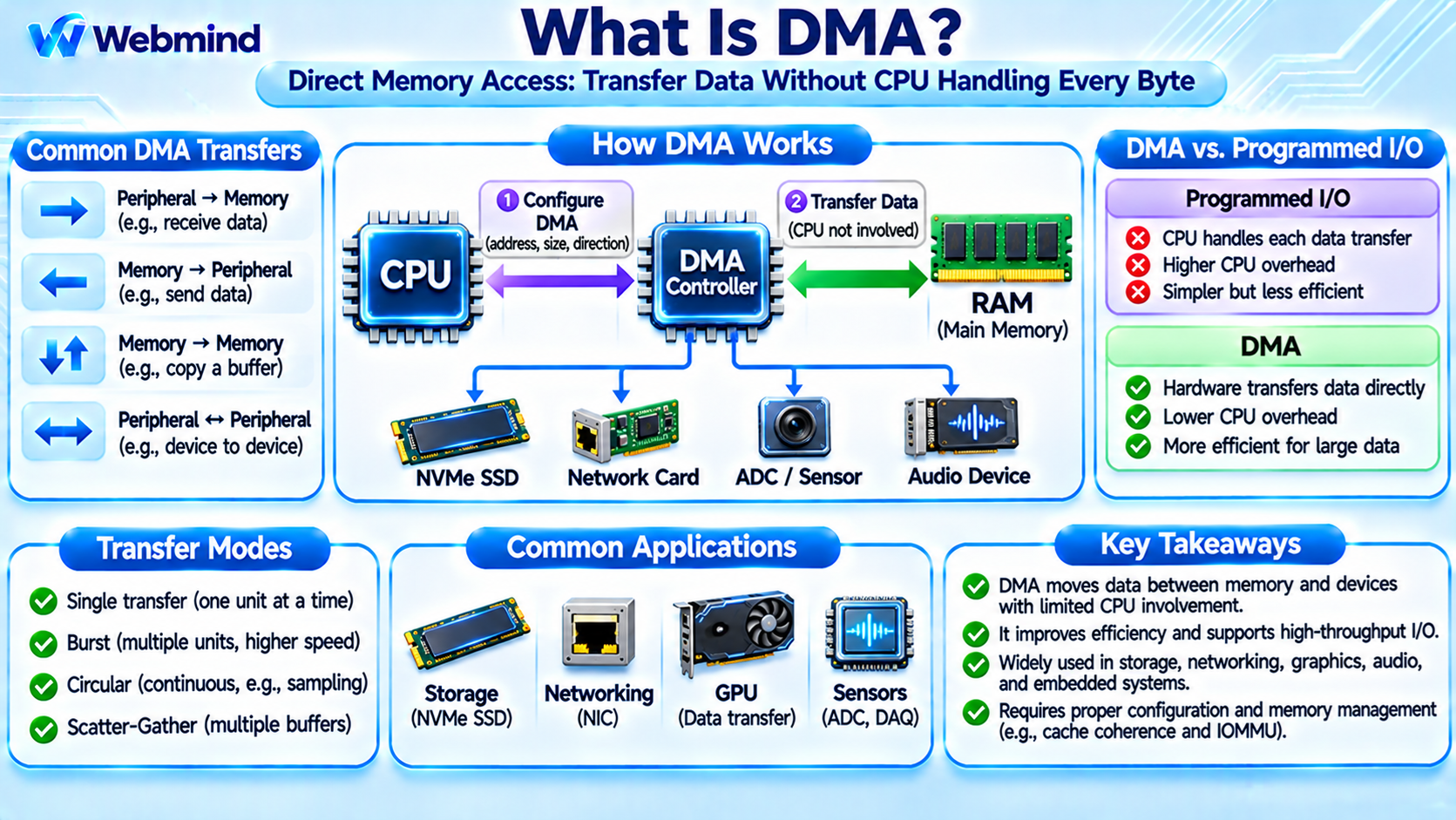
DMA, or Direct Memory Access, is a hardware mechanism that allows peripheral devices and specialized controllers to transfer data to or from system memory without requiring the CPU to handle every individual data transfer.
DMA is widely used in computers, microcontrollers, embedded systems, storage devices, networking equipment, and Systems-on-Chip (SoCs).
It improves data transfer efficiency by reducing CPU involvement in repetitive memory operations.
For example, when a network interface receives a large amount of data, DMA can transfer the incoming information directly into RAM.
The CPU can continue executing other instructions while the data transfer takes place.
DMA is therefore an important part of modern computer architecture and high-performance embedded systems.
How Does DMA Work?
In a simple system without DMA, the CPU may need to repeatedly read data from a peripheral register and write it into memory.
This approach, often called programmed I/O, consumes processor time because the CPU must execute instructions for each transfer.
With DMA, the CPU typically configures a DMA controller by specifying the source address, destination address, transfer size, and other parameters.
The DMA controller then manages the data movement through the system’s memory interconnect.
After the transfer finishes, the controller may generate an interrupt to notify the CPU.
For example, a microcontroller receiving data through a UART interface can use DMA to move incoming bytes into a memory buffer automatically.
The CPU can process the completed buffer instead of handling every received byte individually.
DMA reduces CPU overhead, although the transfer still consumes memory bandwidth and other system resources.
Main Components of a DMA System
A typical DMA system contains several important components.
DMA Controller (DMAC): Hardware responsible for coordinating data transfers between memory and peripherals or between memory regions.
Source Address Register: Identifies the memory location or peripheral data register from which information is read.
Destination Address Register: Identifies where transferred information should be written.
Transfer Count Register: Specifies the amount of data to transfer, commonly measured in bytes or transfer units.
Control Registers: Configure transfer direction, data width, address increment behavior, operating mode, and interrupt generation.
DMA Channels: Allow a controller to manage multiple transfer requests. Different channels may serve different peripherals or workloads.
Interrupt Logic: Notifies the processor when transfers complete or errors occur.
The exact implementation varies between microcontrollers, SoCs, and high-performance computer systems.
Step-by-Step DMA Transfer
A simplified DMA transfer follows several stages.
1. CPU Configuration: The CPU prepares the source and destination addresses, transfer length, and control settings.
2. DMA Request: A peripheral or software initiates a DMA transfer request.
3. Bus Access: The DMA controller obtains access to the required system interconnect or memory resources.
4. Data Transfer: Information moves between the source and destination without requiring the CPU to execute an instruction for every transferred item.
5. Transfer Completion: The controller updates its status and may generate an interrupt.
6. CPU Processing: The CPU examines the transferred data or starts another operation.
The CPU is not necessarily inactive during a DMA transfer. It can continue performing other work, although memory contention may affect execution performance.
DMA vs. Programmed I/O
Programmed I/O and DMA are two different approaches to transferring information.
Programmed I/O: The CPU explicitly reads and writes peripheral registers or memory locations. This approach is relatively simple but can require many processor instructions for large transfers.
DMA: A hardware controller performs the transfer after being configured by software. This reduces repetitive CPU operations and can improve overall system efficiency.
For example, copying a large stream of ADC samples into RAM using CPU instructions may consume substantial processor time.
Using DMA allows the samples to be transferred into a memory buffer automatically while the CPU performs other tasks.
However, DMA setup also requires time and resources. For very small transfers, programmed I/O may be simpler or even faster.
Common Types of DMA Transfers
DMA controllers support different transfer patterns depending on their architecture.
Peripheral-to-Memory DMA
Transfers information from a peripheral device into RAM.
Examples include receiving UART data, capturing ADC samples, or collecting information from a communication interface.
Memory-to-Peripheral DMA
Transfers information from RAM to a peripheral.
Examples include sending data through UART, supplying samples to a digital-to-analog converter, or updating a display interface.
Memory-to-Memory DMA
Copies blocks of information between memory regions without requiring the CPU to execute individual load and store instructions.
This is useful for buffer management and certain data-processing workloads.
Peripheral-to-Peripheral DMA
Some controllers support transfers between peripheral interfaces without storing every intermediate value in main memory.
Support depends on the DMA controller and the system interconnect architecture.
What Are DMA Transfer Modes?
Different DMA controllers support different operating modes.
Single Transfer Mode: Transfers one data unit at a time, often in response to individual peripheral requests.
Burst Mode: Transfers multiple data units consecutively to improve efficiency.
Circular Mode: Automatically restarts a transfer within a configured buffer, making it useful for continuous data collection.
Scatter-Gather DMA: Processes a list of memory descriptors that describe multiple data buffers and transfer operations.
Scatter-gather DMA is especially useful in networking and storage systems because data may be distributed across multiple noncontiguous memory regions.
Not every DMA controller supports all these modes.
DMA in Microcontrollers
DMA is particularly useful in embedded systems where processors must handle several time-sensitive activities.
Consider a microcontroller collecting samples from an Analog-to-Digital Converter (ADC).
Without DMA, the CPU might need to read each sample and store it into RAM.
With DMA, the ADC generates transfer requests, and the DMA controller writes samples directly into a memory buffer.
A common implementation uses circular buffering or double buffering.
While DMA fills one buffer, the CPU processes data stored in another buffer.
This technique is widely used in audio processing, sensor acquisition, motor control, and real-time embedded applications.
DMA in PCs and Servers
Modern computers also rely heavily on DMA.
NVMe SSDs: Storage controllers use DMA to exchange data between system memory and storage hardware. NVMe commands commonly reference memory buffers using physical memory address information.
Network Interface Cards: Network adapters use DMA to place received packets into memory and retrieve outgoing packet data.
Graphics Processing Units: GPUs use DMA engines to transfer data between system memory and device memory where supported.
Audio Devices: DMA allows continuous audio buffers to be transferred without requiring the CPU to handle every sample.
High-Speed Data Acquisition: Specialized PCIe devices use DMA to transfer large volumes of sensor or measurement data into system memory.
These capabilities help modern computers process large amounts of data efficiently.
DMA, Cache Coherence, and the IOMMU
DMA introduces important memory-management and security considerations.
Modern processors use cache memory to store copies of frequently accessed data.
When a DMA device reads or writes system memory, software and hardware must ensure that the device and CPU observe the correct data.
In cache-coherent systems, hardware may maintain consistency between DMA transfers and processor caches.
In non-coherent systems, software may need to perform cache maintenance operations before or after DMA transfers.
Another important component is the IOMMU (Input/Output Memory Management Unit).
An IOMMU translates device-visible addresses and can restrict which memory regions a DMA-capable device may access.
This improves system isolation and helps protect memory from unauthorized or incorrectly configured device accesses.
Operating systems such as Linux and Windows provide DMA-related APIs and driver mechanisms for managing these operations.
Advantages of DMA
Reduced CPU Overhead: The processor does not need to execute instructions for every data transfer.
Efficient Data Movement: DMA hardware can transfer large blocks of information using optimized memory access mechanisms.
Improved Multitasking: The CPU can perform other operations while transfers are in progress.
Real-Time Data Handling: DMA helps embedded systems process continuous streams of sensor, audio, and communication data.
High-Throughput I/O: Storage devices, network adapters, and hardware accelerators can exchange large amounts of information efficiently.
Limitations of DMA
DMA also introduces technical challenges.
Memory Contention: DMA transfers compete with processors and other devices for memory bandwidth.
Cache Consistency: Incorrect cache management can result in stale or inconsistent data.
Configuration Complexity: DMA controllers require correct buffer addresses, transfer sizes, and operating parameters.
Security Risks: Devices with unrestricted DMA access may read or modify sensitive system memory.
Synchronization Requirements: Software must coordinate access to buffers while DMA hardware is reading or writing them.
Careful driver design and memory management are therefore essential for reliable DMA operation.
DMA vs. CPU Memory Copy
A CPU can copy memory by executing load and store instructions, sometimes accelerated by SIMD instructions or specialized copy operations.
DMA performs data movement using dedicated hardware.
For large transfers, DMA may reduce CPU overhead and allow computation and data movement to overlap.
However, CPU-based memory copying can be highly optimized, particularly when data is already present in cache.
DMA is not automatically faster for every transfer. Its benefits depend on buffer size, hardware capabilities, memory bandwidth, and setup overhead.
The most suitable method depends on the application and system architecture.
Conclusion
Direct Memory Access is a hardware mechanism that allows data to move between memory and peripheral devices, or between memory regions, with limited CPU involvement.
DMA controllers improve efficiency by managing data transfers independently after software configuration, allowing processors to concentrate on computation and control tasks.
DMA is widely used in microcontrollers, NVMe storage, network interfaces, GPUs, audio systems, and embedded devices.
Understanding DMA provides an important foundation for studying computer architecture, memory controllers, PCI Express, device drivers, microcontrollers, embedded Linux, and modern high-performance computing systems.