Introduction
RISC, or Reduced Instruction Set Computer, is a processor design approach that emphasizes relatively simple instructions, regular instruction formats, and efficient instruction execution.
RISC architectures are widely used in smartphones, microcontrollers, embedded systems, personal computers, and servers.
The central idea behind RISC is to simplify the operations exposed by the Instruction Set Architecture (ISA), allowing processor designers to build efficient execution pipelines and optimize hardware performance.
Well-known RISC-based architectures include Arm, RISC-V, MIPS, and Power ISA.
These architectures differ in their instruction sets and implementation details but share several important design principles.
How Does RISC Work?
A RISC processor executes machine instructions that are typically designed to perform relatively straightforward operations.
For example, adding two numbers may involve reading values from processor registers, performing addition in the Arithmetic Logic Unit (ALU), and storing the result in another register.
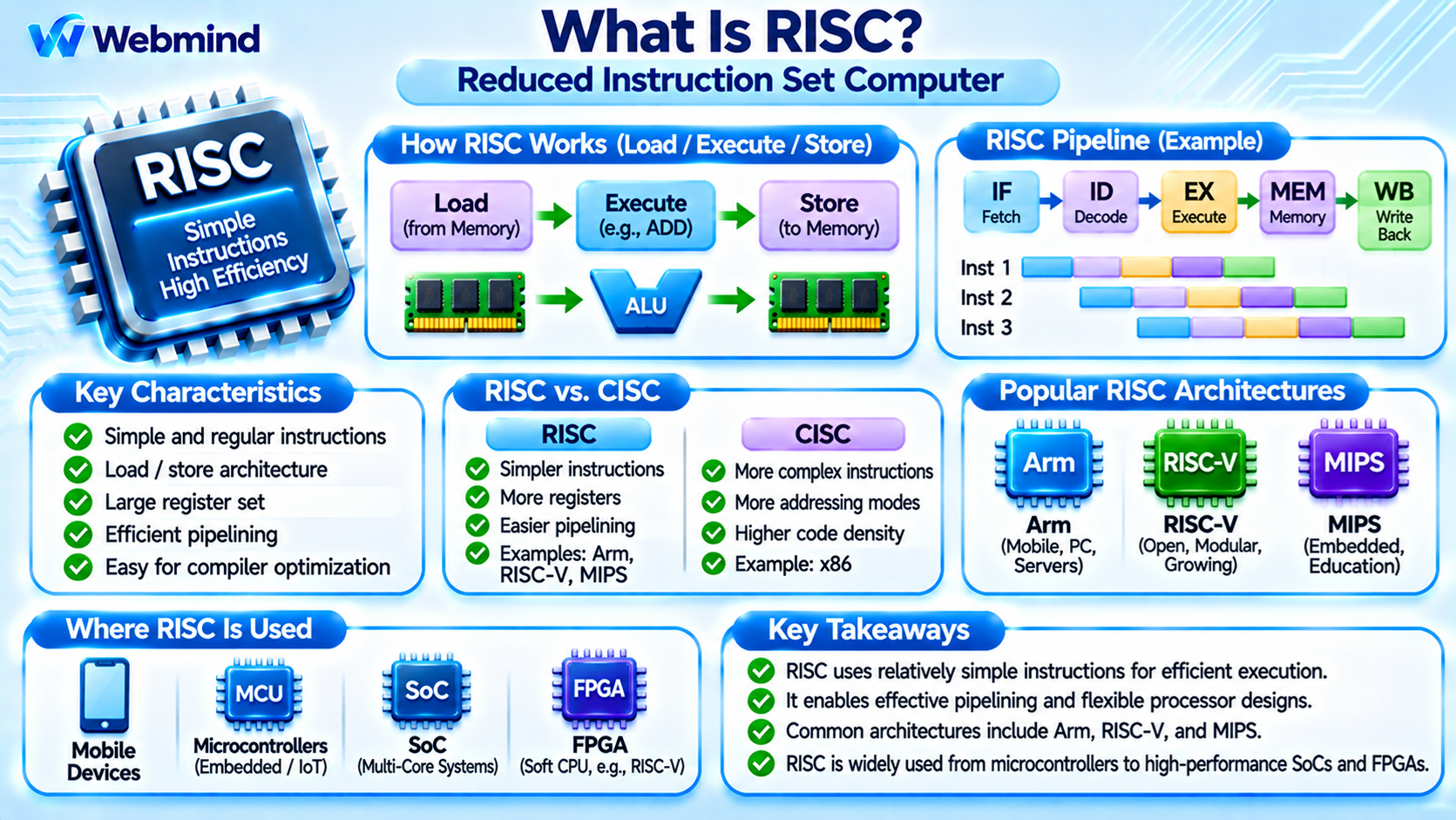
Many RISC architectures use a load/store design.
Arithmetic and logical instructions operate primarily on registers, while dedicated load and store instructions transfer data between registers and memory.
This separation simplifies instruction execution and supports efficient processor pipelines.
RISC does not mean that every instruction executes in exactly one clock cycle.
Modern RISC processors may contain complex pipelines, multiple execution units, and sophisticated instruction scheduling mechanisms.
Main Characteristics of RISC
RISC architectures commonly share several important characteristics.
Simple Instructions: Individual instructions typically perform relatively straightforward operations, such as arithmetic calculations, logical operations, memory access, or branching.
Load/Store Architecture: Most arithmetic operations use registers rather than directly accessing memory operands.
Large Register Set: Many RISC architectures provide numerous general-purpose registers, reducing the need for frequent memory access.
Regular Instruction Encoding: RISC architectures often use consistent instruction formats that simplify decoding. Some use fixed-length instructions, while others support compressed or variable-length encodings.
Efficient Pipelining: Relatively regular instruction structures can simplify pipeline implementation and improve instruction throughput.
Compiler Optimization: Compilers can combine simple instructions and use processor registers efficiently to implement higher-level programming operations.
These characteristics are design tendencies rather than strict requirements shared by every RISC architecture.
RISC and the Load/Store Architecture
The load/store approach is one of the most recognizable features of many RISC processors.
Suppose a program needs to add two numbers stored in memory.
A typical RISC processor performs three basic operations:
Load: Read the values from memory into registers.
Execute: Add the values using an arithmetic instruction.
Store: Write the result from a register back to memory when necessary.
For example, a RISC-V processor might execute the following instructions:
LW x5, 0(x10)
LW x6, 4(x10)
ADD x7, x5, x6
SW x7, 8(x10)
The first two instructions load 32-bit values from memory. The ADD instruction performs the calculation using registers. The final instruction stores the result in memory.
This approach separates memory access from arithmetic operations and helps simplify the processor’s instruction execution structure.
RISC vs. CISC: What Is the Difference?
RISC and CISC represent two traditional approaches to instruction set architecture design.
RISC (Reduced Instruction Set Computer): Emphasizes relatively simple instructions, regular instruction formats, and register-based computation. Arm and RISC-V are prominent examples.
CISC (Complex Instruction Set Computer): Supports more complex instructions, often with multiple addressing modes and variable instruction lengths. The x86 architecture is the most familiar example.
In traditional CISC designs, a single instruction may perform an operation involving memory access and arithmetic.
A RISC architecture may use several simpler instructions to accomplish the same task.
However, modern processors have reduced many practical differences between these approaches.
Modern x86 CPUs commonly decode architectural instructions into smaller internal micro-operations, while high-performance RISC processors may use sophisticated out-of-order execution, branch prediction, and advanced caching.
Therefore, RISC processors are not automatically faster or more energy-efficient than CISC processors. Actual performance depends on microarchitecture, manufacturing technology, software, and workload characteristics.
Popular RISC Architectures
Several important processor architectures follow RISC design principles.
Arm
Arm is widely used in smartphones, tablets, embedded systems, and increasingly in laptops, desktop computers, and servers.
Modern Arm processors include energy-efficient microcontroller cores and powerful application processors.
Arm-based processors are used in products from companies such as Apple, Qualcomm, MediaTek, and many embedded semiconductor manufacturers.
RISC-V
RISC-V is an open-standard instruction set architecture based on RISC principles.
It uses a modular design consisting of a base instruction set and optional extensions for functions such as multiplication, floating-point arithmetic, atomic operations, and vector processing.
RISC-V is used in microcontrollers, embedded systems, research processors, and a growing range of computing platforms.
MIPS
MIPS is a RISC architecture historically used in networking equipment, embedded systems, and computer architecture education.
Its relatively regular instruction structure made it influential in processor design and teaching.
Power ISA
Power ISA is a RISC-based architecture used in selected enterprise servers, high-performance computing systems, and embedded applications.
It provides advanced features for integer arithmetic, floating-point processing, and parallel computation.
RISC and CPU Pipelining
Pipelining is a technique that allows multiple instructions to be processed at different stages simultaneously.
A simplified RISC pipeline commonly includes five stages:
Instruction Fetch (IF): Retrieves an instruction from memory or cache.
Instruction Decode (ID): Decodes the instruction and identifies the required operands.
Execute (EX): Performs arithmetic, logical, or address calculations.
Memory Access (MEM): Reads or writes memory when required.
Write-Back (WB): Stores the result in a destination register.
For example, while one instruction is executing, another instruction may be decoded and a third may be fetched.
This overlapping execution improves instruction throughput.
However, instruction dependencies, branches, and memory delays can interrupt pipeline operation.
Modern processors use forwarding, branch prediction, and other techniques to reduce these delays.
Advantages of RISC
Regular Instruction Design: Simplifies many aspects of instruction decoding and processor implementation.
Efficient Pipelining: Supports predictable instruction structures that can be organized into processing stages.
Register-Based Operations: Reduces unnecessary memory access for arithmetic calculations.
Scalable Architecture: RISC principles can support both small microcontrollers and high-performance multicore processors.
Hardware Design Flexibility: Processor designers can implement the same ISA using different microarchitectures optimized for performance, power consumption, or silicon area.
These advantages depend on the specific architecture and implementation rather than the RISC label alone.
Limitations of RISC
RISC architectures also involve engineering trade-offs.
Instruction Count: Some complex operations require multiple simpler instructions, potentially increasing the number of instructions executed.
Code Density: Certain RISC instruction encodings may produce larger programs, although compressed instruction extensions can improve code density.
Compiler Dependence: Efficient register allocation and instruction selection are important for achieving good performance.
Instruction Fetch Bandwidth: Programs containing more instructions may require greater instruction-fetch bandwidth.
Modern RISC architectures use different techniques to address these challenges, including compressed instructions, vector extensions, and sophisticated compiler optimizations.
RISC in Microcontrollers, SoCs, and FPGAs
RISC architectures are widely used in embedded computing because they can support compact and energy-efficient processor implementations.
Microcontrollers: Arm Cortex-M and RISC-V microcontrollers are used for sensor processing, motor control, industrial automation, and IoT devices.
System-on-Chip (SoC): Many SoCs combine RISC-based CPU cores with GPUs, NPUs, memory controllers, and communication interfaces.
FPGAs: RISC-V soft processor cores can be implemented using programmable logic, allowing developers to create customized computing systems.
Embedded Linux Systems: High-performance Arm and RISC-V processors can run operating systems such as Linux when the required hardware and architectural features are available.
RISC architectures therefore play an important role in both simple control systems and advanced computing platforms.
Conclusion
RISC is a processor design philosophy that emphasizes relatively simple instructions, regular instruction structures, and efficient execution.
Its principles have influenced major instruction set architectures such as Arm, RISC-V, MIPS, and Power ISA.
Although modern RISC and CISC processors share many advanced implementation techniques, RISC remains an important concept in computer architecture.
Understanding RISC provides a strong foundation for studying instruction set architectures, CPU pipelines, assembly language, microcontrollers, embedded systems, RISC-V development, and FPGA-based processor design.