Introduction
PCIe, or Peripheral Component Interconnect Express, is a high-speed communication standard used to connect hardware devices inside computers and other electronic systems.
It provides a fast connection between processors, graphics cards, solid-state drives, network adapters, and expansion devices.
PCIe is widely used in desktop computers, laptops, servers, workstations, and embedded systems.
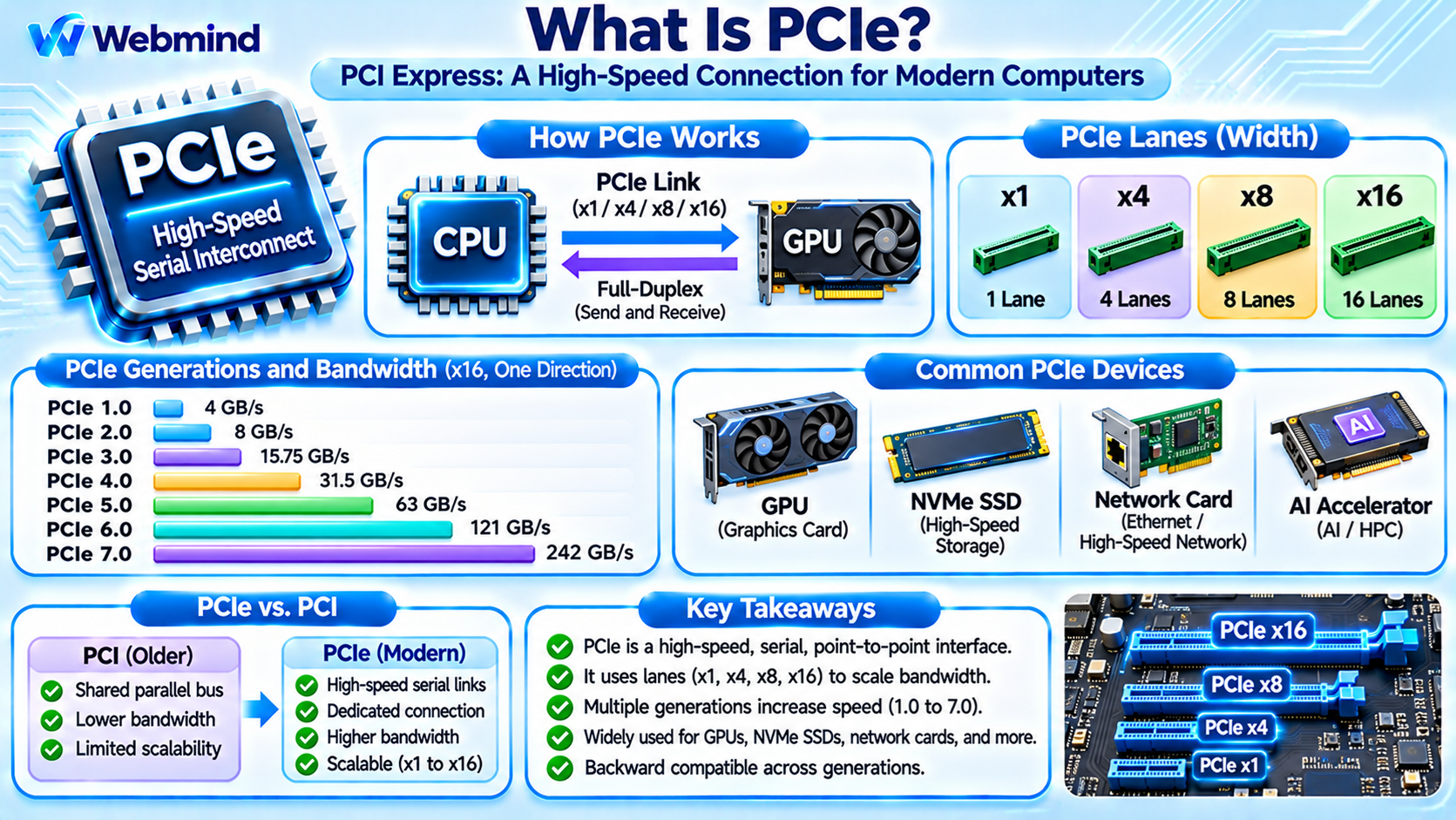
Unlike older shared parallel buses, PCIe uses high-speed serial, point-to-point connections to transfer data between devices.
Modern PCIe technology supports multiple generations and lane configurations, allowing systems to balance bandwidth, power consumption, and hardware requirements.
How Does PCIe Work?
PCIe connects devices using dedicated communication links.
Each connection consists of one or more lanes that transfer data between two endpoints.
A PCIe lane contains two differential signal pairs: one pair transmits data in one direction, while the other receives data in the opposite direction.
This allows simultaneous bidirectional communication, commonly called full-duplex operation.
For example, when a CPU communicates with a graphics card, information travels through a PCIe connection between the processor or chipset and the GPU.
PCIe transfers information using packets rather than a traditional shared parallel data bus.
The protocol manages transactions, routing, flow control, and error detection.
A PCIe system typically contains a Root Complex, which connects the processor and memory subsystem to the PCIe hierarchy, and endpoints such as GPUs, SSDs, and network adapters. PCIe switches can connect additional devices.
What Are PCIe Lanes?
A PCIe lane is the basic communication unit of a PCI Express connection.
Multiple lanes can be combined to increase bandwidth. Common configurations include:
PCIe x1: Uses one lane and is commonly found in smaller expansion cards and peripheral devices.
PCIe x4: Uses four lanes and is widely used for NVMe solid-state drives.
PCIe x8: Uses eight lanes and is common in certain networking devices, storage controllers, and server expansion cards.
PCIe x16: Uses sixteen lanes and is commonly associated with high-performance graphics cards.
The letter x indicates the number of lanes in the connection.
A PCIe x16 slot does not necessarily provide sixteen active electrical lanes. Some physically x16-sized slots operate at x8 or x4, depending on motherboard design.
PCIe Generations and Bandwidth
PCIe technology has evolved through multiple generations, with newer versions offering higher data transfer rates.
The following figures represent approximate theoretical bandwidth in one direction for a sixteen-lane connection.
PCIe 1.0: Approximately 4 GB/s for PCIe x16.
PCIe 2.0: Approximately 8 GB/s for PCIe x16.
PCIe 3.0: Approximately 15.75 GB/s for PCIe x16.
PCIe 4.0: Approximately 31.5 GB/s for PCIe x16.
PCIe 5.0: Approximately 63 GB/s for PCIe x16.
PCIe 6.0: Approximately 121 GB/s for PCIe x16, using its newer signaling and packet-encoding mechanisms.
PCIe 7.0: Approximately 242 GB/s for PCIe x16, based on its specified 128 GT/s signaling rate.
These are theoretical values. Actual application bandwidth is lower because of transaction overhead, protocol behavior, and system limitations.
PCIe 6.0 and 7.0 use PAM4 signaling and FLIT-based operation, while earlier generations use NRZ signaling.
PCIe vs. PCI: What Is the Difference?
PCIe was developed to replace the older PCI expansion bus.
Traditional PCI uses a shared parallel communication bus. Multiple devices may share the same communication resources, limiting scalability and total bandwidth.
PCI Express uses independent high-speed serial links. Each device can communicate through a dedicated connection, and switches can provide additional connectivity.
PCIe also supports multiple lane widths, advanced power management, and sophisticated error-handling mechanisms.
Because PCI and PCIe use different electrical and protocol architectures, their expansion cards are not directly interchangeable.
PCIe and NVMe SSDs
One of the most common applications of PCIe is connecting high-performance solid-state drives.
NVMe, or Non-Volatile Memory Express, is a storage protocol designed for accessing non-volatile memory devices over PCIe.
A typical NVMe SSD uses four PCIe lanes.
For example, a PCIe 4.0 x4 connection provides approximately 7.88 GB/s of theoretical bandwidth in one direction, while PCIe 5.0 x4 provides approximately 15.75 GB/s.
Actual SSD transfer speeds depend on the storage controller, NAND Flash memory, firmware, workload, and thermal conditions.
It is also important to distinguish PCIe, NVMe, and M.2.
PCIe is the hardware communication interface and protocol system.
NVMe is a storage command protocol that operates over PCIe.
M.2 is a physical form factor and connector specification commonly used for compact SSDs.
Not every M.2 SSD uses NVMe, and not every NVMe device uses an M.2 connector.
PCIe in GPUs and Servers
Discrete graphics cards commonly use PCIe connections to communicate with the CPU and system memory.
PCIe transfers commands, data, and other information between the GPU and the rest of the computer.
However, graphics cards typically use their own high-bandwidth local memory, such as GDDR or HBM, for many graphics and computing operations.
PCIe bandwidth is therefore different from GPU memory bandwidth.
In servers, PCIe connects network interface cards, storage controllers, GPUs, AI accelerators, and other high-performance devices.
Enterprise platforms may contain PCIe switches that allow many endpoints to share available upstream connectivity.
PCIe also provides the physical foundation for technologies such as Compute Express Link (CXL), which adds coherent communication and memory-related capabilities on compatible hardware.
PCIe Compatibility and Backward Compatibility
One important advantage of PCIe is its support for backward compatibility between generations.
For example, a PCIe 4.0 graphics card can generally operate in a compatible PCIe 3.0 slot, but the connection is limited by the older generation’s maximum supported speed.
Similarly, a PCIe 5.0 SSD can typically operate in a compatible PCIe 4.0 system at PCIe 4.0 speeds.
The negotiated connection speed and lane width depend on the capabilities of both devices and the platform.
Physical compatibility must also be considered. The connector size, available electrical lanes, motherboard firmware, and device requirements all affect whether a particular expansion card can be used.
PCIe Power Management and Reliability
PCIe includes several mechanisms designed to improve efficiency and communication reliability.
Active State Power Management (ASPM): Allows compatible PCIe links to enter lower-power states when communication activity is reduced.
Error Detection: Uses mechanisms such as cyclic redundancy checks (CRC) to detect transmission errors.
Data Link Reliability: Supports acknowledgment and replay mechanisms to recover from certain transmission errors.
Hot-Plug Support: Allows certain systems to detect and manage devices inserted or removed while operating, provided the hardware and software support hot-plug functionality.
Link Training: Establishes communication between connected devices and negotiates supported link parameters, including speed and lane width.
These features help PCIe operate reliably across a wide range of computing platforms.
PCIe in Modern Motherboards and SoCs
Modern motherboards distribute PCIe connectivity between the processor and chipset.
The CPU typically provides high-bandwidth PCIe lanes for devices such as graphics cards and NVMe SSDs. Additional PCIe lanes may be available through the motherboard chipset.
Devices connected through the chipset may share the chipset’s upstream connection to the CPU, potentially limiting aggregate bandwidth.
In embedded systems and Systems-on-Chip (SoCs), PCIe controllers can be integrated directly into the chip.
Some FPGAs also contain dedicated PCIe interface blocks, allowing programmable logic to communicate with computers and other PCIe devices.
These implementations make PCIe an important communication technology for both conventional computing and specialized hardware development.
Conclusion
PCI Express is a high-speed serial interconnect that connects processors with graphics cards, NVMe SSDs, network adapters, and many other hardware devices.
Its lane-based architecture, point-to-point connections, packet-based communication, and backward compatibility make it a fundamental part of modern computer systems.
Successive PCIe generations have greatly increased available bandwidth, supporting increasingly demanding applications in gaming, storage, networking, artificial intelligence, and data centers.
Understanding PCIe is essential for studying motherboard architecture, computer buses, GPU communication, NVMe storage, embedded systems, and modern hardware interfaces.