Introduction
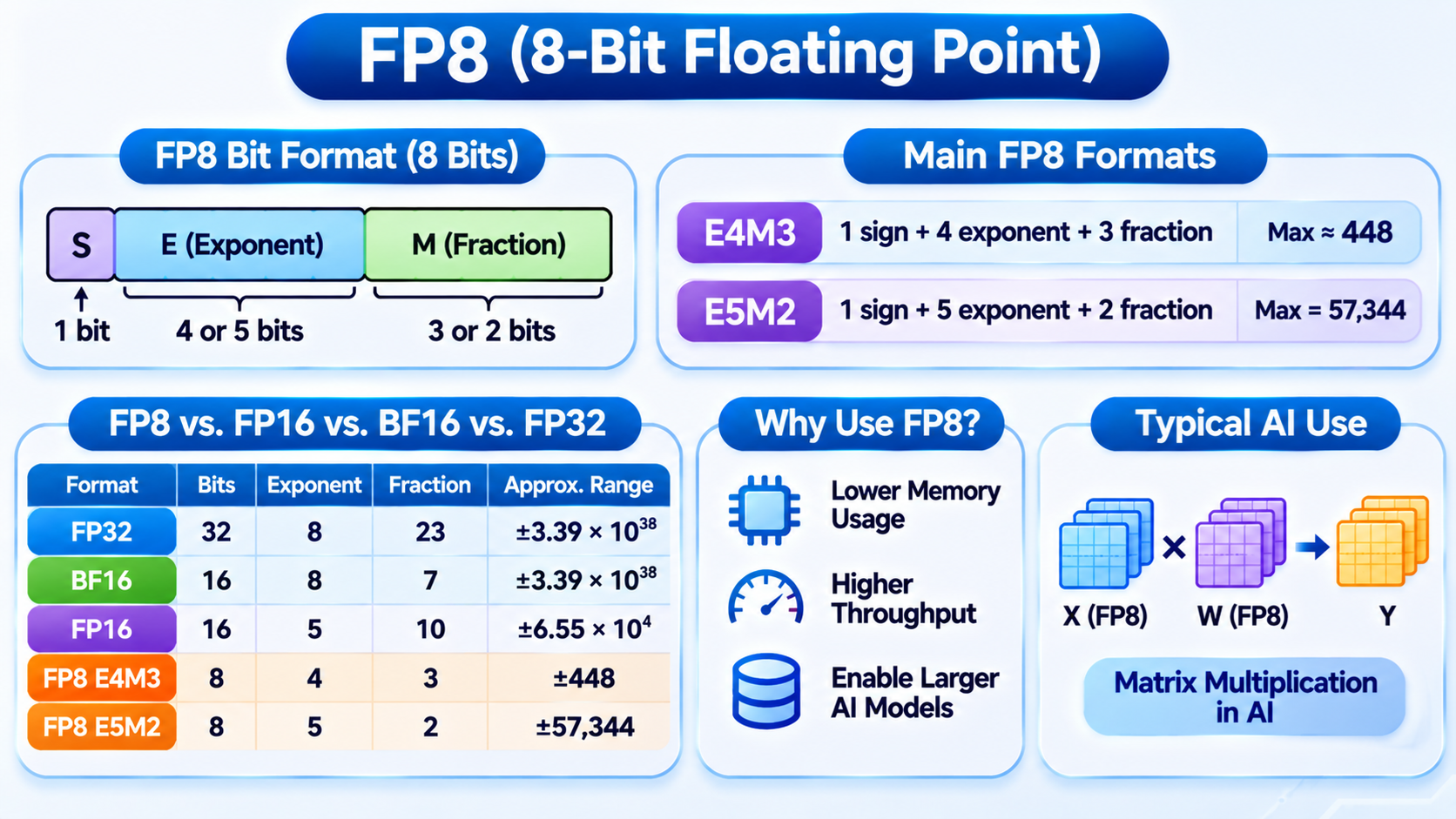
FP8, short for 8-bit Floating Point, is a family of low-precision numerical formats designed to improve the efficiency of Artificial Intelligence (AI), Machine Learning (ML), and Deep Learning (DL) computations.
FP8 represents numerical values using only eight bits, compared with 16 bits for FP16 and BF16 or 32 bits for FP32.
Modern neural networks perform enormous numbers of mathematical operations involving model weights, activations, and intermediate values.
Using smaller numerical formats can reduce memory requirements, decrease data movement, and accelerate supported arithmetic operations.
FP8 is particularly important in large-scale AI training and inference, including Transformer models and Large Language Models (LLMs).
It is supported by selected modern GPUs and specialized AI accelerators.
Unlike traditional integer quantization, FP8 retains a floating-point representation with separate exponent and fraction fields.
How Does FP8 Work?
FP8 represents a numerical value using eight binary bits divided into a sign field, an exponent field, and a fraction field.
The sign determines whether the number is positive or negative.
The exponent controls its approximate magnitude, while the fraction determines the precision of the represented value.
Because FP8 contains only eight bits, it must make significant compromises between numerical precision and representable range.
Different FP8 formats allocate different numbers of bits to the exponent and fraction.
For example, E4M3 uses four exponent bits and three fraction bits, while E5M2 uses five exponent bits and two fraction bits.
These formats provide different numerical characteristics and are suitable for different AI workloads.
What Are the Main FP8 Formats?
Two important FP8 formats are E4M3 and E5M2.
E4M3
E4M3 uses one sign bit, four exponent bits, and three fraction bits.
It provides greater significand precision than E5M2 but a smaller numerical range.
The widely used E4M3FN variant has a maximum finite magnitude of 448 and reserves specific encodings for NaN values rather than supporting infinity.
E4M3 is commonly used for neural network values whose magnitudes can be controlled through suitable scaling.
E5M2
E5M2 uses one sign bit, five exponent bits, and two fraction bits.
Its wider exponent field allows it to represent a larger numerical range than E4M3.
The maximum finite positive E5M2 value is 57,344.
E5M2 supports infinity and NaN representations and is useful when numerical values vary significantly in magnitude.
The choice between E4M3 and E5M2 depends on the numerical characteristics of the workload, hardware support, and the FP8 implementation being used.
FP8 vs. FP16 vs. BF16 vs. FP32
FP8, FP16, BF16, and FP32 are numerical formats used in AI and scientific computing.
FP32: Uses 32 bits, including one sign bit, eight exponent bits, and 23 fraction bits. It provides relatively high precision and a wide numerical range.
FP16: Uses 16 bits, including one sign bit, five exponent bits, and ten fraction bits. It provides more precision than BF16 but a smaller exponent range.
BF16: Uses 16 bits, including one sign bit, eight exponent bits, and seven fraction bits. It retains a numerical range comparable to FP32 while reducing precision.
FP8 E4M3: Uses eight bits with four exponent bits and three fraction bits, emphasizing relatively greater precision within a limited range.
FP8 E5M2: Uses eight bits with five exponent bits and two fraction bits, emphasizing wider numerical range at the expense of precision.
FP8 requires only one-quarter of the raw storage used by FP32 and half the storage used by FP16 or BF16.
However, lower storage requirements come with greater numerical approximation.
Why Is FP8 Important for AI?
Large AI models require substantial memory capacity and computational resources.
For example, a dense neural network containing one billion parameters requires approximately 4 GB of raw weight storage using FP32.
The same parameters require approximately 2 GB using BF16 and 1 GB using FP8.
These figures exclude scaling factors, metadata, intermediate activations, optimizer states, and other runtime overhead.
Reducing weight storage can lower memory bandwidth requirements and make large models easier to deploy.
FP8 can also improve matrix-processing throughput on compatible accelerators.
These advantages are especially valuable when training or serving large Transformer models.
However, FP8 must be applied carefully because its limited numerical range and precision can affect training stability and prediction accuracy.
What Is FP8 Precision?
Numerical precision describes how finely a format can represent values.
FP8 provides substantially less significand precision than FP16, BF16, or FP32.
E4M3 has three explicitly stored fraction bits, while E5M2 has only two.
For example, near the value 1.0, adjacent normal E4M3 values are separated by 0.125, while adjacent E5M2 values are separated by 0.25.
This means many ordinary decimal values cannot be represented exactly.
Values must be rounded to nearby representable numbers.
The resulting rounding errors may influence neural network calculations, particularly when many operations are performed.
For this reason, FP8 systems often use scaling techniques and higher-precision accumulation.
What Is the Numerical Range of FP8?
Numerical range determines the smallest and largest magnitudes a format can represent.
E4M3FN has a maximum finite positive value of 448, while E5M2 has a maximum finite positive value of 57,344.
These ranges are substantially smaller than the finite range of BF16 or FP32.
Consequently, large values may overflow and very small values may underflow when converted directly into FP8.
Scaling techniques help map neural network data into suitable numerical ranges.
For example, a group of model weights can be multiplied by a scaling factor before conversion to FP8.
During computation, the system accounts for the scaling factor to approximate the original numerical values.
Effective scaling is essential for maintaining useful model accuracy.
What Is FP8 Scaling?
FP8 scaling adjusts numerical values before they are represented in an FP8 format.
Because FP8 has a limited representable range, directly converting large or very small values may produce overflow, underflow, or excessive rounding error.
A scaling factor maps the data into a more suitable numerical interval.
For example, a tensor containing large values may be scaled down before conversion to FP8.
The corresponding scale information is used during computation or reconstruction to preserve the intended mathematical relationship.
Scaling can be applied to an entire tensor, individual channels, or smaller groups of values.
Different AI frameworks and accelerator architectures use different scaling strategies.
What Is Per-Tensor and Per-Block Scaling?
Scaling granularity describes how many values share the same scaling parameters.
Per-Tensor Scaling: Uses one scale factor for an entire tensor.
Per-Channel Scaling: Uses separate factors for individual channels or selected tensor dimensions.
Per-Block Scaling: Divides a tensor into smaller groups and applies separate scaling factors to each group.
Per-tensor scaling is relatively simple but may perform poorly when different parts of a tensor have substantially different numerical ranges.
Per-block scaling can provide more flexibility by adapting the numerical range to smaller groups.
However, finer scaling granularity requires additional metadata and potentially more complex hardware or software operations.
The appropriate approach depends on model structure, hardware support, and accuracy requirements.
How Is FP8 Used in AI Training?
Neural network training involves forward propagation, loss calculation, backpropagation, and parameter updates.
These processes perform substantial matrix multiplication and other numerical operations.
FP8 can reduce the memory bandwidth and arithmetic cost of selected computations.
For example, certain matrix multiplications may use FP8 inputs while accumulating results in higher precision.
Training systems often preserve master weights, optimizer states, or numerically sensitive operations in BF16 or FP32.
This approach allows the system to benefit from FP8 acceleration without forcing every training operation to use eight-bit precision.
FP8 training therefore generally involves mixed-precision computation rather than performing all calculations entirely in FP8.
What Is Mixed-Precision Training with FP8?
Mixed-Precision Training uses different numerical formats within the same training process.
For example, a Transformer training system may use FP8 for selected matrix multiplication inputs while using BF16 or FP32 for other calculations.
Some operations require greater numerical precision to maintain stable training.
Normalization, optimization, and certain reductions may use higher-precision arithmetic.
The choice of numerical formats depends on the training framework, hardware, model architecture, and numerical characteristics.
Mixed-precision techniques can improve throughput and reduce memory requirements while preserving acceptable model quality.
However, the results must be evaluated carefully because aggressive precision reduction can introduce instability.
What Is FP8 Accumulation?
Accumulation is the process of adding intermediate multiplication results to produce a final numerical value.
Matrix multiplication and dot-product calculations require large numbers of multiplication and addition operations.
Although inputs may use FP8, accumulation is commonly performed in a higher-precision format on supported AI accelerators.
For example, an accelerator may multiply FP8 values and accumulate partial results using FP32 arithmetic.
Higher-precision accumulation helps reduce errors that would otherwise occur when repeatedly adding values using very limited precision.
However, it cannot recover numerical information already lost during FP8 conversion.
The accumulation behavior depends on the hardware and specific instructions.
FP8 in Large Language Models
Large Language Models perform extensive matrix multiplication in their Transformer layers.
Attention mechanisms generate Query (Q), Key (K), and Value (V) representations through learned matrix transformations.
Feedforward networks perform additional matrix multiplications using model weights.
FP8 can accelerate selected operations and reduce the memory requirements of weights and activations.
For example, a dense seven-billion-parameter model stored entirely in ideal FP8 weight values requires approximately 7 GB of raw storage.
In practice, additional memory is required for scaling metadata, runtime buffers, KV caches, and other components.
FP8 is particularly useful for large-scale inference systems and compatible training workloads.
However, not every layer or model component can be converted to FP8 without affecting model quality.
What Is FP8 Inference?
AI inference uses a trained model to process new information and generate predictions or outputs.
FP8 inference reduces the precision of selected weights or activations to improve efficiency.
For example, an image-classification model may perform matrix calculations using FP8 inputs on compatible hardware.
A language model may also use FP8 weights and selected FP8 arithmetic operations during token generation.
Potential benefits include reduced memory consumption, lower data movement, and higher arithmetic throughput.
However, inference performance depends on model size, numerical format, hardware utilization, batching, and memory bandwidth.
FP8 does not automatically provide faster execution on every device.
FP8 and NVIDIA Tensor Cores
Tensor Cores are specialized matrix-processing execution units integrated into compatible NVIDIA GPUs.
NVIDIA introduced FP8 Tensor Core acceleration with its Hopper GPU architecture.
Supported Tensor Cores can execute matrix operations using FP8 formats, including E4M3 and E5M2.
These operations are particularly useful for large neural network workloads.
Software frameworks and optimized libraries manage numerical conversions, scaling, and matrix operations.
Newer NVIDIA GPU architectures also support additional low-precision numerical formats and processing techniques.
However, available FP8 features and performance vary between GPU generations.
A GPU must provide suitable hardware and software support to benefit from native FP8 acceleration.
FP8 and Transformer Engine
NVIDIA Transformer Engine is a software library and runtime technology designed to accelerate Transformer computations using supported numerical formats and hardware.
It provides mechanisms for mixed-precision operations, including FP8 computation on compatible GPUs.
Transformer Engine can manage scaling and numerical conversions for selected model layers.
This reduces the need for developers to implement every low-precision operation manually.
It is used in compatible deep learning frameworks and large-scale AI training environments.
However, Transformer Engine does not mean that every operation in a Transformer is executed using FP8.
Numerically sensitive calculations may remain in higher precision.
FP8 vs. INT8 Quantization
FP8 and INT8 both use eight bits per numerical value, but they represent information differently.
FP8: Uses floating-point representation with sign, exponent, and fraction fields.
INT8: Uses integer representation, usually combined with scaling parameters when representing neural network values.
FP8 provides a variable spacing between representable values across different magnitudes.
INT8 quantization generally provides uniform spacing within a selected scaled range.
FP8 can be useful for training and inference when floating-point dynamic range is important.
INT8 is widely used for inference because many CPUs, GPUs, NPUs, and other accelerators provide efficient integer arithmetic.
Neither format is universally superior. Their performance and accuracy depend on the model, quantization method, and hardware.
FP8 vs. BF16: Which Is Better?
BF16 and FP8 serve different computational requirements.
BF16 provides a much wider numerical range and generally greater numerical precision than FP8.
It is widely used in neural network training because it offers a useful balance between numerical stability and computational efficiency.
FP8 requires half the storage of BF16 and can provide higher matrix-computation throughput on supported hardware.
However, FP8 often requires more careful scaling and precision management.
For example, BF16 may be preferred for sensitive computations, while FP8 is used for selected matrix multiplications.
Many modern AI systems combine both formats to balance performance and numerical reliability.
What Hardware Supports FP8?
Native FP8 acceleration requires compatible computing hardware.
GPU: Selected modern GPUs provide specialized FP8 matrix-processing capabilities for AI workloads.
AI Accelerator: Specialized processors may support FP8 arithmetic or related low-precision computation.
CPU: FP8 values can be stored and processed through software, but efficient native arithmetic support varies by processor architecture.
NPU: Some neural processing units support low-precision floating-point formats, depending on their design.
FPGA: Configurable logic can implement FP8 arithmetic pipelines and customized numerical operations.
ASIC: Dedicated AI chips can incorporate FP8 processing units optimized for specific workloads.
Hardware compatibility must be checked because different devices support different FP8 variants, scaling methods, and accumulation formats.
How Can FPGAs Implement FP8?
Field-Programmable Gate Arrays (FPGAs) can implement custom FP8 arithmetic using configurable logic, DSP blocks, registers, and memory resources.
For example, an FPGA designer can develop an FP8 multiplier that extracts the sign, exponent, and fraction fields from two input values.
The circuit performs the required arithmetic, normalizes the result, and applies appropriate rounding rules.
Multiple FP8 arithmetic units can be arranged into parallel processing pipelines for neural network inference.
Reduced numerical precision may lower storage and data-transfer requirements.
However, floating-point arithmetic includes exponent handling, normalization, rounding, and special-value processing.
Consequently, FPGA resource usage depends on the FP8 format, arithmetic requirements, and implementation architecture.
Native support is not guaranteed on every FPGA family.
FP8 in Matrix Multiplication
Matrix multiplication is one of the most computationally important operations in modern AI.
A typical neural network layer may calculate:
Y = XW + b
Here, X represents input data, W represents learned weights, and b represents bias values.
In an FP8 implementation, selected elements of X and W may be converted into FP8 representations.
The accelerator then performs supported matrix operations, often accumulating results in a higher-precision format.
This approach can reduce data movement and improve throughput.
However, scaling factors and numerical conversions introduce additional processing requirements.
The effectiveness of FP8 matrix multiplication depends on hardware support, matrix dimensions, and numerical accuracy.
What Are the Advantages of FP8?
FP8 offers several potential benefits for modern AI systems.
Reduced Memory Usage: Uses eight bits per numerical value, reducing raw storage requirements.
Lower Memory Bandwidth: Smaller representations reduce data transferred between memory and processing units.
Higher Arithmetic Throughput: Compatible accelerators can execute FP8 matrix operations efficiently.
Large Model Support: Reduced weight storage can make larger neural networks easier to deploy.
Energy Efficiency: Lower data movement and specialized arithmetic may reduce energy consumption.
Mixed-Precision Flexibility: FP8 can be combined with BF16 or FP32 for numerically sensitive operations.
These advantages make FP8 attractive for large-scale AI training and inference.
What Are the Limitations of FP8?
FP8 also introduces significant technical challenges.
Limited Precision: Small fraction fields produce substantial rounding errors.
Limited Numerical Range: Values outside the representable range may overflow or underflow.
Scaling Requirements: Many workloads need careful scaling to maintain acceptable numerical behavior.
Hardware Compatibility: Efficient FP8 computation requires suitable hardware support.
Accuracy Sensitivity: Some model layers are more vulnerable to precision reduction than others.
Implementation Complexity: Mixed-precision execution and scaling increase software and hardware complexity.
Numerical Stability: Training may become unstable if FP8 is used without suitable safeguards.
FP8 should therefore be evaluated according to model accuracy, numerical stability, memory consumption, throughput, and power efficiency.
Conclusion
FP8 is a family of 8-bit floating-point numerical formats designed to improve the efficiency of AI computation.
Its two widely used formats, E4M3 and E5M2, provide different balances between numerical precision and range.
FP8 reduces raw storage requirements compared with FP16, BF16, and FP32, while enabling efficient matrix operations on compatible AI accelerators.
It is particularly important in Transformer training, Large Language Model inference, mixed-precision computing, and specialized AI hardware.
However, FP8 requires careful numerical scaling and often works alongside higher-precision formats to preserve model accuracy and training stability.
Understanding FP8 provides an essential foundation for studying Floating-Point Arithmetic, BF16, FP16, FP32, Quantization, Mixed-Precision Training, Tensor Cores, Matrix Multiplication, GPU Computing, FPGA Acceleration, and modern AI accelerator architecture.