Introduction
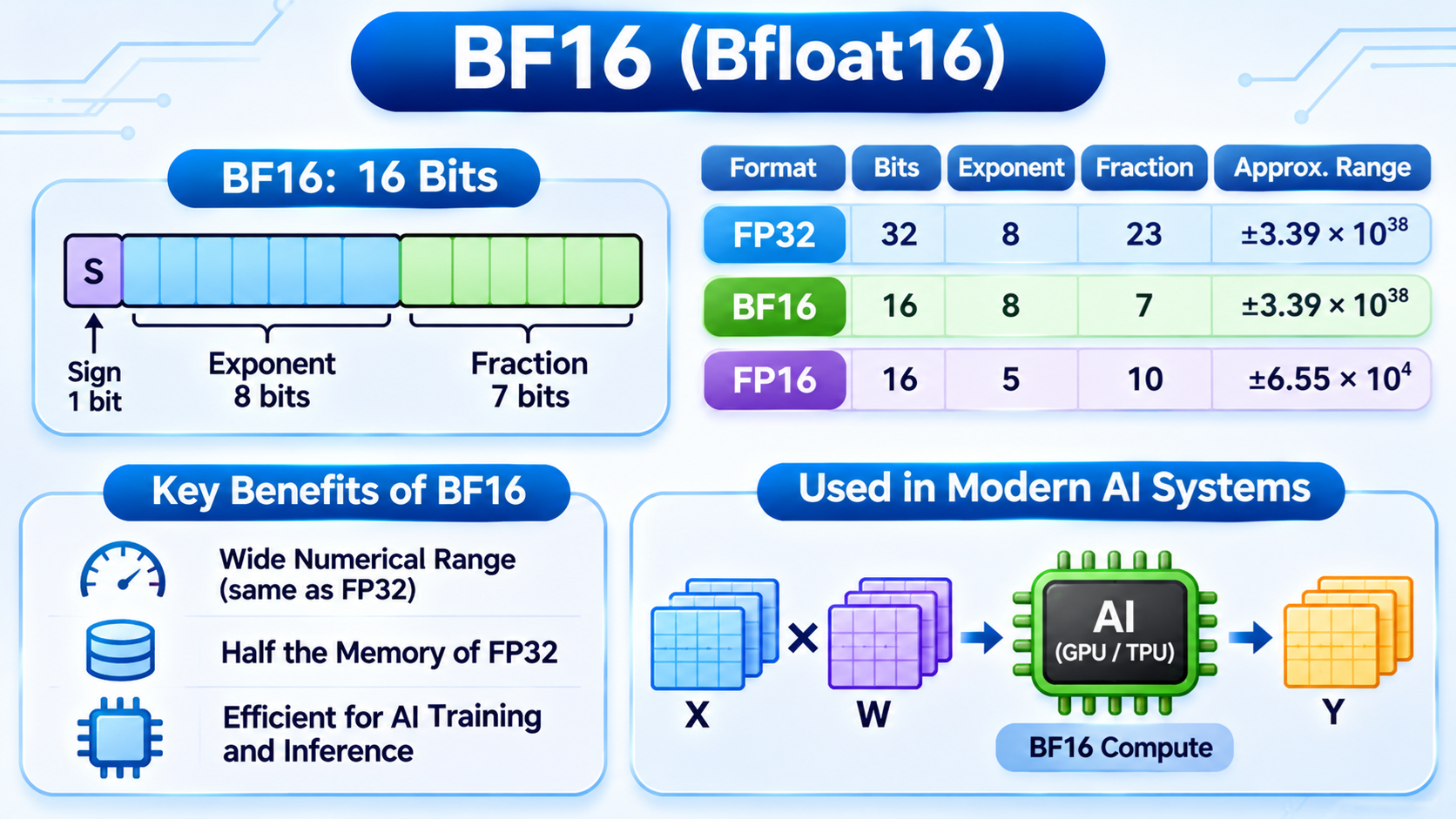
BF16, short for Brain Floating Point 16 (Bfloat16), is a 16-bit floating-point numerical format widely used in Artificial Intelligence (AI), Machine Learning (ML), Deep Learning (DL), and high-performance computing.
BF16 was developed to provide a more memory-efficient alternative to 32-bit floating-point numbers (FP32) while preserving a similar numerical range.
It is particularly useful for training and running large neural networks, including Transformers and Large Language Models (LLMs).
Unlike FP16, which uses more bits for numerical precision but fewer bits for the exponent, BF16 preserves the same exponent width as FP32.
This makes BF16 useful for AI workloads involving values with widely varying magnitudes.
BF16 is supported by many modern AI processors, including compatible GPUs, CPUs, TPUs, and specialized AI accelerators.
How Does BF16 Work?
BF16 represents numerical values using 16 binary bits.
These bits are divided into three fields: a sign bit, an exponent field, and a fraction field.
The sign bit determines whether the number is positive or negative.
The exponent determines the approximate magnitude of the number, while the fraction provides the significant digits used to represent its value.
BF16 uses one sign bit, eight exponent bits, and seven explicitly stored fraction bits.
Like FP32, BF16 uses an exponent bias of 127. For normal finite numbers, its representation follows the same general binary floating-point structure.
By retaining eight exponent bits, BF16 supports a numerical range comparable to FP32 while using only half as many bits for storage.
The trade-off is reduced precision because BF16 stores fewer fraction bits.
What Is the BF16 Bit Structure?
The BF16 format contains three main fields.
Sign Bit — 1 Bit: Determines whether a numerical value is positive or negative.
Exponent — 8 Bits: Represents the scale or magnitude of the number.
Fraction — 7 Bits: Stores the fractional portion of the significand.
The total is 16 bits.
For normal finite values, the numerical representation can be expressed as:
Value = (−1)^sign × 2^(exponent − 127) × (1 + fraction / 128)
The stored fraction contains seven bits, while normal values also have an implicit leading binary digit.
Special exponent patterns represent values such as infinity, NaN (Not a Number), and subnormal numbers.
BF16 uses the same exponent width and bias as FP32, which is its most important distinguishing characteristic.
BF16 vs. FP32: What Is the Difference?
FP32, also called single-precision floating point, uses 32 bits to represent each numerical value.
FP32 contains one sign bit, eight exponent bits, and 23 fraction bits.
BF16 contains one sign bit, eight exponent bits, and seven fraction bits.
The difference is therefore primarily in numerical precision rather than exponent range.
FP32: Provides approximately seven decimal digits of precision and is widely used in scientific computing, machine learning, and general numerical applications.
BF16: Provides approximately two to three significant decimal digits of precision while maintaining a similar numerical range.
BF16 requires only half the storage of FP32.
For example, storing one million numerical values requires approximately 4 MB using FP32 but only 2 MB using BF16, excluding additional storage overhead.
However, BF16 calculations can introduce larger rounding errors than FP32.
BF16 vs. FP16: What Is the Difference?
BF16 and FP16 are both 16-bit floating-point formats, but their internal structures differ.
FP16, commonly called IEEE binary16, contains one sign bit, five exponent bits, and ten fraction bits.
BF16 contains one sign bit, eight exponent bits, and seven fraction bits.
This produces an important trade-off.
FP16: Provides greater significand precision but a smaller exponent range.
BF16: Provides less significand precision but a much wider exponent range.
The maximum finite positive FP16 value is 65,504.
The maximum finite positive BF16 value is approximately 3.39 × 10³⁸, close to the maximum finite FP32 value.
This wider range makes BF16 less susceptible to overflow and underflow than FP16 in many neural network workloads.
However, BF16 is not universally more accurate than FP16.
For values within FP16’s representable range, FP16 generally provides greater numerical precision.
Why Is BF16 Important for AI?
Neural networks perform large numbers of arithmetic operations involving model weights, activations, gradients, and intermediate values.
These numerical values can vary significantly in magnitude.
When using low-precision arithmetic, extremely large values may overflow, while very small values may underflow.
BF16 reduces these risks by retaining FP32’s eight-bit exponent field.
At the same time, BF16 uses half the storage of FP32, reducing memory requirements and data movement.
On compatible hardware, BF16 can also improve computational throughput.
This combination makes BF16 especially valuable for training large neural networks.
However, the reduced significand precision can still introduce numerical errors, and some operations require higher precision.
What Is BF16 Precision?
Precision describes how closely a numerical format can represent values within its supported range.
BF16 has seven stored fraction bits and an implicit leading bit for normal values, providing eight bits of significand precision.
Near the value 1.0, adjacent BF16 values are separated by 0.0078125.
For example, 1.0 and 1.0078125 are consecutive representable BF16 values in that region.
This means BF16 cannot represent every small decimal difference accurately.
By comparison, FP32 provides much finer numerical spacing.
The spacing between representable floating-point values also changes with magnitude.
BF16 is therefore suitable for many neural network calculations but may be inappropriate for applications requiring high numerical precision.
What Is Numerical Range?
Numerical range describes the smallest and largest magnitudes a numerical format can represent.
BF16 provides a large exponent range because it uses eight exponent bits.
Its maximum finite positive value is approximately 3.39 × 10³⁸.
Its smallest positive normal value is approximately 1.18 × 10⁻³⁸.
BF16 also supports smaller subnormal values, although actual hardware handling of subnormal numbers can vary.
This wide numerical range is particularly important during neural network training, where gradients and activations may have very different magnitudes.
However, supporting a wide range does not eliminate rounding errors caused by limited precision.
How Is BF16 Used in Neural Network Training?
Neural network training involves forward propagation, loss calculation, backpropagation, and parameter updates.
These operations require substantial numerical computation and memory.
BF16 can be used for selected matrix multiplication and neural network operations to reduce memory bandwidth requirements and improve processing efficiency.
For example, a Transformer model may use BF16 for many calculations while maintaining selected operations or optimizer states in FP32.
This approach is commonly associated with mixed-precision training.
Using higher precision for sensitive operations can help preserve numerical stability.
The precise combination of formats depends on the model architecture, training framework, hardware, and optimization method.
What Is Mixed-Precision Training?
Mixed-Precision Training uses multiple numerical formats during the same training process.
For example, a model may use BF16 for matrix multiplications and FP32 for certain accumulations or parameter updates.
The objective is to improve computational efficiency while maintaining acceptable numerical accuracy.
BF16 is attractive for mixed-precision training because its exponent range reduces many of the scaling challenges associated with FP16.
FP16 training may require loss scaling to prevent small gradients from underflowing.
BF16 often reduces the need for loss scaling, although it does not eliminate every possible numerical problem.
Modern training frameworks can automatically select suitable numerical formats for supported operations.
What Is Loss Scaling?
Loss scaling is a technique used in mixed-precision neural network training to reduce gradient underflow.
When gradients are represented using a format with limited exponent range, very small values may become zero.
Loss scaling multiplies the loss by a scaling factor before backpropagation and compensates for that scaling during gradient processing.
This technique is commonly associated with FP16 training.
Because BF16 has a much wider exponent range, it generally requires loss scaling less frequently than FP16.
However, BF16 still has limited numerical precision, and model stability must be evaluated according to the specific training workload.
How Is BF16 Used in AI Inference?
AI inference uses trained model parameters to process new information and produce predictions or generated outputs.
BF16 can reduce model weight storage and memory traffic compared with FP32.
For example, a dense model containing seven billion parameters requires approximately 28 GB for FP32 weights alone.
Using BF16 reduces the raw weight storage to approximately 14 GB.
Additional memory is still required for activations, KV caches, runtime buffers, and other components.
On hardware supporting efficient BF16 arithmetic, inference can also benefit from increased matrix-computation throughput.
However, model performance depends on memory bandwidth, software optimization, batching, and other hardware characteristics.
BF16 in Large Language Models
Large Language Models commonly contain billions of parameters and perform extensive matrix multiplication.
Transformer architectures use numerical operations for attention projections, attention calculations, feedforward layers, and other components.
BF16 is widely used during LLM training because it offers a useful balance between numerical range and computational efficiency.
It is also used for LLM inference when sufficient memory and compatible hardware are available.
For example, a seven-billion-parameter model stored entirely using BF16 weights requires approximately 14 GB of raw parameter storage.
Smaller formats such as INT8 or INT4 can reduce weight storage further, but they may require additional quantization procedures and introduce different accuracy considerations.
BF16 and Tensor Cores
Tensor Cores are specialized matrix-processing units available in compatible NVIDIA GPUs.
They accelerate supported matrix multiplication and accumulation operations used in AI workloads.
NVIDIA introduced BF16 Tensor Core support with its Ampere GPU architecture.
On supported GPUs, BF16 values can be used as inputs to matrix operations with accumulation behavior determined by the specific instruction and architecture.
For many supported operations, FP32 accumulation helps reduce numerical error.
Tensor Core acceleration makes BF16 particularly useful in large-scale neural network training and inference.
However, actual performance depends on matrix dimensions, memory bandwidth, software libraries, and GPU architecture.
BF16 on CPUs
BF16 is not limited to GPUs.
Some modern CPUs include instructions designed to accelerate BF16 conversion and arithmetic operations.
For example, selected Intel Xeon processors support BF16-related instructions through compatible vector and matrix-processing extensions.
Some ARM-based processors also support BF16 arithmetic through appropriate architectural extensions.
CPU-based BF16 acceleration can improve performance in certain machine learning workloads, particularly when optimized numerical libraries are available.
However, not every CPU supports native BF16 arithmetic.
On unsupported processors, software may need to emulate conversions or calculations, potentially reducing performance.
BF16 on TPUs and AI Accelerators
BF16 has been particularly important in the development of specialized machine learning hardware.
Google’s Tensor Processing Units (TPUs) have used BF16 to support efficient neural network computation.
Other AI accelerators also provide BF16 support for selected matrix operations.
The format allows hardware designers to reduce storage and arithmetic complexity compared with FP32 while retaining a similar exponent range.
This is useful for training workloads in which numerical values vary widely.
However, different accelerators may use different accumulation formats, conversion rules, and execution architectures.
BF16 support should therefore be evaluated according to the specific hardware and software environment.
BF16 vs. INT8 Quantization
BF16 and INT8 both use eight or more bits fewer than FP32, but they represent numbers differently.
BF16 is a 16-bit floating-point format with an exponent and significand.
INT8 is an 8-bit integer format that represents values within a fixed integer range.
When neural networks use INT8, scaling factors and sometimes zero-point offsets are commonly required to map real-valued data into integer representations.
BF16 generally provides a much wider dynamic range without requiring this type of integer quantization mapping.
INT8 can provide lower memory consumption and efficient arithmetic on suitable hardware.
BF16 is often convenient for training, while INT8 is widely used for optimized inference.
However, both formats can be used in different stages when the system supports them.
BF16 vs. FP8
FP8 refers to a family of 8-bit floating-point formats used in supported AI accelerators.
Common FP8 formats include E4M3 and E5M2, which allocate different numbers of bits to exponent and fraction fields.
FP8 reduces memory requirements compared with BF16 and may provide higher computational throughput on compatible hardware.
However, FP8 generally has more limited numerical range or precision, depending on the selected format.
Training and inference systems using FP8 often require careful scaling and numerical management.
BF16 remains useful when a wider exponent range and more stable numerical behavior are required.
The appropriate format depends on the hardware, model, and acceptable numerical error.
How Does BF16 Relate to Quantization?
Quantization broadly refers to representing numerical information using a limited set of values or lower-precision formats.
BF16 reduces numerical precision compared with FP32, but it is a floating-point format rather than a conventional integer quantization scheme.
Converting FP32 values to BF16 is often described as reduced-precision conversion or mixed-precision computation.
By contrast, INT8 quantization typically maps floating-point values into integers using scaling parameters.
These approaches can both reduce memory requirements and improve computational efficiency.
However, their numerical characteristics and hardware implementations differ.
How Can FPGAs Support BF16?
Field-Programmable Gate Arrays (FPGAs) can implement BF16 arithmetic using configurable logic and dedicated arithmetic resources.
A BF16 processing unit may include hardware for floating-point multiplication, addition, conversion, and normalization.
Some FPGA families provide hardened floating-point or AI-oriented arithmetic resources, while others implement required functions through DSP blocks and programmable logic.
For example, an FPGA-based neural network accelerator may use BF16 matrix multiplication to process model weights and activations.
BF16 can reduce memory bandwidth requirements compared with FP32.
However, native BF16 support depends on the FPGA family, development tools, and available arithmetic IP.
Implementing BF16 operations entirely in configurable logic may require substantial hardware resources compared with fixed-point arithmetic.
BF16 in Matrix Multiplication
Matrix multiplication is one of the most important operations in modern deep learning.
For example, a neural network layer may calculate:
Y = XW + b
Here, X represents input data, W represents model weights, and b represents bias values.
BF16 may be used to represent X and W during matrix multiplication.
On supported hardware, the multiplication results may be accumulated using FP32 or another implementation-defined format.
This combination can reduce input storage and increase arithmetic throughput while maintaining better accumulation precision.
However, BF16 input values have already been rounded to their representable precision, so higher-precision accumulation cannot recover information lost during conversion.
What Are the Advantages of BF16?
BF16 provides several important benefits for AI computing.
Wide Numerical Range: Uses the same exponent width as FP32, reducing many overflow and underflow problems associated with FP16.
Reduced Memory Usage: Requires only 16 bits per value instead of 32 bits.
Lower Memory Bandwidth Requirements: Smaller representations reduce the amount of data transferred between memory and processors.
Efficient AI Computation: Compatible accelerators can execute BF16 matrix operations efficiently.
Simplified Mixed-Precision Training: Often reduces the need for loss scaling compared with FP16.
Large Model Support: Helps reduce memory requirements when training or running large neural networks.
These advantages make BF16 a widely adopted numerical format in modern AI infrastructure.
What Are the Limitations of BF16?
BF16 also has several limitations.
Reduced Precision: Seven stored fraction bits provide considerably less precision than FP32 and FP16.
Rounding Errors: Small numerical differences may disappear during conversion.
Hardware Compatibility: Not every processor or accelerator supports efficient native BF16 operations.
Numerical Sensitivity: Some algorithms and model components require higher precision.
Accumulation Requirements: Low-precision multiplication may need higher-precision accumulation for acceptable accuracy.
Application Dependence: BF16 is not necessarily suitable for scientific calculations requiring precise numerical results.
Performance Variability: BF16 does not automatically improve speed unless suitable hardware and software optimizations are available.
Developers should evaluate BF16 using representative workloads and accuracy requirements.
Conclusion
BF16, or Bfloat16, is a 16-bit floating-point numerical format designed to provide efficient computation while preserving a numerical range similar to FP32.
It contains one sign bit, eight exponent bits, and seven fraction bits.
Compared with FP32, BF16 reduces memory requirements by half but provides substantially less numerical precision.
Compared with FP16, BF16 offers a wider exponent range but lower significand precision.
BF16 is widely used in AI training, Large Language Models, mixed-precision computation, and supported AI inference workloads.
Modern GPUs, TPUs, CPUs, and specialized AI accelerators use BF16 to improve the efficiency of matrix-intensive neural network operations.
Understanding BF16 provides an essential foundation for studying Floating-Point Arithmetic, FP16, FP32, FP8, Mixed-Precision Training, Quantization, Tensor Cores, Matrix Multiplication, GPU Computing, FPGA Acceleration, and modern AI hardware architecture.