Introduction
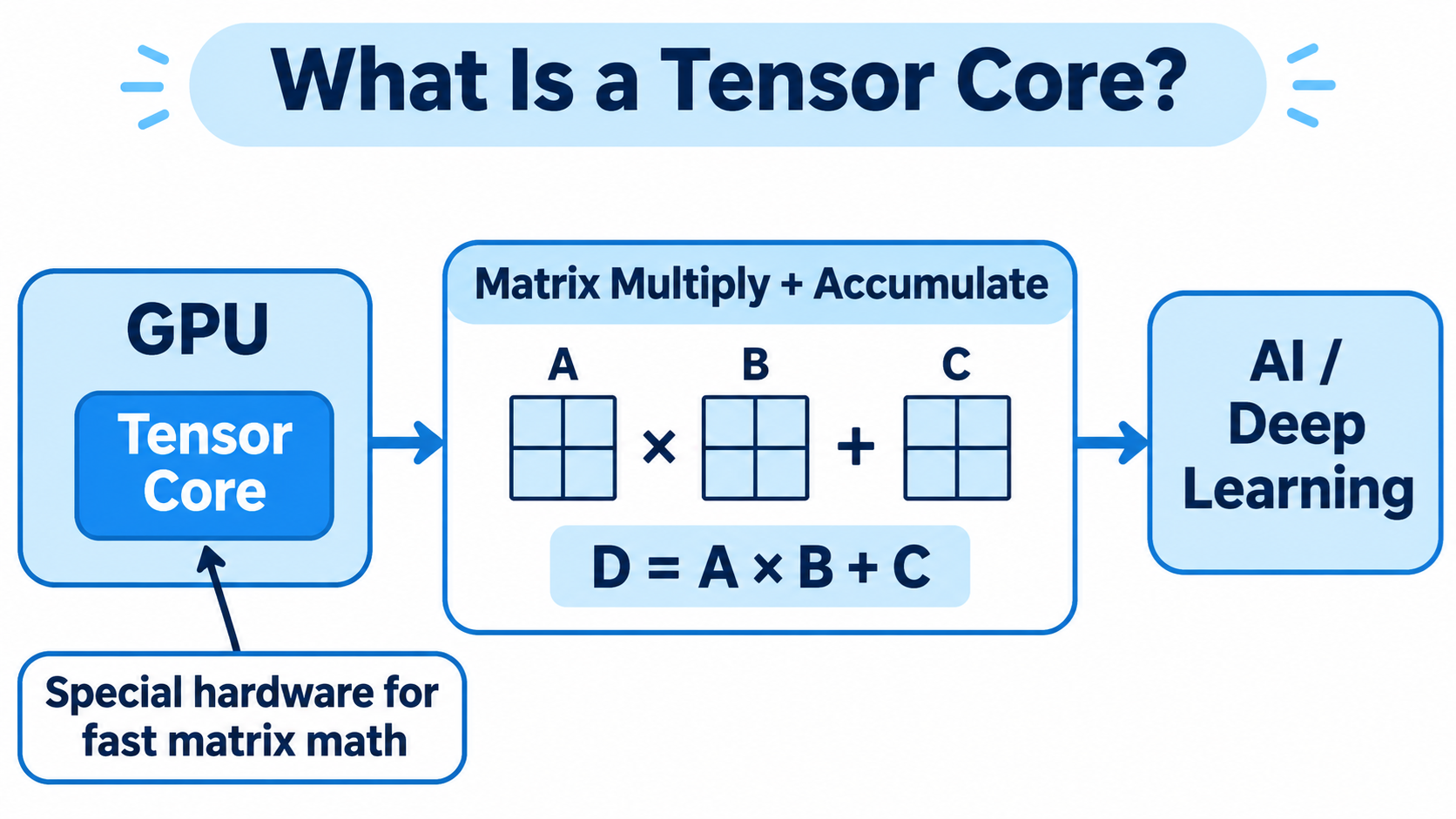
A Tensor Core is a specialized processing unit found in certain NVIDIA Graphics Processing Units (GPUs).
It is designed to accelerate matrix multiplication and related mathematical operations used extensively in Artificial Intelligence (AI), Machine Learning (ML), Deep Learning (DL), and high-performance computing.
Tensor Cores were introduced with NVIDIA’s Volta GPU architecture in 2017.
They provide specialized hardware for performing matrix operations more efficiently than conventional general-purpose GPU arithmetic units for supported workloads.
Modern neural networks rely heavily on matrix multiplication, particularly during model training and inference.
Tensor Cores help accelerate these operations by performing many arithmetic calculations through specialized parallel hardware.
Tensor Cores are widely used in AI training, Large Language Models (LLMs), computer vision, scientific computing, and high-performance GPU applications.
How Does a Tensor Core Work?
A Tensor Core performs specialized matrix arithmetic, commonly involving matrix multiplication followed by accumulation.
A simplified mathematical operation is:
D = A × B + C
Here, A and B are input matrices, C is an accumulation matrix, and D is the resulting matrix.
For example, a neural network layer may multiply a matrix of input values by a matrix of learned weights.
The resulting values are combined with existing partial results or other numerical information.
A Tensor Core accelerates this computation using hardware designed to process matrix operations in parallel.
Rather than performing every individual multiplication and addition through separate general-purpose instructions, supported Tensor Core instructions execute matrix operations on small matrix fragments or tiles.
Larger matrices are divided into tiles, allowing the GPU to process many portions of the calculation concurrently.
The exact matrix dimensions and supported operations depend on the GPU architecture.
Why Are Tensor Cores Important for AI?
Neural networks perform enormous numbers of mathematical operations during both training and inference.
Many of these operations involve multiplying matrices or applying Multiply-Accumulate (MAC) calculations.
For example, a fully connected neural network layer computes outputs from input values and learned weights.
Convolutional neural networks also perform extensive arithmetic that can be implemented through matrix-based computation.
Transformer models use matrix multiplication in attention mechanisms and feedforward neural networks.
Tensor Cores accelerate these operations, helping GPUs process AI workloads more efficiently.
Their benefits are particularly significant when the software uses supported numerical formats, matrix dimensions, and optimized GPU kernels.
What Is Matrix Multiplication?
Matrix multiplication is a mathematical operation that combines two matrices to produce a new matrix.
A matrix is a rectangular arrangement of numerical values organized into rows and columns.
For example, multiplying a 2 × 2 matrix by another 2 × 2 matrix produces a 2 × 2 result.
Each output element is calculated by multiplying corresponding elements from a row of the first matrix and a column of the second matrix, then adding the products together.
These calculations are common in neural networks because model inputs, weights, and intermediate activations are frequently represented as matrices or higher-dimensional tensors.
Tensor Cores provide specialized hardware for executing such matrix calculations efficiently.
What Is a Multiply-Accumulate Operation?
A Multiply-Accumulate operation, commonly called MAC, multiplies two values and adds the product to an accumulated result.
Its basic mathematical form is:
Accumulator = Accumulator + A × B
MAC operations are fundamental to digital signal processing, neural networks, image processing, and scientific computing.
For example, calculating a dot product between two vectors requires multiplying corresponding elements and adding the resulting products.
A neural network may perform millions or billions of these operations during a single inference request.
Tensor Cores accelerate groups of MAC operations organized into matrix calculations.
What Is the Difference Between a Tensor Core and a CUDA Core?
Tensor Cores and CUDA Cores are computational resources within supported NVIDIA GPUs, but they are optimized for different kinds of operations.
CUDA Core: A general-purpose arithmetic execution resource used for many scalar and vector computations, including floating-point and integer operations.
Tensor Core: A specialized execution resource designed primarily for supported matrix multiplication and accumulation operations.
CUDA Cores provide flexibility across a broad range of graphics and computational tasks.
Tensor Cores provide high throughput for particular matrix-oriented workloads.
Modern NVIDIA GPUs can contain both types of computational resources, allowing different portions of an application to use suitable execution hardware.
Tensor Cores are not independent processors running separate applications.
They are integrated execution units within the GPU architecture.
What Is Mixed-Precision Computing?
Mixed-Precision Computing uses different numerical formats or precision levels during mathematical calculations.
For example, a neural network may use 16-bit values for selected matrix operations while maintaining certain accumulated results in 32-bit precision.
This approach can reduce memory requirements and improve arithmetic throughput while helping preserve numerical accuracy.
Tensor Cores support various numerical formats depending on the GPU generation.
Common supported formats across different architectures include FP16, BF16, TF32, INT8, and FP8.
Some newer architectures also support additional low-precision formats.
The exact numerical precision, accumulation behavior, and available acceleration features depend on the hardware.
Mixed-precision techniques are particularly important in modern deep learning because they allow large models to use computing resources more efficiently.
What Are FP16, BF16, TF32, and FP8?
Several numerical formats are commonly associated with Tensor Core acceleration.
FP16: A 16-bit floating-point format that reduces memory consumption and supports efficient arithmetic on compatible hardware.
BF16: A 16-bit floating-point format with a wide exponent range, making it useful for many neural network training operations.
TF32: A computation format introduced for Tensor Core operations on supported NVIDIA GPUs.It uses FP32 inputs with reduced multiplication precision while supporting FP32 accumulation.
FP8: An 8-bit floating-point representation designed for low-precision computation in supported AI workloads.
Lower-precision formats can improve performance and reduce data movement.
However, reduced precision may affect numerical accuracy, making appropriate scaling, training methods, and validation important.
Not every Tensor Core generation supports every format.
How Do Tensor Cores Accelerate Neural Networks?
A neural network contains layers that transform input information through mathematical operations.
Many layers perform matrix multiplication between input activations and learned model weights.
Tensor Cores accelerate these calculations by executing supported matrix operations through specialized hardware.
For example, a neural network processing image data may perform convolution operations that can be mapped to Tensor Core-compatible computations.
Transformer models also use large matrix multiplications for attention projections, feedforward layers, and output transformations.
Tensor Cores can improve processing throughput when these operations are sufficiently large and structured to use the specialized hardware efficiently.
However, not every neural network operation benefits equally from Tensor Core acceleration.
Tensor Cores in AI Training
AI training involves forward propagation, loss calculation, backpropagation, and parameter updates.
Forward propagation processes input data through the model to produce predictions.
Backpropagation calculates gradients used to adjust the model’s parameters.
Both stages can involve substantial matrix multiplication.
Tensor Cores accelerate supported matrix operations during training, particularly when mixed-precision techniques are used.
For example, large Transformer models commonly use GPU acceleration to perform matrix multiplication across many layers and training batches.
Mixed-precision training can increase computational efficiency while retaining higher precision for selected calculations that require it.
This makes Tensor Cores an important component of modern GPU-based AI training infrastructure.
Tensor Cores in AI Inference
Inference is the process of using a trained AI model to generate predictions or other outputs from new input data.
For example, an image-recognition model may classify a photograph, while a language model generates text in response to a question.
During inference, the model performs mathematical operations using its learned parameters.
Tensor Cores can accelerate these operations, particularly when models use supported matrix dimensions and numerical formats.
Lower-precision inference may provide additional performance and memory-efficiency benefits.
However, inference speed also depends on memory bandwidth, model size, batching, and other GPU resources.
Tensor Core performance alone does not determine the overall speed of an AI application.
How Are Tensor Cores Used in Transformers and LLMs?
Transformer-based Large Language Models perform extensive matrix operations.
For example, the attention mechanism generates Query (Q), Key (K), and Value (V) representations through learned matrix transformations.
Attention calculations also involve matrix multiplication and weighted combinations of values.
Transformer feedforward layers perform additional large matrix operations.
Tensor Cores can accelerate these computations when the software maps them to supported hardware instructions.
During LLM inference, the GPU must also access model weights and previously calculated attention information stored in memory.
Consequently, LLM performance depends on both Tensor Core arithmetic throughput and the efficiency of the GPU memory system.
What Is Tensor Core Sparsity Acceleration?
Sparsity refers to the presence of zero-valued elements in a numerical structure.
Some NVIDIA GPU architectures support structured sparsity acceleration through Tensor Cores.
Structured sparsity uses specific patterns of zero and nonzero elements that the hardware can exploit.
For example, certain supported architectures can accelerate matrix operations using a two-out-of-four structured sparsity pattern.
This allows selected calculations to avoid unnecessary arithmetic while maintaining a hardware-compatible data arrangement.
However, sparsity acceleration requires suitable model preparation, numerical formats, and software support.
Arbitrary unstructured sparsity does not automatically produce the same performance benefits.
What Is Tensor Core Performance?
Tensor Core performance is commonly measured by the number of floating-point or integer operations that can be performed per second.
Large AI accelerators may provide very high theoretical matrix-computation throughput.
Performance is often expressed in TFLOPS or related measures, depending on the numerical format and operation.
However, theoretical peak performance is not equivalent to actual application performance.
Real workloads may be limited by memory bandwidth, data transfer overhead, matrix dimensions, software efficiency, synchronization, or unsupported operations.
Performance figures can also differ significantly depending on whether they assume sparsity acceleration.
Meaningful comparisons should use consistent numerical precision, workload characteristics, and measurement methods.
How Do Programmers Use Tensor Cores?
Developers commonly access Tensor Core acceleration through GPU software libraries and machine learning frameworks.
For example, PyTorch and TensorFlow can use optimized NVIDIA libraries to execute supported neural network operations.
NVIDIA cuBLAS provides accelerated linear algebra operations, while cuDNN supports many deep learning computations.
NVIDIA CUDA also provides programming interfaces for developers implementing specialized matrix operations.
The Warp Matrix Multiply and Accumulate (WMMA) API and newer architecture-specific mechanisms provide access to supported matrix computation capabilities.
In many applications, developers do not need to program individual Tensor Cores directly.
Instead, optimized libraries select suitable GPU instructions based on the hardware, numerical format, and operation.
Tensor Core vs. GPU vs. NPU
A GPU is a complete processing architecture containing many computational resources, memory interfaces, scheduling mechanisms, and execution units.
A Tensor Core is a specialized arithmetic resource integrated into certain NVIDIA GPUs.
A Neural Processing Unit (NPU), by comparison, is a processor architecture designed to accelerate neural network workloads.
NPUs may contain specialized matrix multiplication engines that perform functions similar to Tensor Cores, but their internal designs and programming interfaces differ.
Therefore, a Tensor Core is not equivalent to an entire GPU or NPU.
It is one component of a larger computing system optimized for high-throughput mathematical computation.
Tensor Cores vs. FPGA AI Acceleration
Tensor Cores and FPGAs can both accelerate neural network computations, but they use different hardware architectures.
Tensor Cores are fixed-function matrix-processing resources integrated into NVIDIA GPUs.
Their supported operations and numerical formats are determined by the GPU architecture.
FPGAs use configurable logic, DSP blocks, registers, and memory resources to implement custom computation pipelines.
For example, an FPGA designer can build a specialized matrix multiplication engine using arithmetic units arranged for a particular model.
Tensor Cores generally benefit from a mature GPU software ecosystem and provide strong performance for supported matrix workloads.
FPGAs offer greater hardware customization and can be useful for specialized low-latency or energy-constrained applications.
The appropriate choice depends on model requirements, development complexity, computational throughput, memory bandwidth, and power consumption.
What Are the Limitations of Tensor Cores?
Tensor Cores provide substantial computational acceleration for supported workloads, but they also have limitations.
Workload Dependence: They are optimized for matrix-oriented operations rather than arbitrary computations.
Numerical Precision: Supported formats and accumulation modes vary between GPU generations.
Memory Bandwidth: Performance may be limited when memory cannot supply data sufficiently quickly.
Software Compatibility: Applications must use appropriate libraries or instructions to benefit from Tensor Core acceleration.
Matrix Dimensions: Small or irregular operations may not fully utilize the hardware.
Accuracy Considerations: Lower-precision arithmetic may introduce numerical errors.
Hardware Availability: Tensor Cores are available only in compatible NVIDIA GPU architectures.
Effective acceleration requires suitable algorithms, numerical formats, memory management, and optimized software.
Applications of Tensor Cores
Tensor Cores are widely used in applications requiring large amounts of matrix computation.
Large Language Models: Accelerating Transformer layers during training and inference.
Computer Vision: Processing image classification, object detection, and image segmentation models.
Generative AI: Supporting text generation, image generation, and other neural network workloads.
Scientific Computing: Accelerating selected matrix-intensive numerical calculations.
Medical Imaging: Supporting neural network analysis of medical images.
Robotics: Accelerating supported perception and AI inference workloads.
Autonomous Systems: Processing neural network models used for perception and decision support.
Data Centers: Providing high-throughput AI computation for cloud services and research applications.
The performance benefits depend on the characteristics of each application and its implementation.
Conclusion
A Tensor Core is a specialized matrix-processing execution unit integrated into compatible NVIDIA GPUs.
It accelerates supported matrix multiplication and accumulation operations that are fundamental to neural networks, deep learning, and modern AI systems.
Tensor Cores support various numerical formats, including FP16, BF16, TF32, INT8, and FP8 on appropriate GPU architectures.
Their applications include AI training, LLM inference, computer vision, generative AI, and scientific computing.
Unlike general-purpose CUDA Cores, Tensor Cores are optimized for specific matrix computations.
Unlike FPGAs, their hardware functionality is fixed by the GPU architecture rather than being configured as custom logic circuits.
Understanding Tensor Cores provides an essential foundation for studying GPU Architecture, CUDA, Deep Learning, AI Training, AI Inference, Transformers, Large Language Models, Matrix Multiplication, Mixed-Precision Computing, and modern AI accelerator hardware.