Introduction
CISC, or Complex Instruction Set Computer, is a processor design approach that supports a relatively rich instruction set, including instructions capable of performing complex operations.
Unlike traditional RISC (Reduced Instruction Set Computer) architectures, which emphasize simpler and more regular instructions, CISC architectures often provide a wider variety of instructions, addressing modes, and instruction lengths.
The most widely used example of CISC is the x86 architecture, including modern x86-64 processors developed by Intel and AMD.
CISC remains an important concept in computer architecture because it helps explain how processors execute machine instructions and how modern CPUs balance software compatibility, hardware complexity, and performance.
How Does CISC Work?
A CISC processor executes machine instructions that may perform several low-level operations as part of a single architectural instruction.
For example, an arithmetic instruction may read an operand from memory, perform a calculation, and store the result in a register.
In a traditional RISC architecture, the same operation might require separate load and arithmetic instructions.
CISC instructions can therefore express certain operations using fewer machine instructions.
However, a complex instruction does not necessarily execute in a single clock cycle. Some instructions require multiple internal operations and several processor cycles.
Modern x86 processors commonly decode instructions into smaller internal operations called micro-operations, or micro-ops, which are executed by the processor’s internal execution units.
Main Characteristics of CISC
CISC architectures traditionally share several important characteristics.
Rich Instruction Set: Provides a broad range of instructions, including arithmetic, logical, data movement, control-flow, and specialized operations.
Complex Instructions: Some instructions can perform multiple conceptual operations, such as accessing memory and executing arithmetic.
Multiple Addressing Modes: Instructions may support different methods of identifying operands, including registers, immediate values, and memory addresses.
Variable-Length Instructions: Many CISC architectures use instructions of different lengths. For example, x86 instructions can range from 1 to 15 bytes.
Memory Operands: Certain instructions can operate directly on data stored in memory instead of requiring every operand to be loaded into a register first.
Microcode Support: Some processors use microcode to implement complex instructions through sequences of simpler internal operations.
These characteristics are common CISC design principles, although individual architectures may implement them differently.
CISC and Complex Instructions
One important feature of CISC is the ability to express relatively complex operations using individual machine instructions.
Consider the following x86-64 assembly instruction:
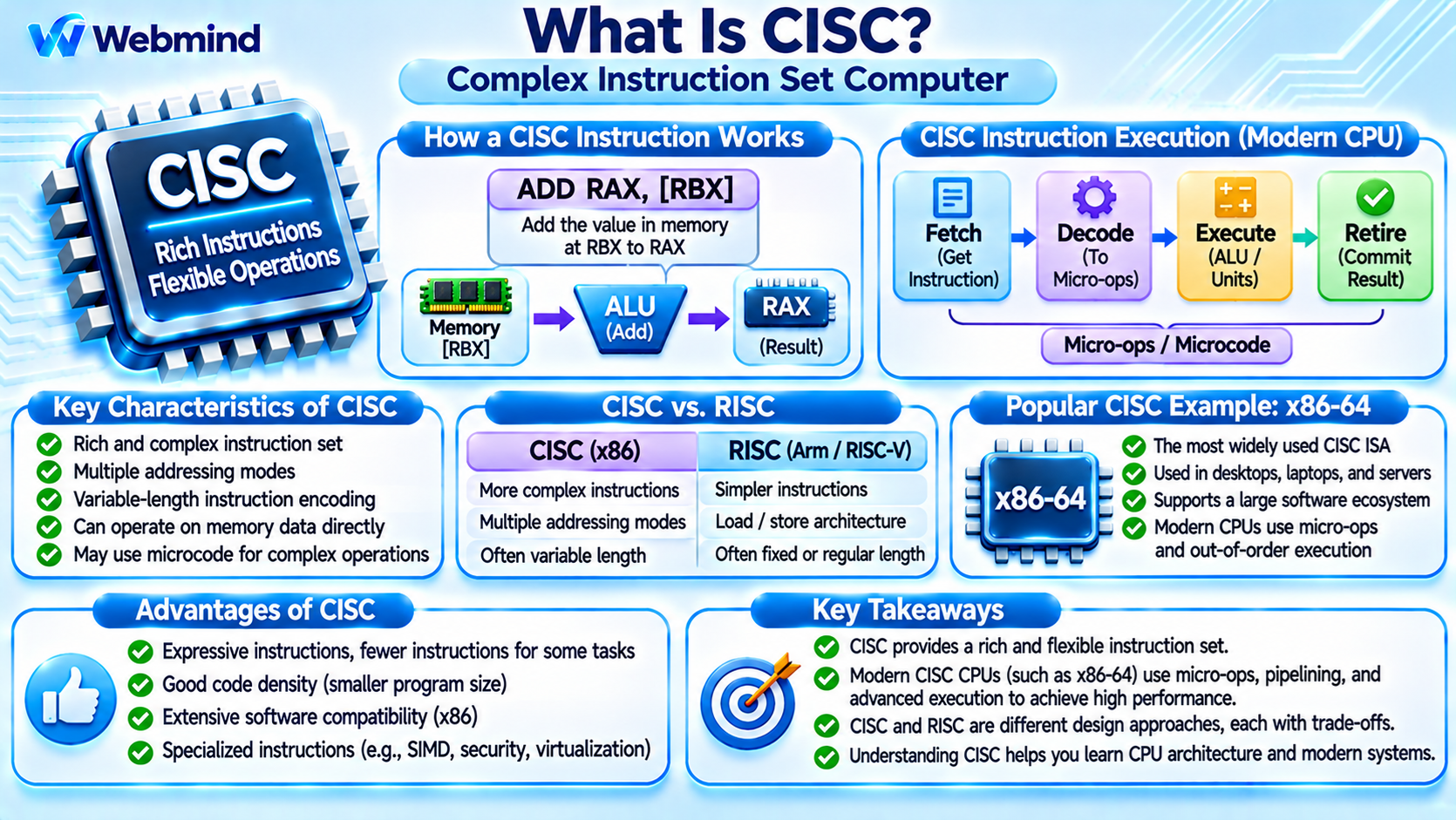
ADD RAX, [RBX]
This instruction reads a value from the memory address stored in RBX, adds it to the value in RAX, and stores the result in RAX.
A typical load/store RISC architecture would use a separate load instruction followed by an addition instruction.
The CISC approach can reduce the number of architectural instructions needed to express certain operations.
However, fewer instructions do not automatically mean faster execution. Performance also depends on instruction decoding, memory access latency, execution resources, and processor microarchitecture.
How Modern CISC Processors Execute Instructions
Modern x86 processors are much more sophisticated than early CISC processors.
A simplified execution process includes several stages.
1. Instruction Fetch: The processor retrieves machine instructions from its instruction cache.
2. Instruction Decode: Hardware decoders interpret variable-length x86 instructions and translate many of them into internal micro-operations.
3. Instruction Scheduling: The processor identifies dependencies and schedules micro-operations for available execution units.
4. Execution: Arithmetic units, load/store units, and other hardware components perform the required operations.
5. Retirement: Completed instructions are committed in architectural order, preserving correct program behavior.
Many modern x86 CPUs also use micro-op caches, branch prediction, register renaming, and out-of-order execution to improve performance.
These techniques allow complex architectural instructions to be executed efficiently using highly optimized internal hardware.
What Is Microcode?
Microcode is a low-level control mechanism used in some processors to implement certain machine instructions or internal processor functions.
Instead of implementing every instruction entirely through fixed control logic, a processor may use stored sequences of microinstructions to coordinate internal operations.
Historically, microcode helped simplify the implementation of complex instruction sets.
Modern x86 processors combine hardwired instruction-decoding logic, micro-op generation, and microcode mechanisms.
Many common instructions are handled directly by fast decoding hardware, while certain complex instructions may require microcode-assisted execution.
Some processors also support microcode updates to address hardware behavior, compatibility issues, or security vulnerabilities.
However, microcode updates do not provide unlimited flexibility to redesign the processor’s instruction set.
CISC vs. RISC: What Is the Difference?
CISC and RISC represent two traditional approaches to instruction set architecture design.
CISC (Complex Instruction Set Computer): Supports relatively complex instructions, multiple addressing modes, and often variable-length instruction encoding. The x86 family is the most prominent example.
RISC (Reduced Instruction Set Computer): Emphasizes relatively simple instructions, regular instruction formats, and register-based operations. Arm and RISC-V are major examples.
A CISC instruction may combine memory access and arithmetic into one instruction, while a typical RISC processor separates these operations.
Traditional RISC designs can simplify instruction decoding and pipeline construction. CISC designs may offer compact instruction representations and extensive software compatibility.
However, modern processors have narrowed many of these differences.
High-performance RISC processors may contain complex out-of-order execution engines, while modern CISC processors frequently execute simpler internal micro-operations.
Neither approach is automatically superior in speed or energy efficiency. Actual performance depends on processor architecture, manufacturing technology, software optimization, and workload characteristics.
What Is x86 and x86-64?
The x86 architecture originated with Intel’s 8086 processor, introduced in 1978.
Over time, the architecture evolved through multiple generations, adding protected memory operation, 32-bit processing, floating-point capabilities, SIMD extensions, and other features.
The x86-64 architecture extended x86 to support 64-bit computing, additional general-purpose registers, and larger address spaces.
Today, x86-64 is widely used in desktop computers, laptops, workstations, and servers.
Processors from Intel and AMD support the x86-64 architecture while using different internal microarchitectures.
One major advantage of the x86 ecosystem is its extensive software compatibility. Modern x86 processors can often execute software built for earlier generations, subject to operating system support and processor operating modes.
Advantages of CISC
Instruction Expressiveness: Complex instructions can perform operations that would otherwise require multiple simpler instructions.
Code Density: Variable-length instruction encoding can reduce program size for certain workloads.
Software Compatibility: Mature CISC architectures such as x86 provide extensive compatibility with existing operating systems and applications.
Specialized Instructions: Modern x86 processors support instructions for vector processing, cryptography, virtualization, and other computational tasks.
Mature Software Ecosystem: CISC-based x86 platforms benefit from decades of compiler development, operating system support, and application optimization.
These advantages depend on the specific ISA and processor implementation rather than the CISC classification alone.
Limitations of CISC
CISC architectures also present important engineering challenges.
Instruction Decoding Complexity: Variable-length instructions and numerous addressing modes can make instruction decoding more complicated.
Hardware Design Complexity: Supporting a large instruction set may require sophisticated decoding logic, control mechanisms, and compatibility features.
Instruction Execution Variability: Different instructions may require significantly different numbers of internal operations and execution cycles.
Compatibility Requirements: Maintaining support for older architectural features can complicate processor development.
Verification Effort: Complex instruction behavior requires extensive hardware verification and testing.
Modern CPU designers address many of these challenges through optimized decoders, micro-op caches, pipelining, and advanced execution engines.
Where Is CISC Used?
CISC architectures are most commonly associated with x86-based computing platforms.
Desktop Computers: Intel and AMD processors execute x86-64 software for operating systems, productivity applications, and gaming.
Laptops: x86-64 processors support general-purpose computing, multimedia applications, and software development.
Servers: Many enterprise servers and cloud computing systems use x86-64 processors.
Workstations: Engineering, scientific computing, content creation, and professional applications frequently run on x86-64 hardware.
Industrial Computers: Some industrial automation systems, embedded PCs, and control equipment use x86-compatible processors.
Although x86 dominates modern CISC computing, other historical CISC architectures include Motorola 68000, VAX, and several earlier processor families.
Why Is CISC Still Important?
CISC remains important because processor design involves more than instruction simplicity.
Modern computing systems must balance performance, power consumption, software compatibility, development cost, and application requirements.
The continued success of x86-64 demonstrates that a complex architectural instruction set can be implemented using advanced internal hardware techniques.
Modern x86 processors combine CISC instruction compatibility with micro-op execution, pipelining, branch prediction, and out-of-order scheduling.
Understanding this relationship also helps explain the distinction between ISA and microarchitecture: software sees the architectural instruction set, while the processor’s internal design determines how those instructions are executed.
Conclusion
CISC is a processor design approach characterized by relatively rich instruction sets, complex operations, and flexible addressing modes.
The x86 and x86-64 architectures are the most important modern examples of CISC computing.
Although CISC architectures can require more sophisticated instruction decoding and control hardware, modern processors use micro-operations, pipelining, and advanced execution techniques to achieve high performance.
Understanding CISC and its differences from RISC provides an essential foundation for studying CPU architecture, assembly language, instruction sets, microcode, processor pipelines, and modern computer systems.