Introduction
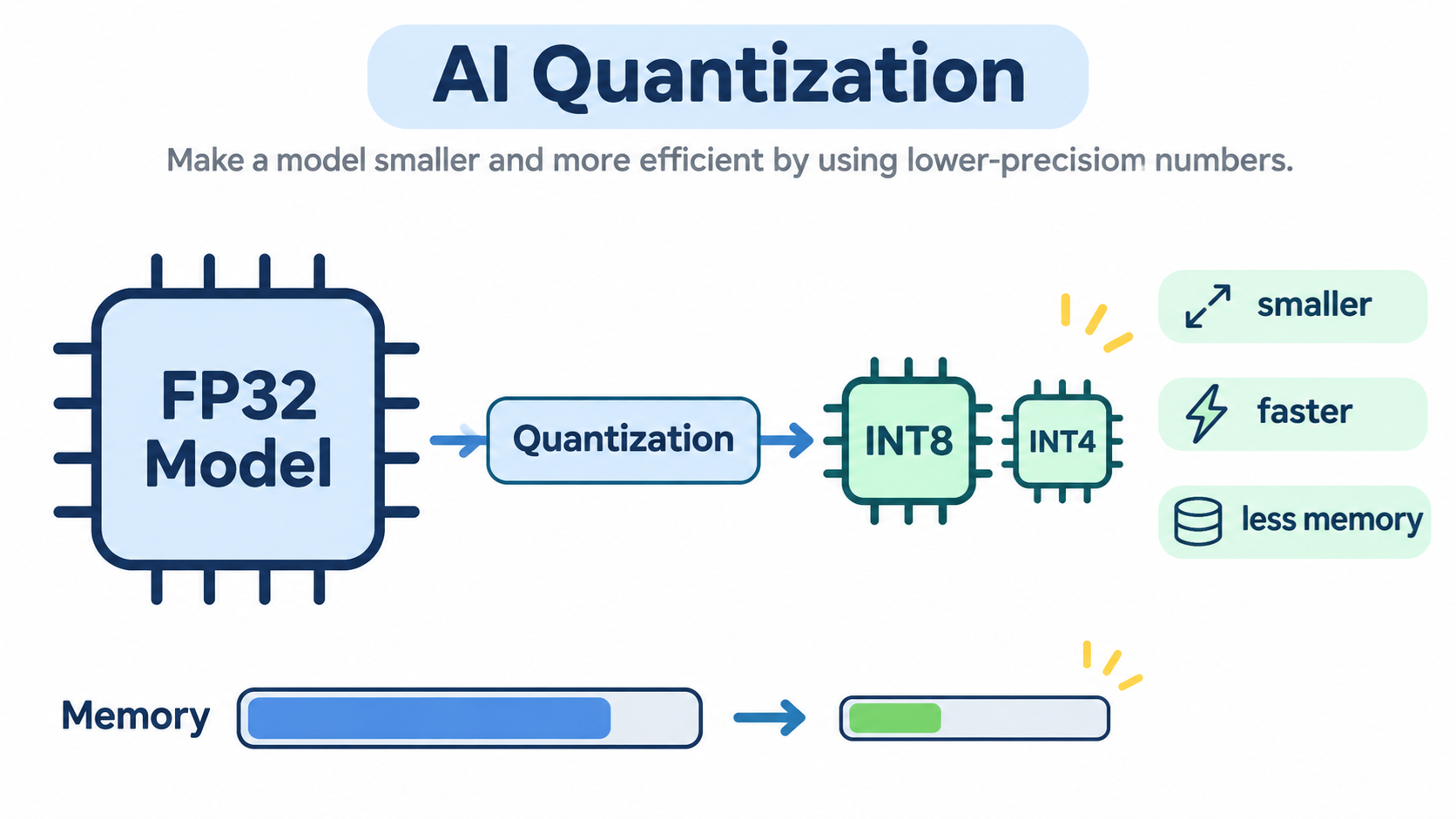
Quantization is a technique used in Artificial Intelligence (AI) and Machine Learning (ML) to represent numerical values using lower-precision formats.
It can reduce model memory requirements, decrease data movement, and improve computational efficiency on compatible hardware.
Modern neural networks commonly use floating-point numbers to represent model weights, activations, and intermediate calculations.
Quantization allows some of these values to be represented using smaller numerical formats, such as 8-bit integers (INT8) or 4-bit integers (INT4), instead of 32-bit floating-point numbers (FP32).
Quantization is widely used in Large Language Models (LLMs), Deep Learning, Computer Vision, Edge AI, microcontrollers, GPUs, NPUs, FPGAs, and specialized AI accelerators.
Its primary objective is to make AI models smaller and more efficient while maintaining acceptable accuracy.
How Does Quantization Work?
Quantization converts values from a higher-precision numerical representation into a lower-precision representation.
For example, a neural network may store a weight using a 32-bit floating-point number.
Quantization can map that value to an 8-bit integer using a scale factor and, in some methods, a zero-point offset.
A simplified uniform quantization formula is:
q = round(x / scale) + zero_point
Here, x is the original numerical value, q is the quantized integer, scale determines the conversion ratio, and zero_point defines the integer representation of zero.
The result is typically clamped to the supported integer range.
When necessary, the quantized value can be converted back to an approximate floating-point value using dequantization.
Because fewer numerical levels are available, quantization introduces approximation errors.
The challenge is to reduce precision without significantly affecting model performance.
Why Is Quantization Important?
Large AI models require substantial memory capacity and memory bandwidth.
For example, a neural network containing one billion parameters requires approximately 4 GB of storage when its parameters use FP32.
The same number of parameters requires approximately 2 GB using FP16, 1 GB using INT8, or 0.5 GB using an ideal packed INT4 representation.
These figures describe raw parameter storage and do not include metadata, scale factors, temporary buffers, or other runtime overhead.
Reducing parameter size can allow larger models to operate on hardware with limited memory.
Quantization can also reduce the amount of data transferred between memory and processing units, which is particularly important in memory-bandwidth-limited AI inference.
However, lower numerical precision does not automatically guarantee faster execution.
Actual performance depends on hardware support and software implementation.
What Are FP32, FP16, BF16, INT8, and INT4?
AI systems use several numerical formats with different precision and range characteristics.
FP32 (32-bit Floating Point): A conventional single-precision floating-point format widely used in numerical computation and model training.
FP16 (16-bit Floating Point): A lower-precision floating-point format that reduces memory consumption and can accelerate supported AI operations.
BF16 (Brain Floating Point): A 16-bit floating-point format with an exponent range similar to FP32 but fewer significand bits.
INT8 (8-bit Integer): An integer format commonly used for quantized neural network weights and activations.
INT4 (4-bit Integer): A very low-precision integer format frequently used for compressed model weights, particularly in LLM inference.
Lower-precision formats can improve storage efficiency, but their numerical behavior differs.
Floating-point conversion and integer quantization also require different mathematical handling.
What Is Post-Training Quantization?
Post-Training Quantization (PTQ) converts a previously trained model into a lower-precision representation without repeating its complete training process.
For example, a neural network trained using FP32 may be converted to use INT8 weights and activations.
Some PTQ methods require calibration data to determine suitable quantization ranges and scaling factors.
Other methods can quantize model weights without using representative activation samples.
PTQ is popular because it is relatively straightforward and can significantly reduce deployment requirements.
However, some models experience substantial accuracy degradation when quantized aggressively.
The resulting model must be evaluated using representative inputs before deployment.
What Is Quantization-Aware Training?
Quantization-Aware Training (QAT) incorporates quantization effects into the training or fine-tuning process.
Instead of converting the model only after training, QAT simulates or applies relevant low-precision behavior while model parameters are being optimized.
This allows the model to adapt to some of the numerical errors introduced by quantization.
For example, a neural network intended for INT8 deployment can be trained while accounting for the limited precision of its target representation.
QAT can preserve accuracy better than simple PTQ for certain models and quantization configurations.
However, it requires additional training resources and a suitable implementation.
What Is Weight Quantization?
Weight quantization reduces the numerical precision used to store neural network parameters.
For example, model weights originally stored in FP16 may be represented using INT8 or INT4 values.
This can significantly reduce the memory required to load and execute large models.
Weight quantization is particularly valuable in LLM inference because model parameters can account for a large portion of memory consumption and data movement.
However, some weight values or layers may be especially sensitive to reduced precision.
Advanced quantization methods may therefore use different scaling strategies or preserve selected operations at higher precision.
What Is Activation Quantization?
Activation quantization reduces the numerical precision of intermediate values generated while a neural network processes input data.
For example, activations that would normally use FP32 or FP16 may be represented using INT8 values.
Quantizing activations can reduce intermediate memory usage and enable efficient integer arithmetic on compatible processors.
However, activation values often change depending on the input, making them more difficult to quantize than fixed model weights.
Activation quantization may use calibration data, dynamic scaling, or quantization-aware training.
Its effectiveness depends on the model architecture and the distribution of intermediate values.
What Is Static vs. Dynamic Quantization?
Static and dynamic quantization differ primarily in how quantization parameters are determined.
Static Quantization: Determines relevant scales and ranges in advance, commonly using calibration data or quantization-aware training.
Dynamic Quantization: Calculates some quantization parameters during inference based on the current input or intermediate values.
Static quantization can reduce runtime conversion overhead when suitable quantization parameters are available.
Dynamic quantization provides flexibility when activation ranges vary substantially between inputs.
The terminology and implementation details differ across AI frameworks.
Both methods can improve efficiency, but their benefits depend on model structure and hardware capabilities.
What Is Symmetric vs. Asymmetric Quantization?
Symmetric quantization represents numerical values using a range centered around zero.
It commonly uses a zero-point of zero and a scale factor.
This simplifies certain arithmetic operations and is widely used for neural network weights.
Asymmetric quantization allows the represented range to shift relative to zero by using a nonzero zero-point.
This can be useful when values are concentrated in a range that is not centered around zero.
For example, an activation function that produces only nonnegative values may benefit from an asymmetric representation.
The appropriate approach depends on the numerical distribution and supported hardware operations.
What Is Per-Tensor and Per-Channel Quantization?
Quantization parameters can be shared across different amounts of data.
Per-Tensor Quantization: Uses one set of quantization parameters for an entire tensor.
Per-Channel Quantization: Uses separate quantization parameters for individual channels or other selected tensor dimensions.
Per-channel quantization can better represent tensors whose channels have different numerical ranges.
For example, different convolutional filters may contain weight values with significantly different magnitudes.
Using separate scales can reduce quantization error.
However, per-channel quantization requires additional scale information and suitable hardware or software support.
Other methods include per-group and per-block quantization.
What Is Quantization Error?
Quantization error is the difference between an original numerical value and its reconstructed quantized approximation.
For example, suppose a value of 0.37 is represented using a quantization step size of 0.1.
The nearest available representation may be 0.4, creating an error of 0.03.
In neural networks, these errors can accumulate or influence later calculations.
Some layers may tolerate quantization errors well, while others may be more sensitive.
Quantization quality is therefore evaluated by examining both numerical error and the model’s actual task performance.
A smaller model is not necessarily useful if its prediction accuracy becomes unacceptable.
What Is Mixed-Precision Quantization?
Mixed-Precision Quantization uses different numerical formats or bit widths for different model components.
For example, one neural network layer may use INT8 weights, while another more sensitive layer uses FP16.
Some systems use INT4 for most model weights but preserve selected parameters or calculations at higher precision.
This approach attempts to balance accuracy, memory consumption, and computational efficiency.
Mixed precision is particularly valuable when some model components are more sensitive to quantization than others.
However, supporting several numerical formats can increase implementation complexity.
What Is LLM Quantization?
LLM quantization reduces the memory and computational requirements of Large Language Models by representing selected parameters or activations using lower-precision formats.
For example, a dense language model containing seven billion parameters requires approximately 14 GB for FP16 weights alone.
Using an ideal 4-bit representation reduces the raw weight storage to approximately 3.5 GB, excluding quantization metadata and runtime overhead.
This reduction can make local inference more practical on personal computers and smaller GPUs.
Popular LLM quantization approaches include GPTQ, AWQ, and other weight-compression techniques.
Different methods use different strategies to preserve model quality, handle sensitive weights, and optimize inference performance.
The best choice depends on the model, hardware, inference framework, and accuracy requirements.
What Is the Relationship Between Quantization and AI Inference?
Inference is the process of using a trained model to generate predictions or other outputs.
Quantization is one technique used to make this process more efficient.
For example, a quantized image-classification model may perform many arithmetic operations using INT8 rather than FP32.
On compatible hardware, this can improve throughput and reduce memory bandwidth requirements.
In LLM inference, quantization is especially useful because moving large amounts of model data from memory can be a major performance bottleneck.
However, quantization may introduce conversion overhead or require specialized computational kernels.
Therefore, actual inference improvements must be measured rather than assumed.
Quantization vs. Pruning vs. Knowledge Distillation
Quantization is one of several methods used to optimize AI models.
Quantization: Reduces numerical precision, allowing values to use fewer bits.
Pruning: Removes selected weights, connections, channels, or other model components.
Knowledge Distillation: Trains a smaller model to learn useful behavior from a larger teacher model.
For example, quantization may reduce a model’s weight representation from 16 bits to 4 bits.
Pruning may eliminate selected model structures, while knowledge distillation may produce an entirely smaller neural network.
These techniques can be combined, but each introduces different accuracy and implementation trade-offs.
How Does Quantization Affect Model Accuracy?
Quantization changes the numerical values used during model execution, potentially affecting predictions.
Moderate quantization, such as carefully implemented INT8 inference, can preserve accuracy well for many neural networks.
More aggressive quantization, such as INT4 or lower bit widths, may create greater challenges.
Accuracy loss depends on the model’s architecture, training data, quantization method, and numerical sensitivity.
For language models, evaluation should include relevant tasks such as question answering, reasoning, coding, and language understanding.
For computer vision systems, evaluation may include classification accuracy or object-detection performance.
A successful quantization strategy reduces resource consumption while maintaining acceptable performance for the intended application.
What Hardware Supports Quantization?
Quantization is widely supported by modern computing hardware, although supported formats and acceleration capabilities differ.
CPU: Many processors provide integer SIMD instructions that accelerate quantized neural network operations.
GPU: Modern GPUs support various low-precision floating-point and integer operations for AI training and inference.
NPU: Neural Processing Units frequently emphasize efficient low-precision arithmetic, particularly for edge and mobile AI.
TPU: Specialized AI accelerators support numerical formats designed for efficient machine learning computation.
FPGA: Configurable digital logic allows designers to implement customized arithmetic precision and data-processing pipelines.
ASIC: Dedicated AI chips can provide highly optimized arithmetic structures for specific numerical formats.
Hardware selection should account for supported operations, memory capacity, bandwidth, software compatibility, and power consumption.
How Do FPGAs Benefit from Quantization?
FPGAs are particularly well suited to customized numerical precision because their arithmetic circuits can be designed around application-specific requirements.
For example, an FPGA neural network accelerator may use 8-bit integer arithmetic instead of 32-bit floating-point operations.
Lower precision can reduce arithmetic resource usage and memory bandwidth requirements.
DSP blocks, Lookup Tables (LUTs), registers, and Block RAM (BRAM) can be used to construct parallel processing pipelines.
In some designs, reduced precision allows more arithmetic operations to be performed simultaneously within the available hardware resources.
However, actual resource savings depend on the FPGA family, arithmetic architecture, synthesis tools, and implementation.
Quantization therefore provides an important optimization technique for FPGA-based AI inference.
Quantization in Microcontrollers and Edge AI
Microcontrollers and embedded devices often have limited RAM, storage, computing capacity, and electrical power.
Quantization allows smaller AI models to operate within these constraints.
For example, a neural network used for keyword recognition or vibration classification may be converted to INT8 for execution on a microcontroller.
Embedded inference frameworks such as TensorFlow Lite Micro, now developed within the LiteRT ecosystem, support quantized model execution on compatible devices.
Quantization can reduce memory requirements and improve computational efficiency, making local AI processing practical for more embedded applications.
However, deployment still requires attention to input preprocessing, supported operators, numerical accuracy, and available hardware resources.
What Is Quantization in Computer Vision?
Computer vision models process large quantities of image data and often contain substantial convolutional or matrix operations.
Quantization can reduce the memory and computational requirements of image-classification, object-detection, and image-segmentation models.
For example, an industrial camera may use an INT8 object-detection model to inspect products on a manufacturing line.
On suitable hardware, low-precision computation can improve processing speed or reduce power consumption.
However, model accuracy must be tested under representative operating conditions, including variations in lighting, object size, and image quality.
Quantization is particularly useful for real-time computer vision systems operating on embedded processors and AI accelerators.
What Are the Advantages of Quantization?
Quantization provides several potential benefits for AI deployment.
Reduced Memory Usage: Lower-precision values require fewer bits of storage.
Lower Memory Bandwidth Requirements: Smaller representations reduce the amount of data transferred between memory and processors.
Improved Inference Performance: Compatible hardware may execute low-precision operations more efficiently.
Lower Power Consumption: Reduced data movement and efficient arithmetic can decrease energy requirements.
Smaller Model Files: Quantized weights can reduce storage and download requirements.
Edge AI Deployment: Smaller models can operate on devices with limited resources.
These advantages make quantization an important part of modern AI hardware and inference optimization.
What Are the Limitations of Quantization?
Quantization also introduces several challenges.
Accuracy Loss: Reduced numerical precision can affect predictions.
Numerical Range: Small integer formats may struggle to represent values with large dynamic ranges.
Calibration Requirements: Some methods need representative data to determine suitable quantization parameters.
Hardware Compatibility: A model may not run faster if the processor lacks efficient low-precision operations.
Operator Support: Some neural network operations may require higher precision or additional conversions.
Implementation Complexity: Mixed-precision and advanced quantization methods require careful engineering.
Model Sensitivity: Certain layers or parameters may be especially vulnerable to numerical approximation.
Quantization should therefore be evaluated according to accuracy, latency, throughput, memory consumption, and energy efficiency.
Conclusion
Quantization is a numerical optimization technique that reduces the precision used to represent neural network parameters, activations, and other computational values.
Common formats include FP16, BF16, INT8, and INT4.
Important methods include Post-Training Quantization, Quantization-Aware Training, weight quantization, activation quantization, and mixed-precision quantization.
Quantization can reduce model size, memory bandwidth requirements, and inference costs while improving performance on compatible hardware.
It is especially important for Large Language Models, Edge AI, embedded systems, computer vision, and specialized AI accelerators.
Understanding quantization provides an essential foundation for studying AI Inference, Machine Learning, Neural Networks, Transformers, LLMs, GPU Computing, NPU Architecture, FPGA Acceleration, and modern AI hardware design.