Introduction
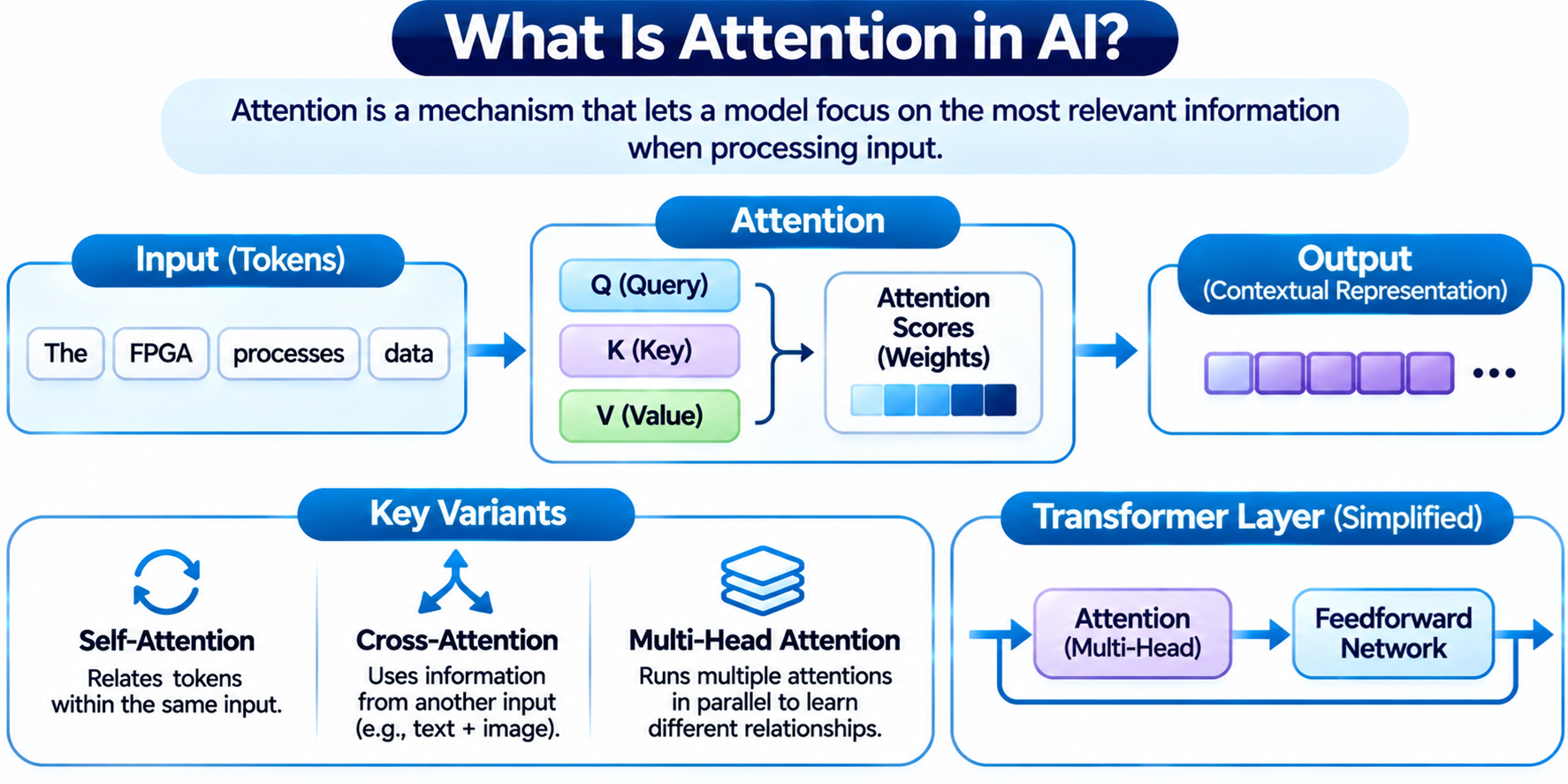
Attention is a neural network mechanism that allows an artificial intelligence model to assign different levels of importance to information when processing input data.
It helps the model determine which parts of a sequence or other data structure are most relevant to a particular computation.
Attention is one of the fundamental technologies behind modern Deep Learning, Natural Language Processing (NLP), Transformers, and Large Language Models (LLMs).
For example, when an AI model processes a sentence, attention allows it to combine information from related words even when those words are separated by several positions.
Attention mechanisms are also used in computer vision, speech recognition, machine translation, and multimodal AI systems.
Why Is Attention Important?
Understanding language often requires examining relationships between different words rather than processing each word independently.
Consider the sentence: “The engineer programmed the FPGA because it needed a new configuration.”
To interpret the word “it,” an AI model benefits from considering its relationship with “FPGA” and other words in the sentence.
An attention mechanism allows the model to calculate how much information from different token positions should contribute to the representation of a particular token.
This makes attention especially useful for processing contextual relationships and long sequences.
However, attention weights do not necessarily represent human-like understanding, and a high attention score does not always provide a reliable explanation of a model’s decision.
How Does Attention Work?
Attention operates by calculating relationships between numerical representations of information.
In a Transformer, text is first divided into tokens.
Each token is converted into a numerical vector, and positional information is incorporated into the model’s representations.
The attention mechanism then uses learned transformations to calculate relationships between tokens.
For each query, it produces attention scores associated with available keys.
These scores are normalized into attention weights, which determine how the corresponding value vectors are combined.
The resulting representation incorporates information from relevant positions in the input sequence.
For example, when processing a technical sentence containing “CPU,” “memory,” and “data,” attention can help the model combine information about how these concepts relate to one another.
What Are Query, Key, and Value?
The attention mechanism commonly uses three types of vectors: Query (Q), Key (K), and Value (V).
Query: Represents the information being sought by a particular token position or processing element.
Key: Provides information used to determine how strongly another position should contribute to the query.
Value: Contains the information that will be combined to produce the attention output.
These vectors are generated through learned mathematical transformations.
A useful analogy is searching a collection of documents.
The query represents what is being searched for, the keys help identify relevant documents, and the values contain the information retrieved from those documents.
In actual neural networks, these operations involve numerical vectors and matrix calculations rather than ordinary keyword matching.
What Is Scaled Dot-Product Attention?
Scaled Dot-Product Attention is a widely used attention calculation in Transformer neural networks.
Its mathematical expression is:
Attention(Q, K, V) = softmax(QKᵀ / √dₖ)V
Here, Q is the query matrix, K is the key matrix, V is the value matrix, and dₖ is the dimensionality of the key vectors.
The query and key matrices are multiplied to calculate attention scores.
Dividing by the square root of the key dimension helps prevent excessively large score magnitudes.
The softmax function converts the scores into normalized weights.
These weights are then used to calculate weighted combinations of the value vectors.
Although the formula is relatively compact, modern AI models perform attention across large numerical matrices, often using GPUs or specialized AI accelerators.
What Is Self-Attention?
Self-Attention is a mechanism in which queries, keys, and values are derived from the same input sequence or collection of representations.
For example, when processing the sentence “The CPU reads data from memory,” each token can incorporate information from other permitted token positions.
This allows the network to represent relationships between “CPU,” “reads,” “data,” and “memory.”
Self-attention is one of the central components of the Transformer architecture.
Unlike recurrent neural networks, which use sequential state updates, self-attention can calculate many token relationships in parallel during training.
However, the amount of computation and memory required by conventional self-attention grows significantly as the sequence becomes longer.
What Is Multi-Head Attention?
Multi-Head Attention allows a model to perform several attention calculations using different learned projections of the input representations.
Each attention head has its own query, key, and value transformations.
Different heads can learn to emphasize different relationships within the same input.
For example, one head may respond strongly to nearby words, while another may capture relationships between more distant tokens.
The outputs of the heads are combined and passed through another learned transformation.
Multi-head attention increases the flexibility of the model, allowing it to represent multiple types of relationships simultaneously.
However, attention heads do not necessarily correspond to simple, independently interpretable concepts.
What Is Causal Attention?
Causal Attention is an attention mechanism that restricts access to future token positions during autoregressive language generation.
For example, when a language model is predicting the next word in a sentence, it must generate that prediction using information already available in the sequence.
A causal attention mask prevents a position from using information from later positions.
This is particularly important in decoder-only Transformer architectures used by many generative LLMs.
During training, causal masks allow the model to calculate predictions for multiple positions in parallel without revealing future target tokens.
During inference, the model generates new tokens using the preceding context and its learned parameters.
What Is Cross-Attention?
Cross-Attention allows one set of representations to obtain information from another set.
Unlike self-attention, where queries, keys, and values come from the same sequence, cross-attention generally uses queries derived from one sequence and keys and values derived from another.
For example, in an encoder-decoder Transformer used for translation, the encoder processes a source-language sentence.
The decoder then uses cross-attention to incorporate information from the encoder while generating the translated sentence.
Cross-attention is also useful in multimodal AI systems that combine text, images, or audio.
It provides a flexible mechanism for connecting different sources of information within a neural network.
Attention vs. Self-Attention vs. Cross-Attention
Attention is the general mechanism for calculating weighted combinations of information.
Attention: A broad category of mechanisms that assign weights to available information.
Self-Attention: Calculates relationships within the same sequence or representation set.
Cross-Attention: Allows representations from one source to incorporate information from another source.
For example, a language model may use self-attention to process relationships between words in a prompt.
A text-to-image model may use cross-attention to connect visual-generation features with text representations.
These mechanisms share related mathematical principles but serve different architectural purposes.
What Is an Attention Mask?
An Attention Mask controls which positions are permitted to participate in an attention calculation.
For example, a causal mask prevents a token from attending to future positions.
A padding mask can prevent artificial padding tokens from influencing meaningful representations.
Other attention masks can restrict processing to local windows or selected groups of tokens.
Masks are commonly implemented by modifying attention scores before normalization so that disallowed positions receive no attention weight.
Attention masks are important for maintaining correct model behavior, supporting efficient computation, and enforcing architectural restrictions.
What Is the Relationship Between Attention and Transformers?
The Transformer architecture was introduced in the 2017 research paper Attention Is All You Need.
Its central innovation was the use of attention mechanisms to process sequence relationships without relying on recurrent computation in the same way as earlier RNN-based architectures.
A typical Transformer layer contains attention operations, feedforward neural networks, residual connections, and normalization.
Attention allows information to be exchanged across token positions, while feedforward layers perform additional transformations on the resulting representations.
Modern Transformers may use encoder-only, decoder-only, or encoder-decoder architectures.
Attention is a central component of these models, but it is not the only operation responsible for their capabilities.
Attention in Large Language Models
Large Language Models use attention to process relationships between tokens in prompts, documents, and generated text.
For example, when an LLM receives a technical question about FPGA architecture, attention helps combine information from relevant words and earlier context.
Many generative LLMs use stacked Transformer layers containing multiple attention heads.
The model repeatedly transforms token representations before producing scores for possible next tokens.
Attention is especially important for language tasks involving context, references, and relationships between different parts of a sentence.
However, an LLM’s ability to produce accurate responses also depends on its training data, model architecture, parameters, and other computational mechanisms.
What Is an Attention Matrix?
An Attention Matrix contains attention weights calculated between query positions and key positions.
In conventional full self-attention, a sequence of n tokens can produce an attention matrix containing n × n values for each attention head.
Each row represents how a query position distributes attention across the permitted key positions.
For example, a sentence containing five tokens may produce a five-by-five attention matrix in an unmasked self-attention calculation.
Researchers sometimes visualize these matrices as heatmaps to examine attention patterns.
However, attention visualizations should be interpreted carefully because attention weights alone do not fully explain a model’s predictions.
Why Is Attention Computationally Expensive?
Conventional full self-attention compares query representations with key representations across many pairs of token positions.
For a sequence of length n, the number of attention-score elements grows approximately as n².
For example, increasing the sequence length from 1,000 to 2,000 tokens increases the number of possible query-key score elements from one million to four million per attention head.
This creates computational and memory challenges when processing long documents or extended conversations.
The complete cost of a Transformer also includes feedforward layers, projections, memory access, and other operations.
Modern attention optimizations aim to reduce memory movement, improve parallel execution, or restrict the number of token relationships that must be calculated.
What Is FlashAttention?
FlashAttention is a family of optimized attention algorithms designed to improve the efficiency of attention computation on suitable hardware.
It reduces expensive data movement between GPU memory and faster on-chip storage by organizing attention calculations into smaller blocks.
FlashAttention uses numerically stable techniques that avoid materializing the entire attention-score matrix in large, slow memory.
This can substantially reduce memory requirements and improve performance.
Importantly, exact FlashAttention implementations compute the same mathematical attention operation, subject to ordinary floating-point differences, rather than simply approximating attention by removing arbitrary token relationships.
FlashAttention is particularly useful for training and inference with long sequences.
What Is Sparse Attention?
Sparse Attention reduces the number of token relationships calculated by an attention mechanism.
Instead of allowing every token to attend to every other token, a sparse architecture restricts attention to selected positions or patterns.
For example, a model may allow tokens to attend primarily to nearby positions while also providing selected connections to more distant positions.
Sparse attention can reduce computation and memory usage for long sequences.
However, restricting attention may also remove relationships that would have been available through full attention.
The appropriate attention pattern depends on the application and model architecture.
What Is Sliding-Window Attention?
Sliding-Window Attention limits attention to a local region around each token position.
For example, a token may be permitted to attend only to a configured number of preceding tokens instead of the entire earlier sequence.
This reduces the computational cost of attention over long inputs.
Sliding-window attention can be useful when local context contains much of the information needed for a task.
However, long-distance relationships may require additional architectural mechanisms, such as global attention positions, periodic full-attention layers, or other information-sharing techniques.
Different Transformer architectures use different combinations of local and global attention.
What Is the Relationship Between Attention and the KV Cache?
A Key-Value Cache, commonly called a KV Cache, stores previously calculated key and value representations during autoregressive Transformer inference.
When a language model generates a new token, it often needs to attend to information from earlier tokens.
Without caching, the model would repeatedly calculate many of the same key and value representations.
By storing these values, an inference system reduces unnecessary computation and improves token-generation efficiency.
However, the cache consumes memory, especially when models process long contexts or serve many users simultaneously.
Techniques such as Multi-Query Attention (MQA) and Grouped-Query Attention (GQA) can reduce the memory required for cached key and value representations.
What Is Grouped-Query Attention?
Grouped-Query Attention is an attention architecture in which multiple query heads share a smaller number of key and value heads.
In conventional Multi-Head Attention, each attention head commonly has its own query, key, and value projections.
Grouped-Query Attention reduces the number of distinct key and value heads while preserving multiple query heads.
This can significantly reduce KV-cache memory requirements and improve inference efficiency.
Multi-Query Attention represents a related design in which multiple query heads share one set of key and value heads.
These approaches are particularly valuable in large language models that must generate tokens efficiently.
Attention in Computer Vision
Attention mechanisms are not limited to language processing.
Vision Transformers use attention to process relationships between visual representations, often derived from image patches.
For example, an image-classification model may analyze different regions of a photograph and combine information from relevant areas.
Attention can help models process relationships between distant image regions and support tasks such as classification, object detection, and image segmentation.
Attention-based architectures are also used in medical imaging, industrial inspection, and video analysis.
The effectiveness of these systems depends on training data, model architecture, image resolution, and computational resources.
Attention in Multimodal AI
Multimodal AI systems process information from more than one type of input, such as text, images, audio, and video.
Attention mechanisms help combine and exchange information between these representations.
For example, a vision-language model may process an image together with a question about the image.
The model can use attention to connect relevant visual features with the language representations involved in answering the question.
Different multimodal architectures use self-attention, cross-attention, or combinations of both.
These techniques are important in modern AI assistants, image understanding, speech processing, robotics, and visual question answering.
What Hardware Is Used for Attention Computation?
Attention involves substantial numerical computation, including matrix multiplication, vector operations, normalization, and memory access.
Different computing platforms can execute these operations.
CPU: Supports attention computation for smaller models and general-purpose inference workloads.
GPU: Provides parallel computing capabilities widely used for Transformer training and large-scale inference.
NPU: Accelerates supported neural network operations, often with an emphasis on power efficiency.
TPU: Provides specialized machine learning acceleration for matrix-intensive computations.
FPGA: Offers configurable digital hardware for implementing customized attention-processing pipelines.
ASIC: Provides specialized hardware designed for particular AI workloads and performance requirements.
Memory bandwidth, on-chip storage, numerical precision, and data movement are important factors affecting attention performance.
How Can FPGAs Accelerate Attention?
FPGAs can accelerate selected attention operations through configurable digital logic, dedicated DSP blocks, and on-chip memory resources.
For example, an FPGA can implement matrix multiplication pipelines for calculating query-key scores and weighted value combinations.
DSP blocks can perform parallel arithmetic, while Block RAM (BRAM) and other memory resources can store intermediate data.
Designers may also implement specialized softmax calculations, quantized arithmetic, and dataflow architectures.
This flexibility can be useful for low-latency inference, industrial AI, telecommunications, and embedded systems.
However, large attention workloads require significant memory capacity and bandwidth.
FPGA-based implementations must balance performance, logic resources, storage requirements, and power consumption.
What Are the Limitations of Attention?
Attention provides a powerful way to model relationships between data elements, but it has several limitations.
Computational Cost: Full attention can become expensive as sequence lengths increase.
Memory Requirements: Attention calculations and KV caches can consume substantial memory.
Context Limitations: Models may struggle to use relevant information effectively across very long sequences.
Interpretability: Attention weights do not necessarily provide reliable explanations of a model’s decisions.
Training Dependence: Attention patterns are learned from data and may reflect inaccuracies or biases in the training process.
Hardware Constraints: Efficient attention computation requires suitable numerical processing and memory systems.
These limitations have motivated research into efficient attention algorithms, alternative neural architectures, and improved hardware acceleration.
Conclusion
Attention is a neural network mechanism that allows AI models to calculate relationships between information elements and combine relevant representations using learned weights.
Its fundamental components include Query (Q), Key (K), Value (V), attention scores, and weighted value combinations.
Important attention mechanisms include Self-Attention, Cross-Attention, Multi-Head Attention, Causal Attention, Grouped-Query Attention, and Sliding-Window Attention.
Attention is central to the Transformer architecture and many modern Large Language Models, computer vision systems, and multimodal AI applications.
Understanding attention provides an essential foundation for studying Neural Networks, Transformers, LLMs, Generative AI, token processing, KV caching, GPU computing, FPGA acceleration, and modern artificial intelligence hardware.