Introduction
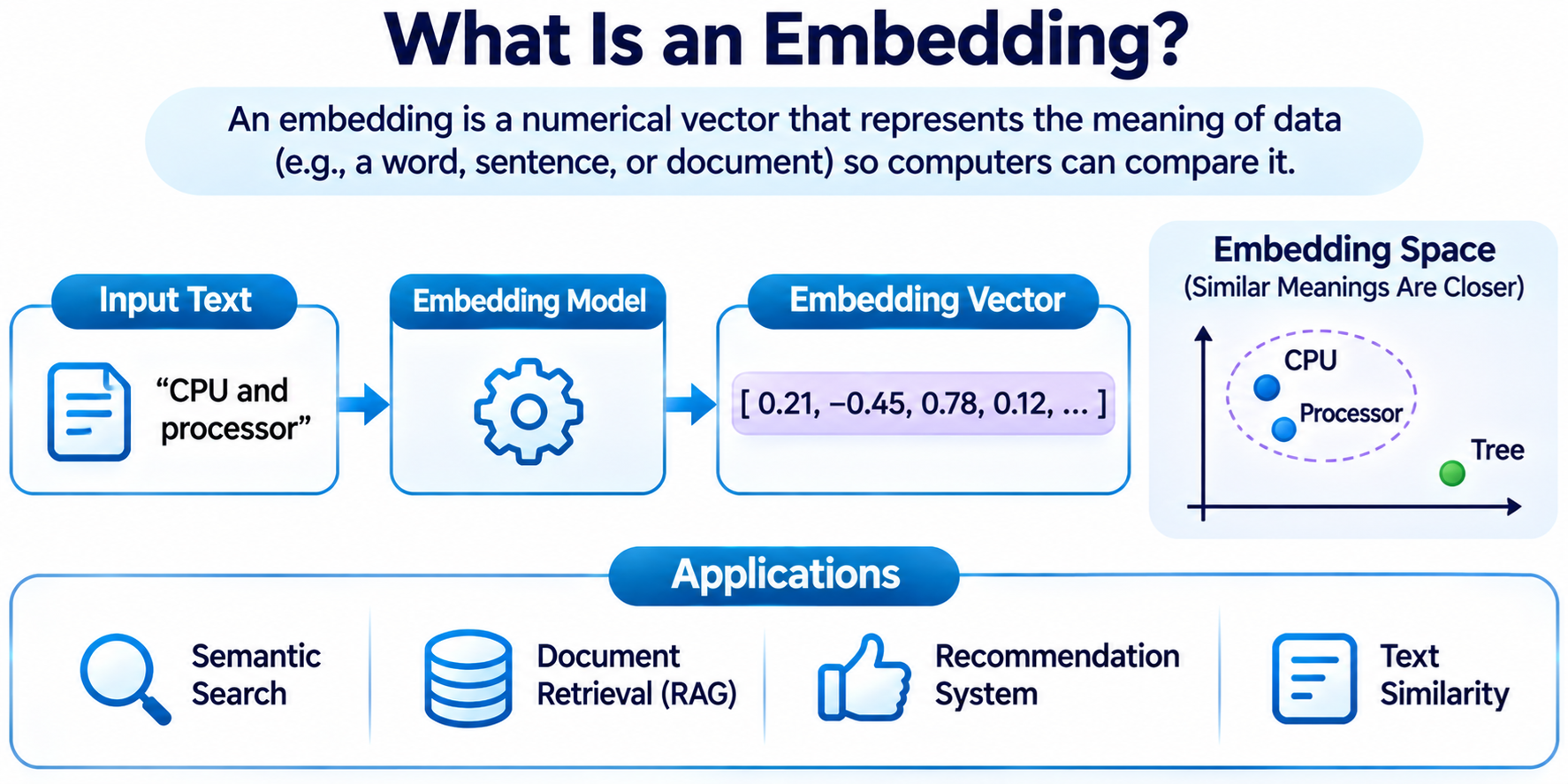
An Embedding is a numerical representation of information in the form of a vector, allowing machine learning models to process and compare data mathematically.
Embeddings are widely used in Artificial Intelligence (AI), Machine Learning (ML), Deep Learning (DL), Natural Language Processing (NLP), and Large Language Models (LLMs).
For example, an embedding model can convert a word, sentence, document, or image into a sequence of numerical values.
These values are designed to represent useful characteristics and relationships learned from training data.
Embeddings are essential to modern AI applications, including semantic search, recommendation systems, document retrieval, image recognition, and Retrieval-Augmented Generation (RAG).
How Does an Embedding Work?
An embedding model transforms input information into a vector containing numerical values.
For example, the word “computer” might be represented by a simplified vector such as [0.21, -0.45, 0.78, 0.12].
This is an illustrative example rather than an actual embedding from a specific model.
Each number represents a coordinate in a mathematical space. Real embedding models commonly produce vectors containing hundreds or thousands of dimensions.
During training, the model learns numerical representations that capture relationships useful for its objectives.
For example, the words “CPU” and “processor” may have relatively similar embeddings because they frequently appear in related contexts.
The meaning of an embedding is represented by the overall pattern of numerical values rather than by any single coordinate.
What Is an Embedding Vector?
An embedding vector is an ordered collection of numerical values used to represent an item.
For example, a four-dimensional embedding can be written as:
[0.21, -0.45, 0.78, 0.12]
Each position in the vector represents one dimension of the embedding space.
A model with 768-dimensional embeddings produces vectors containing 768 numerical values, while another model may use 1,024 or more dimensions.
The dimensionality is determined by the model architecture and configuration.
Higher-dimensional embeddings can represent complex relationships, but larger vectors also require more memory, storage, and computational resources.
A larger embedding dimension does not automatically guarantee better performance.
What Is Embedding Space?
Embedding space is a mathematical coordinate system in which data items are represented as vectors.
The purpose of this representation is to make useful relationships between data items accessible through mathematical operations.
For example, a model trained for semantic similarity may place representations of “microcontroller” and “MCU” relatively close together.
A representation of “temperature sensor” may also be close to related terms such as “thermistor” or “thermal measurement.”
However, embedding spaces are model-specific.
Numerical distances are meaningful only according to the model’s training objective and the similarity metric being used.
Embeddings from unrelated models should not generally be compared directly without an appropriate alignment or transformation.
What Is the Difference Between a Token and an Embedding?
Tokens and embeddings are closely related but perform different functions in language models.
Token: A discrete unit of text or other information processed by a model.
Token ID: A numerical identifier assigned to a token in the model’s vocabulary.
Embedding: A numerical vector associated with an input item or learned representation.
For example, a tokenizer may divide the sentence “The FPGA is fast” into several tokens.
Each token is converted into a Token ID, which can be used to retrieve its learned embedding vector.
The Transformer then processes these vectors through attention mechanisms and neural network layers.
The token identifies the information unit, while the embedding provides a numerical representation that the model can calculate with.
What Is a Token Embedding?
A Token Embedding is a vector representation associated with a token in a neural language model.
A token embedding layer commonly contains a learned matrix that maps Token IDs to numerical vectors.
For example, if a model has a vocabulary containing 50,000 tokens and an embedding dimension of 768, its token embedding matrix contains 50,000 rows and 768 columns.
Each row represents the learned embedding associated with a particular Token ID.
The embedding matrix is typically adjusted during model training.
Token embeddings provide the initial numerical representations that are passed into the Transformer’s processing layers.
What Is a Contextual Embedding?
A contextual embedding is a representation that changes according to the surrounding information.
For example, consider the word “bank” in two sentences: “She deposited money in the bank” and “The boat stopped near the river bank.”
The same word has different meanings in these contexts.
A Transformer can produce different contextual representations for the word because its attention mechanisms incorporate information from surrounding tokens.
This is different from a static token embedding, which provides the same initial vector whenever the same Token ID is used.
Contextual embeddings are important in modern language understanding, translation, information extraction, and other NLP applications.
What Is a Sentence Embedding?
A Sentence Embedding represents an entire sentence as a single numerical vector.
For example, the sentences “What is a microcontroller?” and “Can you explain what an MCU is?” express closely related questions.
A sentence embedding model trained for semantic similarity may generate vectors that are close to each other.
Sentence embeddings allow software to compare meanings rather than relying exclusively on identical words.
They are widely used in semantic search, duplicate-question detection, text clustering, and recommendation systems.
A sentence embedding is not simply the collection of individual token embeddings.
It is a representation constructed to summarize useful information about the entire sentence.
What Is a Document Embedding?
A Document Embedding represents a document, paragraph, or other extended text as a numerical vector.
For example, an embedding system may represent technical articles about FPGA architecture, embedded Linux, or computer networking.
Documents discussing similar subjects may produce relatively similar vectors.
Document embeddings are useful for organizing large collections of information and retrieving content relevant to a user’s query.
Long documents are often divided into smaller sections called chunks before embeddings are generated.
This approach helps retrieval systems locate specific passages rather than returning entire documents containing large amounts of unrelated information.
What Is an Embedding Model?
An Embedding Model is a machine learning model designed to convert input information into useful vector representations.
Different embedding models support different data types and tasks.
Text Embedding Model: Converts words, sentences, or documents into numerical vectors.
Image Embedding Model: Converts images into representations useful for visual similarity or recognition.
Audio Embedding Model: Represents speech, sounds, or other audio information.
Multimodal Embedding Model: Produces representations that support relationships across different information types.
Some embedding models use Transformer architectures, while others use different neural network designs.
An embedding model is not necessarily a generative language model.
Its primary purpose may be representing and comparing information rather than generating text.
How Are Embedding Models Trained?
Embedding models learn representations by optimizing an objective that encourages useful relationships between data items.
For example, a text embedding model may be trained using pairs of related and unrelated sentences.
The training process encourages related examples to receive similar representations while distinguishing examples with different meanings.
One common approach is contrastive learning, which uses positive and negative examples to shape the embedding space.
Other approaches include language-model pretraining, classification objectives, metric learning, and task-specific fine-tuning.
The resulting embedding quality depends on the training data, model architecture, optimization objective, and intended application.
What Is Cosine Similarity?
Cosine Similarity is a mathematical measure used to compare the direction of two vectors.
It is commonly used to estimate similarity between embeddings.
Cosine similarity is calculated by dividing the dot product of two vectors by the product of their magnitudes.
For nonzero vectors, the result ranges from -1 to 1.
A value close to 1 indicates that the vectors point in similar directions.
A value near zero indicates that they are approximately perpendicular, while a value near -1 indicates opposite directions.
For example, a semantic search system may calculate cosine similarity between a user’s question embedding and embeddings stored for documents.
Higher similarity scores can indicate more relevant documents when the embedding model has been trained for that purpose.
However, a high similarity score does not guarantee factual relevance or correctness.
What Is Vector Search?
Vector Search is a technique for finding data items whose embedding vectors are close to a query vector.
For example, a user may search for “How does an FPGA process signals?” without using the exact terminology found in stored documents.
An embedding model converts the query into a vector.
The search system compares that vector with stored document embeddings and retrieves nearby results.
Unlike traditional keyword search, vector search can identify semantically related information even when the wording differs.
However, vector search may also retrieve conceptually similar but factually unrelated information.
Modern information-retrieval systems frequently combine vector search with keyword matching, filtering, and reranking.
What Is a Vector Database?
A Vector Database is a data-management system designed to store, index, and retrieve vector embeddings efficiently.
For example, an organization may generate embeddings for thousands of technical documents and store them in a vector database.
When a user submits a question, the system generates a query embedding and searches for similar document vectors.
Vector databases commonly use approximate nearest-neighbor search algorithms to improve retrieval efficiency.
Examples of technologies supporting vector search include FAISS, Milvus, Weaviate, Qdrant, and PostgreSQL with pgvector.
Not all these systems are standalone databases. Some are libraries or database extensions that provide vector-search capabilities.
The appropriate technology depends on data volume, search latency, filtering requirements, and infrastructure complexity.
What Is Nearest Neighbor Search?
Nearest Neighbor Search identifies data points located closest to a query point in a mathematical space.
In embedding applications, the data points are vector representations of documents, images, products, or other items.
An exact nearest-neighbor search evaluates distances or similarities sufficiently to identify the closest vectors according to the selected metric.
Approximate Nearest Neighbor (ANN) algorithms improve search efficiency by using specialized indexes and accepting a possibility of missing some exact nearest neighbors.
Common ANN approaches include Hierarchical Navigable Small World (HNSW) graphs and Inverted File (IVF) indexes.
These techniques are widely used in large-scale semantic search and recommendation systems.
What Is Retrieval-Augmented Generation?
Retrieval-Augmented Generation (RAG) combines external information retrieval with a generative language model.
Embeddings are frequently used to identify documents or passages relevant to a user’s question.
A typical embedding-based RAG workflow begins by dividing source documents into smaller chunks.
The system generates embeddings for these chunks and stores them in a searchable index.
When a user asks a question, the system generates an embedding for the query, retrieves relevant passages, and provides them to the language model as context.
The language model then generates a response using the supplied information.
RAG can help AI systems access specialized or updated knowledge without retraining the underlying language model.
However, RAG does not guarantee correctness. Retrieval quality, source reliability, and generated-answer accuracy must still be evaluated.
What Is Semantic Search?
Semantic Search attempts to retrieve information based on meaning and relevance rather than relying entirely on exact keyword matches.
For example, a search for “How does a processor communicate with memory?” may retrieve an article discussing CPU buses, memory controllers, and data transfers.
An embedding model can represent both the query and candidate documents in a mathematical space.
The search system uses similarity calculations to identify potentially relevant results.
Semantic search is widely used in documentation systems, knowledge bases, customer support platforms, research applications, and enterprise search.
Traditional keyword methods such as BM25 remain valuable, and hybrid search systems often combine both approaches.
How Are Embeddings Used in Recommendation Systems?
Recommendation systems use embeddings to represent users, products, media, or other entities.
For example, an online electronics store may generate product embeddings based on descriptions, categories, and other attributes.
Products with similar characteristics may receive nearby embeddings.
A recommendation system can use these representations together with user behavior and other information to suggest relevant products.
User and product embeddings may also be learned jointly from interaction data.
Embedding-based recommendation systems are widely used in e-commerce, video platforms, music services, and content discovery.
However, effective recommendations require more than vector similarity.
Availability, user preferences, business constraints, and other factors may also be important.
What Is a Multimodal Embedding?
A Multimodal Embedding represents information from different modalities, such as text and images, in related numerical spaces.
For example, a multimodal model can be trained so that a photograph of a circuit board and a text description of that circuit board produce related representations.
This allows an application to search images using text queries or retrieve text associated with visual content.
CLIP is a well-known example of a model designed to learn relationships between images and text.
Multimodal embeddings are useful in image search, product discovery, visual document retrieval, and AI assistants that work with multiple information types.
What Is Embedding Dimensionality?
Embedding dimensionality refers to the number of numerical coordinates in an embedding vector.
For example, a 384-dimensional embedding contains 384 values, while a 1,536-dimensional embedding contains 1,536 values.
Larger vectors require more storage and computation during similarity searches.
For instance, storing one million 1,536-dimensional vectors using 32-bit floating-point values requires approximately 6.14 GB for the raw vector values alone.
Index structures, identifiers, metadata, and database overhead require additional storage.
Dimensionality reduction and vector quantization can reduce these resource requirements.
However, smaller representations may lose information relevant to certain retrieval tasks.
What Is Embedding Quantization?
Embedding Quantization reduces the numerical precision used to store or process embedding vectors.
For example, a system may convert 32-bit floating-point vector values into lower-precision representations.
This can reduce memory consumption and improve retrieval efficiency.
Some vector-search systems support scalar quantization, binary quantization, and other compression methods.
Quantization can be particularly valuable when storing millions or billions of embeddings.
However, reduced precision may change similarity calculations and affect retrieval accuracy.
The appropriate technique depends on the model, index structure, application requirements, and available hardware.
Embeddings vs. Fine-Tuning
Embeddings and fine-tuning solve different problems.
Embeddings: Convert information into numerical representations that can be compared or retrieved.
Fine-Tuning: Updates model parameters using additional training data to change or improve model behavior.
For example, a company may use embeddings and RAG to allow an AI assistant to retrieve information from product manuals.
Fine-tuning may instead help the model produce more consistent technical responses or follow specialized instructions.
These approaches can also be combined.
Embeddings provide access to relevant information, while fine-tuning modifies how a model processes or generates information.
How Are Embeddings Used in LLMs?
Embeddings play two important roles in modern Large Language Model systems.
First, internal token embeddings convert Token IDs into numerical representations that Transformer layers can process.
Second, separate embedding models may be used for document retrieval, semantic search, and RAG.
These two uses should not be confused.
A generative LLM’s token embedding matrix is part of its internal neural network architecture.
A retrieval embedding model produces vectors designed to compare entire queries, sentences, or documents.
Although both involve numerical representations, they serve different purposes and may use different models.
What Hardware Is Used for Embeddings?
Embedding generation and vector search can run on CPUs, GPUs, and specialized AI accelerators.
CPU: Commonly handles smaller embedding models, vector indexing, and similarity calculations.
GPU: Accelerates neural network inference and large-scale vector computations through parallel processing.
NPU: Supports embedding-related neural network operations in compatible mobile and embedded systems.
FPGA: Can implement customized vector-processing, distance-calculation, and similarity-search acceleration pipelines.
ASIC: May provide specialized hardware for AI inference or large-scale data-processing operations.
Hardware selection depends on embedding model size, vector dimensionality, dataset size, latency requirements, and energy consumption.
How Can FPGAs Accelerate Embedding Operations?
FPGAs can accelerate selected operations involved in embedding generation and vector similarity search.
For example, an FPGA can implement parallel dot-product calculations, vector normalization, and distance-comparison operations.
DSP blocks provide arithmetic processing capabilities, while on-chip memory can store intermediate data and support high-throughput computation.
These operations are relevant to cosine similarity, nearest-neighbor search, and certain neural embedding models.
However, large vector datasets often require significant external memory capacity and bandwidth.
The practical benefits of FPGA acceleration therefore depend on workload characteristics, data movement, hardware resources, and implementation complexity.
What Are the Limitations of Embeddings?
Embeddings provide useful representations, but they have several important limitations.
Information Loss: A single vector cannot preserve every detail of a long document or complex data item.
Model Dependence: Embedding quality depends on the model’s training data and objectives.
Semantic Ambiguity: Similar vectors do not necessarily indicate that two statements have the same factual meaning.
Domain Limitations: A general-purpose embedding model may perform poorly on specialized technical terminology.
Language Differences: Multilingual performance varies between models and languages.
Search Errors: Approximate vector search may fail to retrieve the most relevant result.
Privacy Risks: Embeddings may retain information about their source data and require appropriate access controls.
Computational Cost: Large embedding collections can require substantial storage, indexing, and processing resources.
These limitations make evaluation and suitable retrieval-system design essential.
Why Are Embeddings Important?
Embeddings provide a numerical bridge between complex information and mathematical computation.
They allow machine learning systems to represent language, images, audio, and other data in formats suitable for comparison and processing.
Without learned representations, modern semantic search, many recommendation systems, and numerous neural network applications would be much more difficult to implement effectively.
Embeddings are especially important in LLM applications because they support both internal token processing and external knowledge retrieval.
They also connect AI software with hardware operations such as vector arithmetic, matrix multiplication, and similarity calculation.
Conclusion
An Embedding is a numerical vector representation of information learned or generated by a machine learning model.
Embeddings allow AI systems to represent relationships between words, sentences, documents, images, and other data.
Important embedding concepts include Token Embeddings, Contextual Embeddings, Sentence Embeddings, Vector Space, Cosine Similarity, Vector Search, Vector Databases, and Nearest Neighbor Search.
Embeddings are widely used in Large Language Models, semantic search, recommendation systems, multimodal AI, and Retrieval-Augmented Generation.
Understanding embeddings provides an essential foundation for studying tokens, neural networks, Transformers, LLMs, RAG, vector databases, AI accelerators, and modern artificial intelligence systems.