Introduction
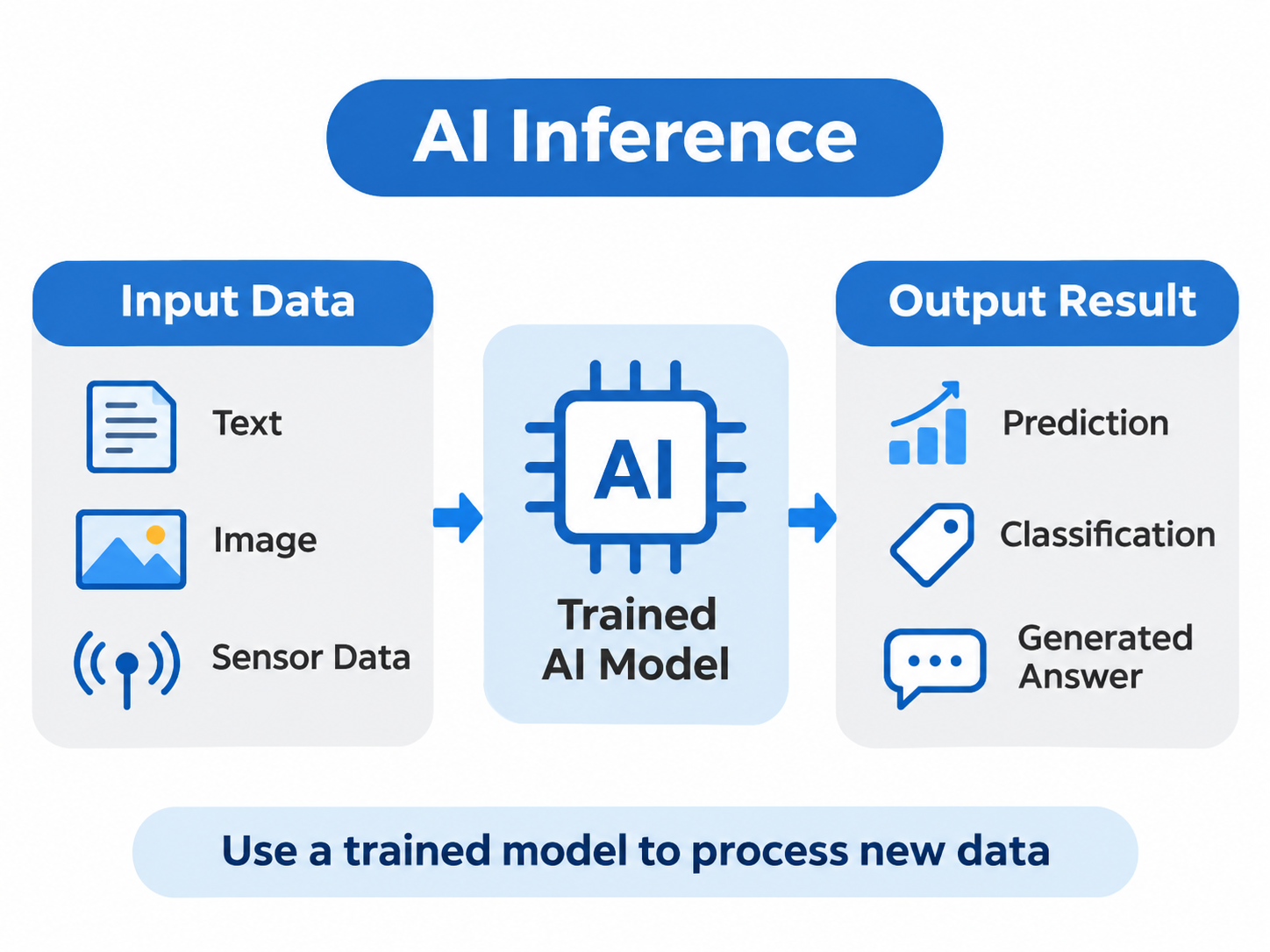
Inference is the process of using a trained Artificial Intelligence (AI) or Machine Learning (ML) model to analyze new input data and generate predictions, classifications, decisions, or other outputs.
It is the stage in which a model applies what it learned during training to perform a practical task.
For example, when an AI chatbot answers a question, an image-recognition system identifies an object, or a smart camera detects movement, the underlying AI model performs inference.
AI inference is fundamental to Large Language Models (LLMs), Neural Networks, Computer Vision, Natural Language Processing (NLP), robotics, autonomous systems, and Generative AI.
Inference can run on CPUs, GPUs, NPUs, FPGAs, and specialized AI accelerators.
Its performance depends on model architecture, computational resources, memory bandwidth, numerical precision, and application requirements.
How Does AI Inference Work?
AI inference begins when new information is provided to a previously trained model.
The input may be text, an image, an audio recording, numerical measurements, or sensor data.
The system prepares the input in the format expected by the model.
This may involve tokenization, normalization, resizing, or conversion into numerical tensors.
The model then processes the information using its learned parameters and mathematical operations.
For example, an image-classification model receives an image and processes its pixel values through neural network layers.
The output may contain scores indicating the likelihood of different object categories.
The application interprets these scores and produces a result, such as identifying the image as containing a cat.
During ordinary inference, the model’s trained parameters remain unchanged.
The model uses its existing knowledge rather than learning new parameters from each request.
What Is the Difference Between Training and Inference?
Training and inference are two distinct stages of machine learning.
Training: The model learns patterns from data by adjusting internal parameters through an optimization process.
Inference: The trained model applies those parameters to new information and produces an output.
For example, a neural network may be trained using thousands of photographs of electronic components.
During training, the model repeatedly compares its predictions with expected results and updates its parameters.
After training, the model can examine a new photograph and classify the component without repeating the training process.
Training commonly involves forward propagation, loss calculation, backpropagation, and parameter updates.
Inference primarily uses forward computation and does not normally require backpropagation.
Training is often computationally expensive, while inference is optimized for efficient and repeated execution.
What Is an Inference Model?
An inference model is a trained machine learning model used to process new inputs and generate outputs.
The model contains learned parameters such as neural network weights and biases.
For example, a temperature-prediction model may use sensor readings, historical operating conditions, and environmental measurements to estimate future temperatures.
An image-recognition model may use convolutional neural networks or Vision Transformers to classify visual information.
A language model may use a Transformer architecture to generate text.
The term inference model usually describes a model being used for prediction or generation rather than a fundamentally different type of neural network.
What Is Forward Propagation?
Forward propagation is the process of passing input information through a neural network to calculate an output.
Each layer performs mathematical operations using the outputs of preceding layers and its learned parameters.
For example, a simple feedforward network may receive three input values, process them through several hidden layers, and produce a numerical prediction.
These calculations commonly involve matrix multiplication, vector addition, activation functions, and normalization.
Forward propagation occurs during both training and inference.
However, during ordinary inference, gradients are not calculated for parameter updates, which reduces computational and memory requirements compared with training.
What Is Inference in a Large Language Model?
Large Language Model inference involves processing input tokens and generating output tokens using a trained language model.
For example, when a user asks an AI assistant to explain an FPGA, the text is converted into tokens.
These tokens are mapped to numerical representations and processed through Transformer layers containing attention mechanisms and feedforward networks.
The model calculates scores for possible next tokens.
A decoding method selects a token, which becomes part of the generated output.
The process repeats until the model reaches a stopping condition or output limit.
This token-by-token generation process is a central characteristic of autoregressive language model inference.
What Are Prefill and Decode?
LLM inference commonly consists of two computational phases: prefill and decode.
Prefill
During prefill, the model processes the initial input prompt and computes the internal representations needed for generation.
For example, if a prompt contains 2,000 tokens, the model processes those tokens before generating its first output token.
Prefill often involves substantial parallel computation because multiple input positions can be processed together.
Decode
During decoding, the model generates new tokens, typically one at a time for each active sequence.
Previously calculated attention information can be reused through a Key-Value Cache.
Decode performance is often strongly influenced by memory bandwidth, model size, batch size, and hardware efficiency.
The balance between prefill and decode workloads is important when designing systems that serve large numbers of LLM requests.
What Is a KV Cache in AI Inference?
A Key-Value Cache, commonly called a KV Cache, stores attention-related key and value representations for previously processed tokens.
During autoregressive text generation, the model needs information from earlier tokens when calculating attention for the next token.
Without caching, many earlier computations would have to be repeated.
The KV Cache allows the model to reuse previously calculated representations, reducing unnecessary computation.
However, KV caches consume memory, especially when processing long contexts or serving multiple users simultaneously.
Techniques such as Grouped-Query Attention (GQA), Multi-Query Attention (MQA), cache quantization, and optimized memory allocation can reduce these requirements.
KV-cache management is an important part of high-performance LLM inference systems.
What Is Inference Latency?
Inference latency is the time required for an AI system to produce an output after receiving an input.
For example, a camera-based object-detection system may need to analyze each video frame within a limited period.
Low latency is particularly important for real-time applications such as robotics, industrial automation, interactive AI assistants, and autonomous systems.
For LLMs, latency may be measured using several metrics.
Time to First Token (TTFT): The time between submitting a request and receiving the first generated token.
Time per Output Token: The time required to generate successive output tokens.
End-to-End Latency: The total time required to complete the inference request, including applicable processing overhead.
Latency depends on model size, hardware performance, input length, output length, batching, and system configuration.
What Is Inference Throughput?
Inference throughput measures how much work an AI system can complete during a given period.
For LLMs, throughput is commonly expressed in tokens per second.
For computer vision systems, throughput may be measured in images or frames per second.
For example, an inference server may process multiple requests simultaneously to increase the total number of generated tokens per second.
However, increasing throughput can sometimes increase latency for individual requests.
Inference-system design therefore involves balancing throughput, responsiveness, memory requirements, and resource utilization.
Different applications require different optimization strategies.
What Is Batch Inference?
Batch inference processes multiple inputs together rather than handling each input individually.
For example, an image-classification system may analyze 32 images in one batch.
Batching allows GPUs and other parallel-processing hardware to use computational resources more efficiently.
Larger batches can improve throughput, but they may increase memory consumption and the time individual requests spend waiting.
Batch inference is commonly used in offline data analysis, scientific computing, recommendation systems, and large-scale AI services.
The optimal batch size depends on model architecture, available hardware, and latency requirements.
What Is Real-Time Inference?
Real-time inference produces AI results within timing requirements established by the application.
For example, an industrial inspection system may need to identify a defective product before it reaches the next stage of a production line.
A robot may need to process sensor measurements quickly enough to support stable control.
Real-time inference often requires predictable execution time rather than simply high average performance.
Embedded processors, NPUs, FPGAs, and specialized accelerators are frequently used when timing and power constraints are important.
However, running a model on specialized hardware does not automatically guarantee real-time behavior.
The complete system must be designed and tested against its timing requirements.
What Is Edge AI Inference?
Edge AI inference refers to executing trained AI models locally on or near the device where data is generated.
For example, a smart camera may detect people or vehicles using an embedded AI processor without transmitting every video frame to a cloud server.
Edge inference can reduce network bandwidth requirements, improve response time, and support operation without continuous internet connectivity.
It may also reduce the amount of sensitive information transmitted to remote systems.
Common edge inference hardware includes microcontrollers, single-board computers, embedded GPUs, NPUs, and FPGAs.
Challenges include limited memory, computational capacity, power consumption, and thermal constraints.
What Is Cloud AI Inference?
Cloud AI inference executes trained models on remote computing infrastructure accessed through networks or application programming interfaces.
Cloud platforms can provide access to powerful GPUs, specialized AI accelerators, large memory systems, and scalable computing resources.
For example, a website may send a user request to a cloud-hosted language model and display the generated response.
Cloud inference supports centralized model management and can serve many users without requiring powerful AI hardware on every client device.
However, cloud inference introduces network dependency, communication latency, operating costs, and data-management considerations.
Many AI applications combine cloud inference with local processing.
What Is Model Quantization?
Quantization is a technique that reduces the numerical precision used to represent model parameters or intermediate calculations.
For example, a neural network originally using 32-bit floating-point values may be converted to use 16-bit floating-point or 8-bit integer representations for selected operations.
Some LLM inference systems also use 4-bit or other low-precision weight representations.
Lower precision can reduce memory requirements and improve processing efficiency on compatible hardware.
However, quantization may affect model accuracy and numerical stability.
Common approaches include Post-Training Quantization (PTQ) and Quantization-Aware Training (QAT).
The best quantization method depends on model architecture, hardware capabilities, and acceptable accuracy loss.
What Is Model Pruning?
Model pruning reduces the size or computational requirements of a neural network by removing selected parameters, connections, channels, or other model structures.
For example, a model may contain weights that contribute relatively little to its predictions.
Removing these weights can reduce model complexity.
However, unstructured pruning does not necessarily improve inference speed unless the hardware and software support efficient sparse computation.
Structured pruning removes larger components, such as channels or groups of neurons, and may provide more practical acceleration.
Pruned models often require additional evaluation or fine-tuning to preserve acceptable accuracy.
What Is Knowledge Distillation?
Knowledge Distillation is a technique in which a smaller model learns from the outputs or internal representations of a larger model.
The larger model is commonly called the teacher, while the smaller model is called the student.
For example, a large image-recognition model may provide training signals that help a smaller model achieve useful accuracy with fewer parameters.
The smaller model can then be deployed on devices with limited memory and processing resources.
Knowledge distillation is widely used to develop efficient models for mobile devices, embedded systems, and cost-sensitive inference applications.
However, a distilled model may not reproduce every capability of its larger teacher.
What Is an AI Inference Engine?
An inference engine is software that executes a trained AI model on supported computing hardware.
It manages operations such as loading model parameters, organizing computations, allocating memory, and executing neural network layers.
Examples of inference technologies include ONNX Runtime, TensorRT, TensorFlow Lite, OpenVINO, llama.cpp, and specialized accelerator runtimes.
Different inference engines support different model formats, hardware platforms, and optimization techniques.
For example, an inference engine may combine mathematical operations, select optimized kernels, or use lower-precision arithmetic to improve performance.
The inference engine forms an important connection between trained AI models and the hardware used to execute them.
What Is an AI Inference Accelerator?
An AI inference accelerator is specialized computing hardware designed to execute trained models efficiently.
Many inference workloads involve matrix multiplication, vector operations, convolution, and memory-intensive calculations.
AI accelerators provide hardware architectures optimized for these operations.
For example, an NPU may execute supported neural network layers with lower energy consumption than a general-purpose CPU.
GPUs provide extensive parallel-processing capabilities and are widely used for large-scale inference.
FPGAs allow customized hardware implementations, while ASICs can provide specialized architectures for particular AI workloads.
The actual performance advantage depends on model structure, software support, numerical precision, and memory bandwidth.
CPU vs. GPU vs. NPU vs. FPGA for Inference
Different computing architectures provide different advantages for AI inference.
CPU: Offers flexible general-purpose computation and is suitable for smaller models, traditional machine learning, and many low-volume inference applications.
GPU: Provides high parallel computational throughput and is widely used for deep learning and LLM inference.
NPU: Is designed for neural network acceleration, often emphasizing energy efficiency in mobile and embedded systems.
FPGA: Provides configurable hardware that can implement customized inference pipelines and specialized numerical formats.
ASIC: Can deliver high efficiency for targeted AI workloads through dedicated hardware.
No single architecture is best for every inference task.
Hardware selection depends on latency, throughput, model compatibility, power consumption, development complexity, and cost.
How Do FPGAs Accelerate AI Inference?
FPGAs can execute selected neural network operations through configurable digital logic.
For example, an FPGA may implement parallel Multiply-Accumulate (MAC) units, convolution pipelines, matrix multiplication, and specialized activation functions.
DSP blocks provide efficient arithmetic resources, while Block RAM (BRAM) and other memory structures support data buffering and reuse.
Unlike a CPU that executes a sequence of software instructions, an FPGA can implement customized hardware pipelines that process multiple data elements concurrently.
This can be useful for applications requiring low latency, deterministic processing, or specialized numerical precision.
However, large neural networks may exceed the logic, DSP, or memory resources of smaller FPGA devices.
Efficient FPGA inference therefore requires careful optimization of model architecture, data movement, and hardware utilization.
What Is Memory Bandwidth in AI Inference?
Memory bandwidth describes the rate at which data can be transferred between memory and processing components.
AI inference requires access to model parameters, input data, intermediate activations, and other information.
For large language models, reading model weights from memory can be a major performance limitation, especially during token-by-token decoding.
A processor may have substantial arithmetic capability but remain underutilized if memory cannot supply data quickly enough.
High-bandwidth memory technologies, caching, data compression, and optimized computation pipelines help reduce these bottlenecks.
Memory bandwidth is therefore a critical performance factor in GPUs, NPUs, FPGAs, and specialized AI accelerators.
What Is Inference Cost?
Inference cost refers to the resources required to execute trained AI models.
These costs may include computing hardware, electrical power, memory, network infrastructure, software services, and operational maintenance.
Commercial AI services frequently calculate usage costs according to the number of input and output tokens processed.
For other applications, inference cost may be measured per image, per audio minute, per request, or per unit of processing time.
Optimization techniques such as batching, quantization, caching, model compression, and efficient hardware deployment can reduce operating costs.
However, cost reduction must be balanced against accuracy, latency, reliability, and service-quality requirements.
What Are the Applications of AI Inference?
AI inference is used across many industries and computing environments.
Large Language Models: Generating text, answering questions, translation, summarization, and programming assistance.
Computer Vision: Object detection, image classification, medical imaging, and industrial inspection.
Speech Processing: Speech recognition, voice assistants, and audio classification.
Manufacturing: Predictive maintenance, defect detection, and process monitoring.
Robotics: Sensor interpretation, object recognition, and intelligent control.
Cybersecurity: Malware detection, anomaly analysis, and suspicious-activity identification.
Finance: Fraud detection, risk analysis, and transaction monitoring.
Embedded Systems: Local AI processing in cameras, sensors, microcontrollers, and industrial controllers.
The appropriate inference architecture depends on the timing, accuracy, reliability, and resource requirements of each application.
What Are the Limitations of AI Inference?
AI inference systems face several important limitations.
Model Accuracy: A trained model can produce incorrect predictions when encountering unfamiliar or difficult inputs.
Latency: Large models may require substantial processing time.
Memory Consumption: Model parameters and intermediate representations can exceed available memory.
Hardware Compatibility: Some models require operations that are not efficiently supported by particular accelerators.
Power Consumption: High-performance inference can require substantial electrical energy.
Data Distribution Changes: Model performance may decline when real-world inputs differ from training data.
Security Risks: Inference systems may be vulnerable to adversarial inputs, unauthorized access, and other attacks.
Operating Cost: Large-scale inference services require ongoing computational and infrastructure resources.
Reliable inference requires appropriate model evaluation, deployment optimization, monitoring, and security controls.
Conclusion
AI Inference is the process of using a trained machine learning model to analyze new information and generate predictions, classifications, decisions, or other outputs.
Unlike training, inference normally uses fixed model parameters and focuses on efficient execution rather than parameter optimization.
Important inference concepts include forward propagation, prefill, decoding, KV caching, latency, throughput, batching, quantization, and model optimization.
AI inference can run on CPUs, GPUs, NPUs, FPGAs, and specialized ASICs, either in cloud infrastructure or directly on edge devices.
Understanding inference provides an essential foundation for studying Artificial Intelligence, Machine Learning, Neural Networks, Large Language Models, Transformers, AI accelerators, embedded AI, and modern computing hardware.